
Anyone who has participated in several rounds of street light procurement has likely encountered this situation: luminaires specified in bidding documents as 60 W, 7,000 lumens, and the lowest-priced option may begin to malfunction as early as the second year after installation. Some fail to operate for more than three consecutive nights during the rainy season, while others begin to rust within six months in coastal areas. Still others provide sufficient brightness but produce uneven illumination, leaving patches of light and darkness across the road.
The problem often lies not with the luminaires themselves, but with a procurement process that focuses exclusively on wattage, lumens, and unit price without adequately considering solar irradiance, environmental conditions, maintenance requirements, and delivery capabilities.
Government and EPC projects should therefore treat solar street light procurement as a systematic process. Products and suppliers should be evaluated comprehensively based on project suitability, lighting performance, energy configuration, environmental adaptability, supplier capabilities, total life-cycle costs, and acceptance criteria.
This guide draws on practical engineering procurement procedures to help project teams establish a workable framework for product selection, bidding, supplier evaluation, and acceptance.
I. Initial Assessment: Is Solar Power Suitable for This Project?
Solar street lights are commonly used on rural roads, municipal side streets, in industrial parks, parking lots, along scenic trails, and in locations where connecting to the power grid would be prohibitively expensive. Before selecting a solution, consider the following five questions:
- Power Grid: Would the costs of installing new cables, excavating roads, and restoring road surfaces exceed those of a solar solution?
- Sunlight: Is the solar irradiance during the least favorable month sufficient to support nighttime operation?
- Lighting Requirements: How many hours must the lights operate each night? Is time-based dimming permitted?
- Environment: Will the equipment be exposed to salt spray, high humidity, extreme temperatures, strong winds, or prolonged shading?
- Maintenance: Is the project located in a remote area? Can maintenance personnel, vehicles, and spare parts reach the site promptly?
If the site experiences prolonged shading, very low winter solar irradiance, or requires full brightness throughout the night even during extended rainy periods, the energy configuration must be recalculated. Grid-connected or hybrid power solutions should also be considered.
Design calculations should be based on solar irradiance during the least favorable month, not the annual average. Even when annual averages appear favorable, insufficient winter solar energy can still lead to power shortages.
For projects without a reliable grid connection, where equipment transportation and maintenance are expensive, energy configuration affects not only nighttime lighting performance but also long-term operation and maintenance (O&M) costs. Therefore, solar panel and battery capacities should be evaluated alongside local climate conditions, spare parts availability, and maintenance accessibility.
[“How Can Road Lighting Be Achieved on Islands Without a Grid?”]
II. Procurement Process: Define Requirements First, Then Select Products
A prudent procurement sequence is: requirements analysis, site assessment, technical design, preparation of bidding documents, supplier screening, cost comparison, and acceptance inspection.
The most common mistake is to reverse this process by selecting a specific model first and then attempting to adapt the project to that product.
During the early stages, clearly define the road type, lighting requirements, quantity, budget, and delivery schedule. Conduct a thorough site assessment covering solar irradiance during the least favorable month, rainy-season duration, shading, temperature range, salt spray exposure, wind loads, and maintenance accessibility.
Based on these findings, the technical solution should specify the optical distribution, pole height and spacing, solar panel capacity, battery capacity, and control strategies.
For large-scale projects, sample testing or small-scale pilot installations are recommended before the final bid is confirmed. During bulk delivery, acceptance inspections should be conducted in batches to reduce procurement and implementation risks.
III. Core Parameters: Evaluate the System, Not Individual Components
A solar street light is an integrated system comprising a light source, optics, solar panels, batteries, a controller, and structural components. Even if individual components have excellent specifications, the complete system may still be unsuitable for a particular project.
The following table provides common reference ranges for establishing evaluation criteria. These figures are guidelines, not mandatory standards.
| Parameter | Common Reference Range | Notes |
|---|---|---|
| Pole Height | Rural roads and walkways: 4–6 m; general roads: 6–10 m | Design in conjunction with light distribution, pole spacing, and road width. |
| Pole Spacing | Approximately 3–5 times the pole height | Verify through lighting simulations rather than relying solely on empirical values. |
| Color Temperature | 3,000–4,000 K; lower color temperatures, such as 2,200 K, may be used in ecologically sensitive areas | Consider local regulations and environmental requirements. |
| Designed Battery Autonomy | 3–5 nights, with longer autonomy in areas with limited sunlight | Require a calculation report specifying the operating profile and solar irradiance assumptions. |
| Battery Type and Life | Lithium iron phosphate (LiFePO₄) is widely used, with a typical cycle life of approximately 2,000–4,000 cycles | Verify usable capacity, operating temperature, and protection features. |
| Protection Rating | IP65 minimum; coastal areas with high humidity may require IP66 or higher | An IP rating does not guarantee resistance to salt spray. |
| Impact Resistance | IK08 or higher | Particularly important in areas prone to vandalism. |
| Wind Resistance | Calculated according to the design wind speed at the project site | Structural calculations are required for light poles, cantilever arms, and panel mounting brackets. |
Lighting performance is often overlooked when buyers assume that sufficient wattage guarantees satisfactory results. Wattage and nominal lumen output do not reflect how a luminaire will perform on a specific road.
Require suppliers to provide IES or LDT photometric files for the exact models proposed in the bid, along with lighting simulations using DIALux or Relux. These simulations should reflect the project’s road width, pole height, and spacing, and report average illuminance or luminance, uniformity, and glare control, as applicable.
Environmental adaptability must be assessed separately. For coastal and high-humidity locations, the technical requirements should individually specify:
- Dust and water ingress protection in accordance with IEC 60529.
- Salt spray resistance in accordance with IEC 60068-2-52 or other project-specified methods.
- Fastener materials and surface treatments.
- Operating temperature ranges for luminaires and batteries.
- Wind resistance calculations for light poles and mounting brackets.
Treating a single IP rating as proof of compliance with all environmental requirements is a common oversight in coastal projects.
Control strategies must also be clearly defined in the contract. Dimming, motion sensors, and remote monitoring can improve energy efficiency and simplify maintenance, but their effectiveness depends on how they are configured.
Bidding documents should specify output levels for each operating period, system behavior when battery charge is low, the data transmitted through remote monitoring, and the procedures for reporting and addressing faults.
IV. Energy Allocation: A Ready-to-Use Calculation Method
The following is an illustrative calculation. Actual projects must be recalculated using local solar irradiance data and the supplier’s actual technical parameters.
Assume a 30 W luminaire operating during 11-hour winter nights, with the following dimming schedule:
- 4 hours at 100% brightness.
- 4 hours at 50% brightness.
- 3 hours at 30% brightness.
Additional assumptions:
- Equivalent daily sunlight during the least favorable month: 3.0 hours/day.
- Overall system efficiency: 0.65.
- Designed battery autonomy: 4 nights.
- Battery depth of discharge (DoD): 80%.
- Discharge efficiency: 0.9.
- System voltage: 12.8 V.
1. Nightly energy consumption
30 × (4 + 2 + 0.9) = 207 Wh
2. Solar panel capacity
207 ÷ (3.0 × 0.65) ≈ 106 W
Recommended illustrative selection: 110–120 W.
3. Battery capacity
207 × 4 ÷ (0.8 × 0.9) ≈ 1,150 Wh, equivalent to approximately 90 Ah at 12.8 V.
The value of this calculation method lies in making bid proposals comparable. By standardizing the operating schedule, solar irradiance assumptions for the least favorable month, and required operating nights, all suppliers can be required to calculate their configurations using the same assumptions.
If a supplier proposes a configuration significantly below the calculated reference level, the supplier should provide a technical justification.
V. Common Standards
Standards frequently referenced in international projects can be grouped into several categories. The specific standards adopted must comply with local regulations and contractual requirements.
- Road Lighting Classes: EN 13201, CIE 115, ANSI/IES RP-8.
- Luminaires and Modules: IEC 62722-2-1, IEC 62717.
- Photometric Testing and Degradation: LM-79, LM-80, TM-21.
- Ingress Protection and Impact Resistance: IEC 60529 (IP), IEC 62262 (IK).
- Salt Spray: IEC 60068-2-52.
- Photovoltaic Modules: IEC 61215, IEC 61730.
- Battery Safety and Transportation: IEC 62133, UN 38.3.
For projects in areas exposed to high temperatures, heavy rain, dust storms, or strong winds, checking the IP rating alone is insufficient to establish environmental suitability. Operating temperature, drainage and sealing design, corrosion resistance, and structural wind resistance must also be evaluated separately.
VI. Bidding Documents: Every Requirement Must Be Verifiable
Well-drafted bidding clauses follow a consistent structure: specifications, supporting documentation, and evaluation criteria. If any of these elements is missing, disputes may arise during bid evaluation or acceptance.
The technical section should generally require suppliers to submit:
- Product documentation and drawings.
- Photometric data and lighting simulation reports.
- Energy consumption and battery autonomy calculations.
- Test data for the specific models proposed.
- Certification and quality control documents.
- Verifiable project experience.
- Warranty terms and spare parts plans.
- Delivery and installation schedules.
The following sample clauses can be adapted directly to project requirements. Replace the bracketed information with project-specific details.
- Lighting: The bidder must provide IES or LDT files corresponding to the proposed model and a lighting simulation report based on the road parameters of this project. The results must comply with [applicable standards and lighting classifications].
- Operating Life: The system must be designed to provide lighting for at least [X] nights under the specified operating conditions. The calculation report must use solar irradiance data for the least favorable month at the project site and include the operating profile.
- Battery: The bidder must provide the battery model, usable capacity, cycle-life test data, and transportation test data, such as UN 38.3 documentation. The charging and discharging protection strategy under high- and low-temperature conditions must also be described.
- Corrosion Resistance: The materials and surface treatments used for the luminaire housing, fasteners, and connection points must be specified. A salt spray test report based on [specified method and duration] must be provided.
- Warranty: The warranty period must be at least [X] years for the complete luminaire and [X] years for the battery. The warranty scope, response time, and responsibilities for replacement must be clearly stated.
- Technical Deviations: All technical deviations and additional conditions must be listed individually. Any deviation or condition not disclosed in the bid shall be deemed not to have been declared.
The final clause is often overlooked, but it helps prevent suppliers from introducing undisclosed conditions during contract negotiations.
What Technical Support Can SRESKY Provide for EPC Projects?
To address the procurement, design, and delivery requirements of government and EPC projects, SRESKY can provide technical support tailored to specific project needs. This support helps project teams refine technical proposals, prepare bidding documents, and improve readiness for installation and acceptance.
- Lighting Simulation and Light Distribution Data: Provide relevant photometric data and lighting simulation support based on road width, pole height, installation spacing, and lighting requirements.
- Energy Configuration Recommendations: Recommend solar panel and battery configurations and system autonomy based on site-specific solar irradiance, nighttime lighting duration, and operating strategies.
- Product Technical and Testing Documentation: Provide technical specifications, product documentation, and applicable test reports for specific models to support technical evaluation and bid preparation.
- Installation, Acceptance, and Maintenance Documentation: Assist in preparing installation guidelines, acceptance documentation, and maintenance records according to project requirements, helping project teams refine the delivery process.
For government and EPC projects, technical documentation, lighting simulations, energy calculations, and acceptance requirements should be clarified before bidding. The corresponding support arrangements should also be confirmed with suppliers to improve the feasibility of bid evaluation, on-site implementation, and subsequent operation and maintenance.
VII. Bid Evaluation: A Two-Stage Process—Price Is Not the Sole Determining Factor
A two-stage evaluation process is recommended.
First, conduct a technical compliance review and classify each bid as either “pass” or “fail.” Only bids that pass this review should proceed to the scoring stage.
The following reference weighting can be adjusted according to project risks and should be published before bidding begins.
| Scoring Criteria | Weight | Main Evaluation Points |
|---|---|---|
| Technical Proposal | 35% | Lighting simulations, energy configuration, and environmental adaptability |
| Price (Preferably Based on LCC) | 30% | Completeness of quotation and life-cycle cost |
| After-Sales Service and Warranty | 15% | Warranty scope, spare parts availability, response time, and training |
| Delivery Capability | 10% | Production capacity, delivery time, transportation, and phased delivery plans |
| Project Experience | 10% | Relevant experience in similar applications, supported by verifiable evidence |
During evaluation, pay close attention to the following details:
- Whether test reports apply to the specific model proposed or only to the product series as a whole.
- Whether the testing organization, test date, and test conditions are clearly stated.
- Whether project experience is supported by verifiable contacts or publicly available documentation.
- Whether warranty terms separately define responsibilities for batteries, controllers, and solar panels.
- Whether technical deviations have been documented and reflected in the evaluation scores.
VIII. Compare Total Cost, Not Just Unit Price
A simplified life-cycle cost (LCC) formula is:
LCC = Initial Purchase and Installation Costs + Maintenance Costs + Replacement Costs + Other Operating Costs
The following table presents a purely illustrative comparison in USD per pole over a 15-year period, without discounting. These figures are not actual quotations.
| Cost Item | Solar Street Light (USD) | Grid-Connected Street Light (USD) |
|---|---|---|
| Luminaire and Accessories (Including Pole) | 950 | 550 |
| Foundation and Installation | 150 | 150 |
| Grid Connection and Wiring (50 m Spacing, Approximately $20/m) | 0 | 1,000 |
| Electricity Costs (15 Years) | 0 | 123 |
| Maintenance and Cleaning (15 Years) | 150 | 120 |
| Battery Replacement (Year 8, Including Labor) / Driver Replacement | 220 | 60 |
| Total | 1,470 | 2,003 |
In this example, the cost of installing new cables is the decisive factor. If an existing power grid is available along the route, wiring costs may decrease substantially, making the grid-connected option more cost-effective.
Therefore, the two options must be compared against the same lighting objectives, using consistent currencies, time periods, and assumptions.
Where appropriate, the analysis should also account for discount rates, residual value, road excavation and restoration costs, and maintenance travel expenses for remote sites. Finally, the illustrative figures should be replaced with actual quotations for the project.
IX. Acceptance and Maintenance: Do More Than Check Whether the Lights Turn On
Confirming that the lights turn on is only the minimum acceptance requirement. A more comprehensive inspection should use an itemized checklist.
- Appearance Upon Delivery: Verify the model, quantity, appearance, accessories, and packaging.
- Structural Installation: Inspect the foundations, light poles, fasteners, solar panel orientation and tilt angle, and potential shading.
- System Configuration: Verify solar panel, battery, and controller specifications, wiring, and control parameter settings.
- Lighting Performance: Conduct measurements using the agreed methods and verify compliance with the approved design and contractual specifications.
- Documentation Handover: Check product documentation, test reports, installation records, maintenance manuals, and warranty documents.
- Operational Records: Review initial operation and performance under low-battery conditions, where remote monitoring is available.
For lighting performance measurements, the measurement methods, test conditions, and acceptance criteria should be specified in the contract in advance. Otherwise, disagreements may arise during on-site inspections.
For large-scale or remote projects, acceptance inspections can be conducted in phases or through a pilot program.
Ongoing maintenance should include regular solar panel cleaning, inspections of luminaires and fasteners for corrosion, records of malfunctions and replacements, periodic battery status checks, and spare parts inventory management in accordance with warranty terms.
X. Three Types of Environments, Three Key Areas of Focus
Project risks vary significantly by environment. The following examples illustrate how procurement priorities can differ.
- Mauritius Coastal Highway (260 Units): This project involves salt spray, high humidity, intense ultraviolet radiation, and dust. Procurement should prioritize corrosion-resistant luminaire and fastener designs, salt spray test data, and long-term maintenance plans.
- Rural Roads in Central Chile (55 Units): Located far from the municipal power grid, this project involves low-color-temperature lighting and energy storage safety. Key considerations include light distribution data, color temperature requirements, energy configuration, and battery safety.
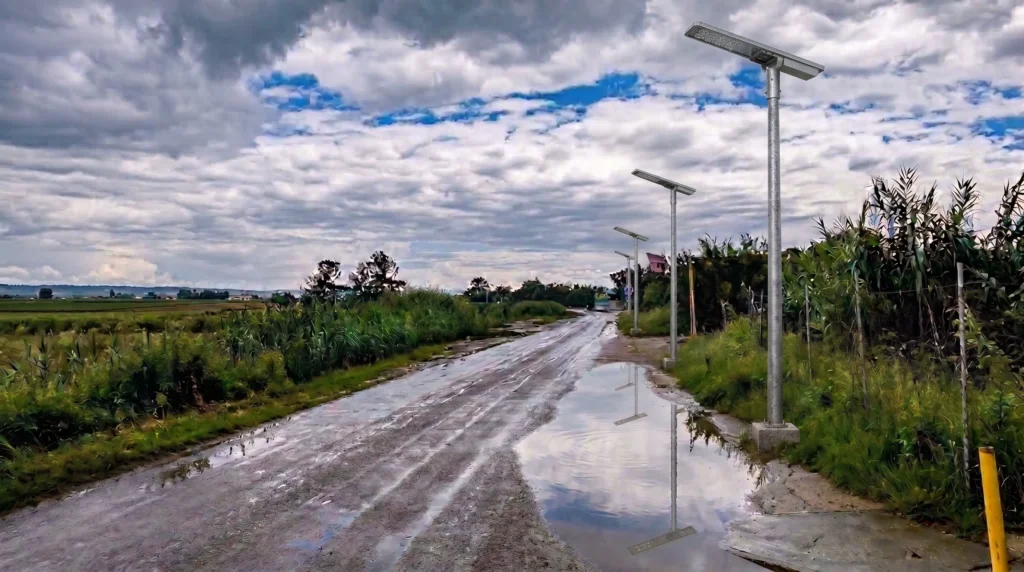
- Unpaved Rural Roads in Mexico (Approximately 165 Sets): This project involves low solar irradiance during the rainy season, challenging road conditions, and limited maintenance access. Key considerations include solar irradiance during the most unfavorable season, designed operating autonomy, and low-battery lighting strategies.
These three scenarios are based on Sresky’s project experience. For further details, visit the official case study page.
XI. Frequently Asked Questions
Are Solar Street Lights Suitable for Government and Municipal Roads?
Yes. Solar street lights are suitable for certain municipal roads, rural roads, and projects where grid connection costs are high, provided that a site assessment and energy design have been completed.
Will Solar Street Lights Remain On During Consecutive Days of Rain?
This depends on solar panel power, battery capacity, luminaire energy consumption, and control strategies.
A typical design autonomy is 3–5 nights. In areas with limited solar irradiance, longer autonomy may be necessary. Suppliers must also specify the system’s lighting output under low-battery conditions.
How Long Do Solar Street Light Batteries Typically Last?
Lithium iron phosphate (LiFePO₄) batteries typically have a cycle life of approximately 2,000–4,000 cycles. Actual service life depends on depth of discharge, operating temperature, and control strategies. Refer to the test data and warranty for the specific model.
Why Can’t Coastal Projects Rely Solely on the IP Rating?
The IP rating indicates dust and water ingress protection under specified test conditions. It does not guarantee resistance to salt spray or overall structural reliability.
Separate salt spray test data, material and surface treatment specifications, and structural calculations are required.
How Should the Costs of Solar-Powered and Grid-Connected Streetlights Be Compared?
Compare life-cycle costs (LCC) under identical lighting requirements and operating periods, accounting for equipment, installation, wiring, maintenance, battery replacement, and operating expenses.
The cost of new cabling is often a key variable in determining which option is more economical.
Conclusion
When procuring solar street lights, the key is to translate project requirements into verifiable criteria.
- Base energy design on solar irradiance during the least favorable month.
- Verify lighting performance using photometric documentation and lighting simulations.
- Compare suppliers using standardized scoring criteria and life-cycle cost analysis.
- Conduct acceptance inspections using itemized checklists.
When preparing bidding documents, use the sample clauses, scoring sheets, and acceptance checklists in this guide as a starting point, adapting them to local standards and actual site conditions.