
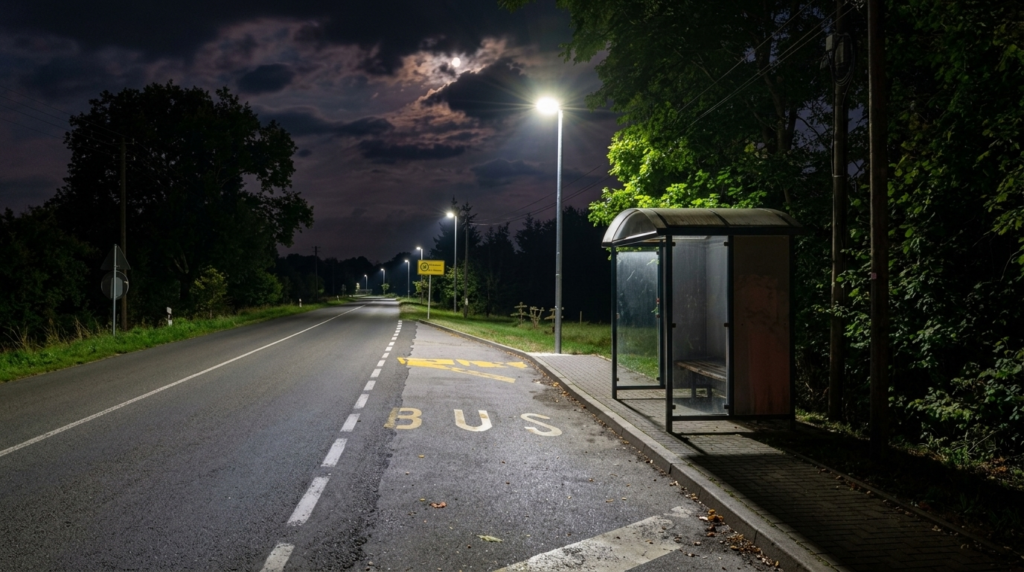
At 6:00 a.m., the Pannonian Plain in northeastern Croatia is still shrouded in thick fog. Rural bus shelters are often located far from the municipal power grid, and connecting them to the grid is not only complex but also involves high long-term costs. In winter, low temperatures, limited sunlight, and prolonged periods of overcast and foggy weather can cause conventional solar streetlights to experience insufficient charging and reduced battery life.
This project required more than simply installing individual lights; it called for a solar streetlight system capable of withstanding the winter climate of inland Europe, meeting eco-friendly lighting requirements, and ensuring long-term operational reliability and ease of maintenance.
Based on local climate conditions and road application requirements, the Sresky Atlas Series solar streetlights were selected for the planning and design of approximately 30 bus shelter lighting points.
Project Snapshot
| Project | Information |
|---|---|
| Project Type | Rural Road Bus Shelter Solar Lighting Project |
| Project Area | Pannonian Plain region in northeastern Croatia |
| Project Owner Type | County Road Administration (Županijska uprava za ceste) |
| Application Scenarios | Public bus shelters and rural road junction lighting |
| Product Solution | Sresky Atlas Series Integrated Solar Street Lights |
| Estimated Number of Units to Be Installed | Approximately 30 sets |
Challenge 1: How Can Solar Street Lights Ensure Battery Life in Cold, Foggy Winter Conditions?
Winters on the Pannonian Plain are characterized not only by insufficient sunlight but also by periods of dense fog and low temperatures lasting for several consecutive days. On-site project data shows that during prolonged periods of overcast and foggy weather, daylight hours are significantly reduced, resulting in lower solar power generation. At the same time, low temperatures can impair battery charging capacity. For rural bus shelters, insufficient energy storage or the activation of low-temperature charging protection can shorten nighttime lighting duration, directly affecting passenger safety.
Key Consequences:
- Prolonged overcast and foggy conditions lead to reduced solar power generation;
- Low temperatures may trigger battery charging protection;
- Insufficient energy storage may shorten nighttime illumination duration;
- Separate battery boxes and underground battery wells increase installation and maintenance costs.
Solution: Integrated Solar Street Lights + Low-Temperature Adaptive Design
Sresky Atlas adopts an integrated solar street light structure, eliminating the need for external battery boxes, underground battery wells, and additional electrical wiring.
Key Design Features Include:
- Thermal insulation design: Combines TCS temperature-controlled insulation technology to improve battery performance in low-temperature environments;
- Low-temperature operational capability: Battery discharge temperatures can reach as low as -20°C, while temperature-controlled insulation technology supports charging management in cold conditions;
- ALS adaptive lighting algorithm: Adjusts lighting output based on energy availability during prolonged periods of overcast and foggy weather;
- Integrated structure: Reduces civil engineering work, electrical wiring, and future maintenance requirements.
Compared with split-type solar streetlight solutions that require additional insulation equipment, this project offers a more cost-effective overall solution.
Key Selling Point: Rather than simply adding more batteries, this solution enhances the operational reliability of solar streetlights under complex winter weather conditions through an integrated structure, low-temperature design, and intelligent energy management.
Challenge 2: In Ecologically Sensitive Areas, How Can Solar Street Lights Balance Lighting Needs with Environmental Requirements?
Some nature reserves in Croatia fall within the scope of the EU’s Natura 2000 ecological network. For road lighting projects that may involve ecologically sensitive areas, solar streetlights must not only meet basic lighting needs but also address color temperature, light distribution, and light pollution control.
If conventional high-color-temperature LEDs (4000K or even 5700K) continue to be used, the project may face stricter lighting planning and compliance requirements in certain ecological areas.
Key Consequences:
- High-color-temperature light sources may contain a higher proportion of blue light;
- Unwanted scattered light may amplify the impact of ambient light;
- Low-color-temperature LEDs typically require adjustments to luminous efficacy and system capacity;
- Compliance requirements may increase during the bidding, planning, and acceptance phases.
Solution: 2200K Low-Color-Temperature LEDs + Optimal Light Distribution + Smart Dimming
To address ecological lighting needs, Sresky can customize 2200K low-color-temperature LED solar streetlight solutions based on project-specific regulatory requirements.
The key is not simply replacing the LED chips but simultaneously optimizing the entire lighting system:
- 2200K low-color-temperature LEDs: Reduce certain blue light components;
- Optical design: Concentrate light as much as possible on bus shelters and areas of the road that require illumination;
- Optimized light distribution: Reduces unnecessary stray light and the impact of ambient light;
- ALS smart dimming: Reduces output power during late-night hours when foot traffic is low;
- System reconfiguration: Matches LEDs, solar panels, and energy storage systems to the lighting requirements.
For municipal roads, rural bus shelters, and ecologically sensitive areas, the combination of 2200K low color temperature, optimized light distribution, and smart dimming helps solar streetlights move beyond simply “providing illumination” to better align with environmental and lighting-planning requirements.
Key Selling Point: Low color temperature is not an isolated parameter; it should be designed in conjunction with light distribution, dimming, and overall system capacity.
Project Results
Approximately 30 Atlas solar streetlights were installed in the fall of 2025 along county roads at rural bus shelters and adjacent road sections.
- Approximately 30 solar streetlights were deployed, covering multiple rural bus shelter lighting points;
- During winter operation, no feedback was received regarding lighting interruptions caused by low-temperature charging protection;
- The 2200K low-color-temperature solution passed the local lighting planning compliance review;
- Compared with split-system solutions with equivalent functionality, the single-unit system offers a cost advantage;
- Reduced underground civil engineering work and external electrical wiring lowered construction complexity.
Project Summary: Through an integrated structure, low-temperature energy storage design, and a 2200K eco-friendly lighting solution, this project balanced winter reliability, lighting requirements, and project costs under off-grid conditions.
Client Feedback
“Low temperatures, budget constraints, and civil engineering were the biggest challenges. The integrated solution resolved these issues, and the 2200K compliance documentation enabled the project to move forward.”
—Project Manager, County-Level Road Management Agency
FAQ: Solar Streetlight Projects in Rural Croatia and Europe
1. Are Solar Street Lights Suitable for Installation in Croatia Given the Low Winter Temperatures and Heavy Fog?
Yes, but the system must be designed for the worst-case winter weather conditions.
- Assess winter daylight hours and the number of consecutive overcast or foggy days;
- Configure an energy storage system suitable for low-temperature environments;
- Implement smart energy management and dimming strategies;
- Calculate solar panel and battery capacity based on actual lighting duration.
The key issue is not whether installation is possible, but whether the solar streetlights are designed according to local winter operating conditions.
2. Are 2200K Low-Color-Temperature Solar Street Lights Suitable for Ecologically Sensitive Areas?
2200K is a warm color temperature that can be used in certain projects with stricter requirements for controlling blue light, light pollution, and environmental impact.
- Suitable for certain ecologically sensitive areas;
- Can reduce some blue light components;
- Requires appropriate optical design;
- The final configuration should comply with local regulations and lighting planning requirements.
3. How Do Solar Street Lights Cope with Prolonged Periods of Overcast and Foggy Weather?
The key is not simply adding more batteries but improving the energy efficiency of the entire system.
- Optimize solar panel and energy storage capacity;
- Use ALS (Advanced Lighting System) intelligent dimming;
- Dynamically adjust lighting power based on energy status;
- Allow for a reasonable energy storage margin to account for the worst local weather conditions.
In areas with prolonged overcast and foggy conditions, the reliability of solar streetlights depends on the entire energy management system, not just battery capacity.
4. Why Are Integrated Solar Street Lights Suitable for Rural Bus Shelters?
Bus shelters are typically located far from the utility grid and often exist in large numbers along rural roads. Integrated solar streetlights can reduce the need for grid connections and civil engineering work.
- Reduce the need for large-scale utility cable installation;
- Eliminate the need for underground battery vaults and external battery enclosures;
- Lower construction complexity;
- Facilitate future maintenance;
- Better suited for off-grid lighting at remote road junctions.
Conclusion: Solar Street Lights Are Evolving from “Replacing Grid Power” to “Adapting to Complex Scenarios”
With the renovation of rural roads in Europe, the upgrading of public transportation infrastructure, and increasing demand for eco-friendly lighting, the design of solar streetlight projects is no longer limited to comparing luminaire power and battery capacity.
For municipal departments, road management agencies, lighting contractors, and road planners, preliminary planning must place greater emphasis on:
- Winter sunlight and low-temperature conditions;
- Energy management during prolonged periods of overcast and foggy weather;
- Low color temperature and light pollution control;
- Construction, civil engineering, and grid connection costs;
- Long-term maintenance and total life-cycle costs.
The Croatian bus shelter project offers a design approach worth considering: by integrating all-in-one solar streetlights, low-temperature energy storage, a 2200K low-color-temperature solution, optimal light distribution, and smart dimming, the off-grid lighting system is better adapted to European rural roads and complex outdoor environments.
If you are planning a similar solar streetlight, rural road lighting, or off-grid bus shelter project, we recommend evaluating four key factors—climatic conditions, lighting regulations, system capacity, and total life-cycle costs—before selecting a solution and then determining the appropriate solar streetlight configuration.
Table of Contents