
In a residential development project in the Colombian Andes, the main residential roads have been completed, while supporting facilities, including landscaping and pedestrian areas, are being finalized. Reliable nighttime lighting has become a critical requirement that must be addressed before the project can be handed over.
Installing traditional grid-connected streetlights would typically require underground cabling, road excavation, utility infrastructure installation, and ongoing maintenance. In contrast, solar streetlights can reduce dependence on underground electrical infrastructure. However, residential solar lighting projects in Colombia involve more than simply ensuring that the lights function properly. They must also address RETILAP compliance, adaptability to mountainous terrain, and long-term energy reliability.
To meet the project’s specific requirements, Sresky equipped the residential community with Atlas Series all-in-one solar streetlights, configured to address local regulatory requirements and low solar irradiance in the mountainous region.
Project Overview
| Project Parameter | Project Information |
|---|---|
| Project Location | Residential development in a city in the Colombian Andes |
| Project Type | Solar streetlighting for public areas in a new residential community |
| Project Owner | Real estate developer (Constructora) |
| Product Solution | Sresky Atlas Series all-in-one solar streetlights |
| Installation Height | 6–8 meters |
| Number of Units Installed | 68 solar streetlights |
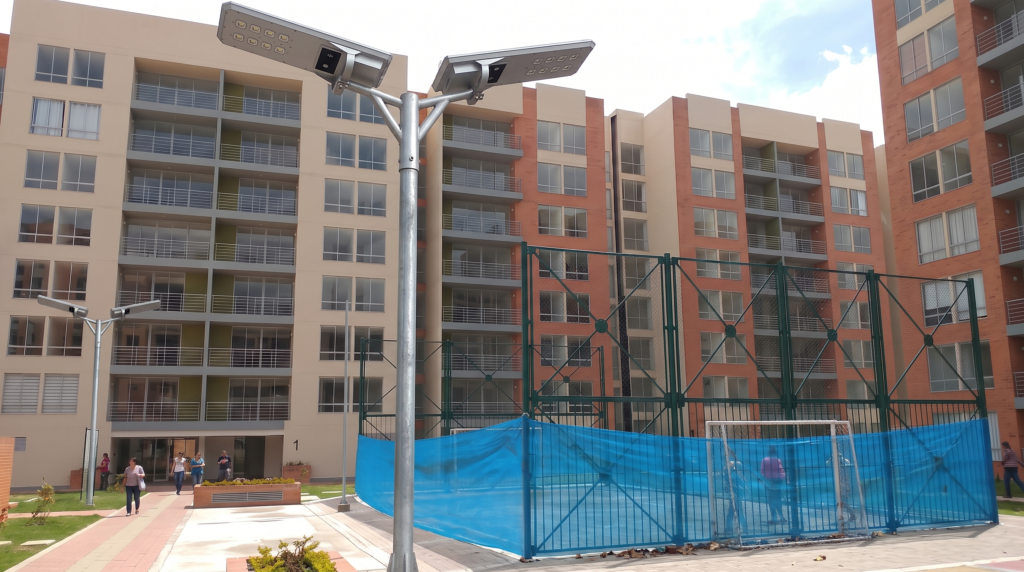
Two Core Challenges Faced by the Project
Challenge 1: How Can Solar Streetlights Meet RETILAP Compliance Requirements?
For residential projects in Colombia, solar streetlights should not be selected based solely on power output, brightness, and price. Procurement teams must also verify technical documentation, photometric performance, electrical parameters, photovoltaic (PV) systems, energy storage, and control solutions against applicable RETILAP requirements.
The main risk is often not whether a product has the required specifications, but whether its documentation accurately reflects the actual installation conditions and meets the project’s requirements.
If compliance documentation is not properly prepared during the early stages, several issues may arise:
- Incomplete technical documentation may delay procurement reviews.
- Insufficient photometric data and installation details may lead to additional communication during the design and acceptance phases.
- Missing documents may be discovered only after product selection, requiring supplementary submissions.
- Documentation reviews and technical coordination may further delay the project schedule.
Solution: Prepare RETILAP Documentation Early and Establish a Compliance Chain Linking the Product, Documentation, and Installation Conditions
Sresky incorporates compliance requirements into the product selection process during the proposal stage, rather than waiting until installation or acceptance to provide supplementary documentation.
Based on the project’s requirements, the company prepares photometric data, electrical parameters, mechanical reliability data, PV module and battery specifications, and technical information about controllers and energy management in advance. It also evaluates the lighting requirements for the actual installation height of 6–8 meters.
The objective is not merely to claim that a product is certified, but to establish a clear link between product performance, technical documentation, and actual installation conditions. This approach helps project teams identify compliance risks earlier and reduces the need for repeated communication and document revisions at later stages.
Challenge 2: How Can Stable Nighttime Lighting Be Ensured in Mountainous Areas with Low Solar Irradiance?
Solar streetlighting projects in the Andes must account for seasonal variations in solar irradiance and extended periods of overcast weather. In off-grid lighting systems, several consecutive days of insufficient solar power generation can cause the battery’s state of charge (SOC) to decline. If the system continues operating at a fixed power output, it may consume too much energy during the first half of the night, leaving insufficient stored energy for the second half.
Therefore, the project must address more than whether the battery capacity is sufficient. Other considerations include:
- Declining battery SOC after prolonged periods of low solar irradiance.
- Excessively high lighting output early in the night, increasing the risk of power shortages later.
- Unnecessary energy consumption when lighting remains at high output late at night, despite limited pedestrian activity.
- Reduced energy storage system stability due to improper charging and discharging over time.
Solution: Improve Low-Irradiance Performance Through ALS and Smart Energy Management
To address the challenges of mountainous environments, Sresky uses features such as ALS smart lighting, PIR sensors, and battery protection to adjust lighting strategies according to power generation, stored energy, and actual usage demands.
When the battery SOC is low, the system can appropriately reduce lighting output to prevent excessive energy consumption during the first half of the night. During late-night hours, when pedestrian traffic is low, dimming helps minimize unnecessary power consumption. In addition, battery temperature monitoring and charge/discharge management help improve the stability of the energy storage system.
The core principle is not simply to increase battery capacity, but to dynamically balance power generation, energy storage, and lighting loads. This allows the limited solar energy available to be distributed more efficiently throughout the night.
Project Results
68 Atlas Systems Support Community Lighting Deployment: The 68 Sresky Atlas Series systems provide lighting for residential roads and public areas while reducing dependence on underground cables, road excavation, and utility infrastructure maintenance.
Low-Irradiance Strategy Improves Nighttime Reliability in Mountainous Areas: By dynamically balancing power generation, energy storage, and lighting loads through ALS, PIR, and battery protection, the system helps reduce the risk of power shortages during the latter half of the night.
Optical Configuration for 6–8-Meter Installation Heights Reduces the Need for Post-Installation Adjustments: Lighting requirements are evaluated based on actual pole heights, helping align product selection, lighting design, and acceptance criteria.
Smart Dimming Reduces Long-Term Operation and Maintenance (O&M) Demands: The system automatically reduces output during late-night hours when pedestrian traffic is low, minimizing energy waste and supporting the long-term stability of the energy storage system.
Project Feedback
“We are concerned not only with the price of solar streetlights, but also with whether the products can pass acceptance testing and continue to operate reliably for years to come.”
— Engineering Team, Residential Development Project in Colombia (Compiled Project Feedback)
FAQ: Frequently Asked Questions About the Colombia Solar Streetlight Project
1. Are Solar Streetlights Suitable for Residential Projects in Colombia’s Mountainous Regions?
Yes. Solar streetlights are suitable for these projects, provided that the system configuration is selected according to local climatic conditions.
For mountainous projects, average sunshine data alone is not sufficient. The following factors must also be considered:
- The duration of consecutive cloudy days.
- Solar panel installation angle.
- Battery capacity.
- Smart control strategies.
A properly designed solar streetlighting system can serve residential roads, parks, community walkways, and other public areas.
2. What Are the Advantages of Solar Streetlights Compared with Traditional Grid-Connected Streetlights?
The main advantages include:
- Reduced dependence on underground cables.
- Greater flexibility in installation locations.
- Less civil engineering work.
- Suitability for newly developed areas and locations with limited power infrastructure.
However, solar streetlights require careful preliminary system design. Evaluating them solely by comparing fixture purchase prices may overlook important factors affecting long-term performance and reliability.
3. How Can Solar Streetlights Cope with Prolonged Periods of Overcast Weather?
The key is not simply to add more batteries, but to use the solar energy collected each day more efficiently.
Common approaches include:
- Improving solar energy utilization during the day.
- Managing nighttime power consumption according to battery status.
- Automatically reducing lighting output during late-night hours.
- Increasing brightness when motion is detected by sensors.
- Designing energy management strategies for prolonged low-irradiance conditions based on the project’s actual requirements.
Core Principle: Minimize unnecessary energy consumption and reserve limited stored energy for periods when lighting is most needed.
Conclusion
Solar streetlighting projects in Colombia are moving beyond simple product procurement toward more comprehensive, project-specific solutions.
For residential developments, road lighting, and public area lighting projects, key considerations include:
- Whether RETILAP compliance requirements have been addressed and the necessary technical documentation is complete.
- Whether the system has been configured to accommodate mountainous terrain and low solar irradiance.
- Whether actual installation conditions, including mounting heights of 6–8 meters, align with the optical design.
- Whether energy storage and smart control systems can support stable, long-term operation.
For the Colombian and broader Latin American markets, an effective solar streetlighting solution must do more than provide illumination at night. It should deliver reliable, practical lighting performance under changing regulatory requirements, environmental conditions, and real-world usage scenarios.
This is a key focus of Sresky’s residential solar streetlighting projects in Colombia.