
For islands, coastal communities, and remote tourist areas, street lighting often presents a unique challenge: streets need to be illuminated, but traditional power grids are difficult to extend to these locations.
Islands have limited land area and complex topography, and some areas are far from the main island or the urban power grid. If traditional utility-powered streetlights are used, the project requires not only underground cable installation but also the construction of cable trenches, installation of power distribution equipment and transformers, and ongoing line maintenance. For island projects with long roads and low population density, these infrastructure investments can further increase construction costs and complexity.
However, having “no power grid” does not mean it is impossible to build a stable street lighting system.
Solar street lights consist of solar panels, batteries, LED light sources, and a control system that together form an independent power supply system. They can provide street lighting without access to the utility grid, making them particularly suitable for islands, coastal roads, resort communities, rural roads, and other off-grid scenarios.
However, island solar street light projects cannot be viewed simply as “installing solar panels and lights.”
The real challenges to address are: Will salt spray from sea winds corrode the equipment? Will typhoons or hurricanes affect the structural integrity of the light poles and fixtures? Can nighttime illumination be guaranteed during prolonged periods of overcast or rainy weather? Will high-temperature and high-humidity environments affect battery life? Given the project’s distance from urban areas, how can long-term maintenance costs be controlled?
Therefore, for island road lighting projects, the selection criteria for solar street lights should shift from “how many watts” to environmental adaptability, structural reliability, energy management, and long-term O&M costs.
I. Why Are Solar Street Lights Suitable for Islands Without a Power Grid?
For ordinary urban roads, grid-connected street lights can typically rely on mature power grid infrastructure for a continuous power supply. However, on islands or in remote areas, the situation is often different.
1. No Need to Lay Long-Distance Underground Cables
Traditional street lighting requires connecting each light to the power distribution system. If the road is far from the power grid, additional cables, distribution boxes, and related civil engineering work are required.
Solar street lights use an independent power supply model in which each light generates and stores electricity through solar panels and then uses a battery to provide power for nighttime lighting.
For island projects with scattered roads, complex terrain, or insufficient grid coverage, this means reduced reliance on underground cables and centralized power supply infrastructure.
2. Better Suited for Areas with Long Roads and Low Population Density
Many island roads are not continuous urban thoroughfares but rather roads connecting communities, docks, tourist areas, residential areas, or public facilities.
Building complete power infrastructure just to illuminate a small number of roads can be highly complex.
Solar street lights, however, can be installed in sections based on actual road conditions, eliminating the need to wait for the entire area’s power grid to be completed before installing lighting.
3. Off-Grid Power Supply Minimizes the Impact of Line Failures
In traditional street lighting, underground cables, connection points, and power distribution equipment can all become potential failure points.
In contrast, standalone solar street lights integrate power generation, energy storage, and lighting systems into a single unit. When properly designed, this approach reduces the need for complex external power lines.
For island projects located far from urban areas, reducing the number of power lines and distribution facilities also means that future maintenance will not require frequent reliance on professional electrical contractors.
Therefore, the value of solar street lights for islands lies not only in “saving on electricity bills” but, more importantly, in providing a form of road lighting that does not depend on a centralized power grid.
II. The Four Greatest Environmental Challenges for Island Road Lighting
Although solar street lights are suitable for off-grid environments, the real challenges in island projects typically stem from the natural environment.
1. Salt Fog and High Humidity: Corrosion May Be a Greater Concern Than Lighting Itself
Equipment located near the coast is chronically exposed to salt fog, causing salt to accumulate on lamp housings, poles, bolts, connectors, and other components.
When salt interacts with moisture, the risk of corrosion in metal components increases significantly.
Therefore, when selecting solar street lights for islands, one must consider not only the lamp’s power output but also:
- The materials used for the lamp housing;
- The materials used for bolts and fasteners;
- Whether the surfaces have undergone anti-corrosion treatment;
- The anti-corrosion treatment applied to the lamp posts; and
- The waterproofing and moisture-proofing capabilities of the electrical enclosures.
For example, coastal projects typically require attention to stainless steel fasteners, anti-corrosion coatings, hot-dip galvanizing, and higher-grade protective designs.
For island projects, corrosion protection is not an optional feature but a fundamental requirement for ensuring the long-term reliability of the equipment.
2. Typhoons, Hurricanes, and Strong Winds: Structural Design Cannot Rely Solely on Normal Weather Conditions
Island regions often face typhoons, hurricanes, or seasonal strong winds.
Since solar street lights are equipped with solar panels on top, additional consideration must be given to wind loads compared with conventional streetlights.
Therefore, when designing a project, it is not enough to simply ask, “How bright is the light?” It is also necessary to confirm:
- What is the maximum local wind speed?
- What is the height of the light pole?
- What is the area of the solar panels, and how are they mounted?
- Have the connection points of the lamp arms been structurally optimized?
- Has the wind load capacity of the entire system been tested or calculated?
- Are there any stress concentrations at the connection points between the luminaire and the pole?
Especially in typhoon- and hurricane-prone areas, structural reliability directly determines whether the street lighting system can continue to function after extreme weather events.
3. Prolonged Rainy Weather: Solar Street Lights Must Address the Question, “What If There Is No Sun?”
Living on an island does not guarantee abundant sunshine every day.
Tropical and subtropical regions may experience prolonged periods of overcast skies, heavy rain, or low solar irradiance.
Therefore, the design of solar street lights must consider not only the peak power generation capacity of the solar panels but also the energy management of the entire system.
Typically, the following factors must be considered comprehensively:
Local solar resources + PV module capacity + battery capacity + nightly lighting duration + LED power + control strategy.
If the system operates continuously at maximum power every day, the battery may deplete rapidly during cloudy or rainy weather.
Therefore, a more reasonable approach is to use smart controls to adjust lighting power based on the remaining battery charge, ambient light, and operating time while still meeting road lighting requirements. This can improve energy efficiency during prolonged periods of cloudy or rainy weather.
4. High Temperatures, High Humidity, and Temperature Fluctuations: Batteries and Electronic Components Also Need Protection
Island environments typically feature high temperatures and humidity.
For solar street lights, the battery is one of the most critical components. High-temperature environments increase the strain on battery thermal management, while high humidity and diurnal temperature fluctuations may pose a risk of internal condensation.
Therefore, in island projects, attention must also be paid to:
- Heat dissipation design of the battery compartment;
- Battery operating temperature range;
- Moisture-proof design inside the lamp body;
- Sealing structure;
- Anti-condensation measures; and
- Environmental adaptability of electronic components for long-term operation.
This is why selecting the right solar street lights for islands cannot be based solely on LED power or solar panel size.
III. How Should You Select Solar Street Lights for Islands?
Translating the environmental challenges above into procurement criteria can be summarized in four key areas:
| Island Environmental Challenges | Key Metrics to Verify |
|---|---|
| Salt fog, high humidity | Corrosion-resistant materials, anti-corrosion processes, protection rating |
| Typhoons, hurricanes | Wind load design, lamp arm connections, overall structure |
| Prolonged rainy weather | Photovoltaic configuration, battery capacity, energy management |
| Remote areas | Degree of integration, reliability, ease of maintenance |
1. Coastal Areas: Prioritize Corrosion Resistance
If the project is located near the coastline, do not limit your procurement inquiry to simply asking, “Is the light pole galvanized?”
You should further verify whether the fasteners, lamp body, connectors, and surface treatments are specifically designed for marine environments.
2. Typhoon-Prone Areas: Prioritize Structural Safety
For islands frequently affected by typhoons and hurricanes, the structural design of solar street lights should be a key procurement criterion.
Suppliers should provide design documentation based on local wind speed conditions to confirm that the connections between the light pole, lamp arm, solar panels, and luminaires have been structurally optimized.
In high-wind areas, the problem cannot be solved simply by increasing the weight of the luminaires; rather, the design must address the overall structure and load-bearing mechanisms.
3. Cloudy and Rainy Weather: Don’t Focus Solely on Battery Capacity
In some procurement projects, it is common to ask directly, “How many days can this light stay on?”
However, the actual lighting capability during consecutive days of cloudy or rainy weather depends on the entire energy system.
A more reasonable procurement approach is to require suppliers to design a system that takes into account the project site’s solar irradiance conditions, daily lighting hours, LED power, and battery capacity.
Especially for large-scale road projects, it is essential to confirm whether the product incorporates appropriate smart dimming and energy management strategies.
4. Remote Projects: Prioritize Low-Maintenance Designs
Island roads are often located far from urban areas.
If a single light fails, maintenance personnel may need to travel by boat, drive long distances, or even wait for favorable weather conditions before they can reach the site.
Therefore, for island projects, low maintenance is an engineering value in itself.
Integrated designs, fewer external connection points, reliable sealed structures, and stable battery and control systems can all help reduce on-site maintenance work later on.
IV. Three Real-World Island Projects: How Do Solar Street Lights Cope with Different Environments?
Theoretical parameters ultimately need to be validated through real-world projects.
The following three case studies are all taken from Sresky’s official project documentation and correspond to three typical scenarios: high salt fog + typhoons, hurricanes + high temperatures, and long-term operation and maintenance of coastal highways.
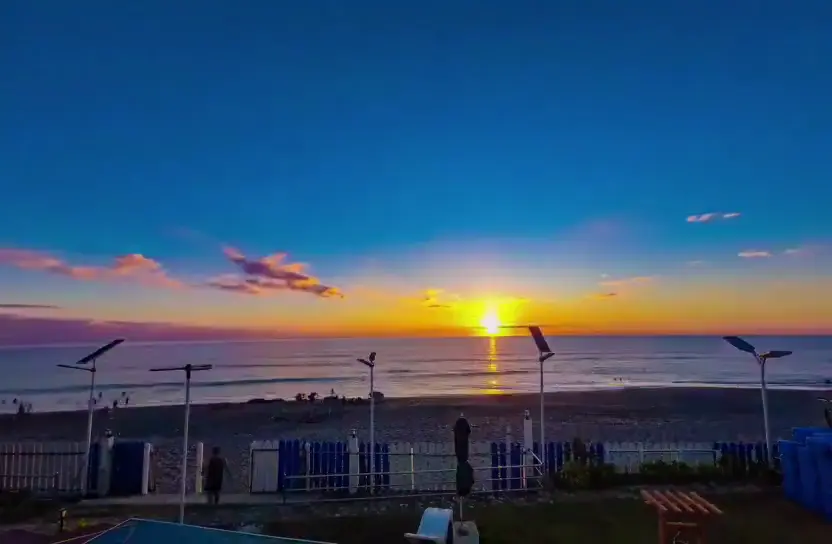
Case Study 1: Bohol Island, Philippines—High Salt Fog, Typhoons, and Off-Grid Power Supply
In 2025, a coastal resort community on Bohol Island in the Philippines installed 100 sets of Sresky ATLAS Series all-in-one solar street lights to illuminate seaside roads, residential areas, and public walkways.
The project area faces high humidity, high salt fog, strong UV radiation, and seasonal typhoons. Additionally, grid coverage is limited in some areas, and the cost of installing traditional underground cables is high.
The project utilizes an independent solar power supply, eliminating the need for underground cabling.
To address the local environment, the project focused on three key challenges: salt fog corrosion, wind-resistant structural design, and off-grid energy management.
The ATLAS Series incorporates protective measures such as SUS316L fasteners, hot-dip galvanization, and polyester powder coating. It also enhances wind resistance through structural optimization and reduces long-term maintenance requirements through an all-in-one design and intelligent energy management.
The core demonstration of this project is not merely that “solar street lights can generate electricity,” but rather that, in an island environment without underground cables, it is possible to combine off-grid power supply, corrosion resistance, wind resistance, and low maintenance requirements.
View the real-world case study of 100 ATLAS units on Bohol Island, Philippines.
Case Study 2: Tonga—Hurricanes, High Temperatures, and Salt Fog Environments
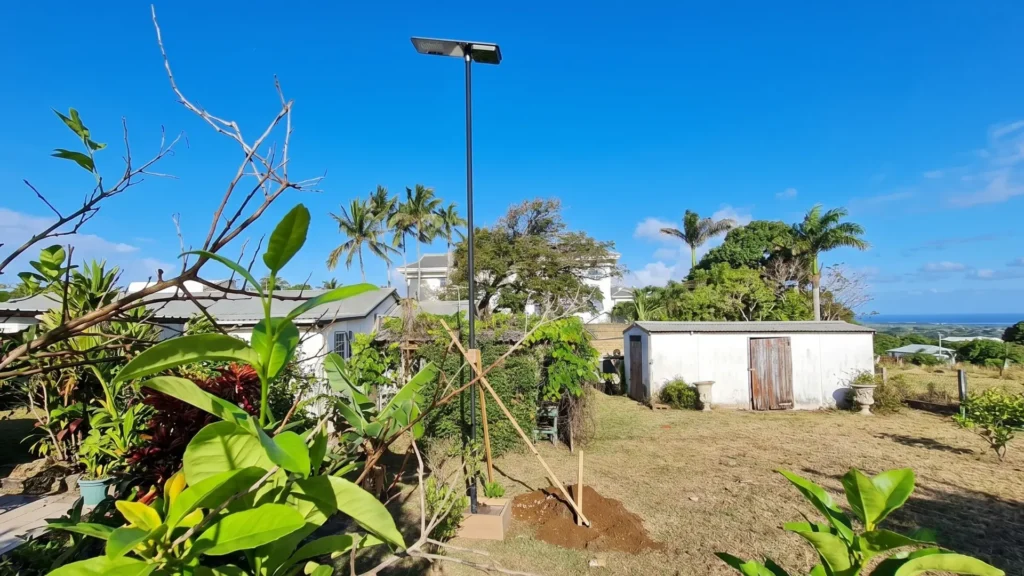
A coastal community in Tonga, located approximately 150 meters from the shoreline, also represents a typical off-grid lighting scenario.
The project installed approximately 30 sets of Sresky BASALT Series integrated solar street lights to illuminate roads, sidewalks, and community gardens.
The project faced major challenges from cyclones, high temperatures, and salt fog, while the client also sought equipment with a long service life and low maintenance requirements.
Consequently, the project prioritized structural reliability, battery thermal management, and corrosion-resistant design.
According to official Sresky project documentation, the BASALT features an integrated aluminum structure with battery thermal management specifically designed for high-temperature environments, along with 316 stainless steel fasteners and appropriate anti-corrosion treatments. Follow-up monitoring over the subsequent 18 months showed that all 30 units remained in normal operation.
This project demonstrates that on islands in hurricane-prone regions, product selection criteria must shift from a focus on “brightness” to structural integrity, thermal management, corrosion protection, and long-term maintenance.
View real-world project case studies from the Pacific Islands of Tonga.
Case Study 3: Mauritius—Large-Scale Deployment Along Coastal Roads
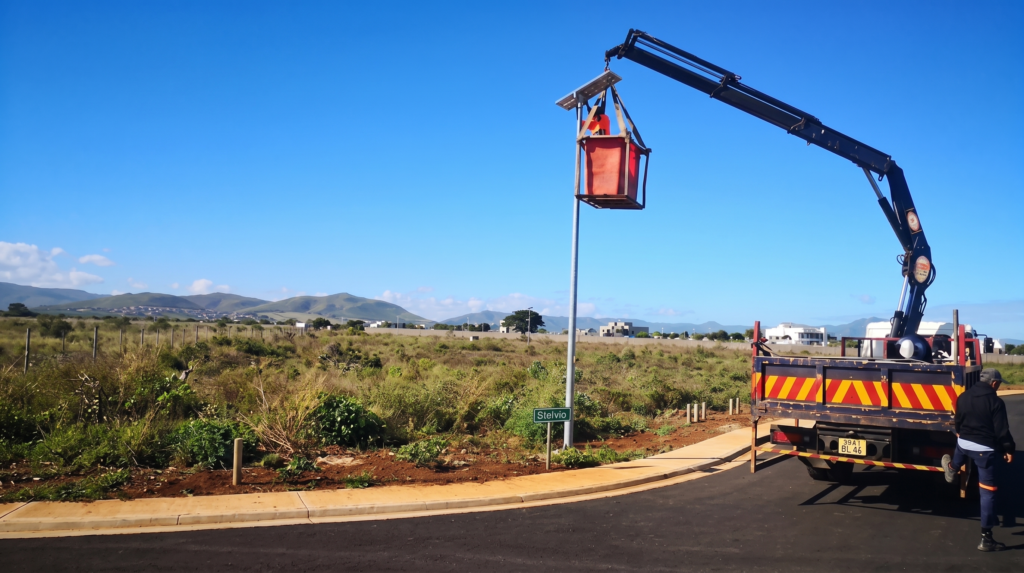
The coastal road project on Mauritius’s east coast represents a different set of requirements: large-scale coastal road lighting and long-term operation and maintenance.
Driven by the road lighting needs of the Mauritius Road Development Authority (RDA), the project ultimately deployed 260 Sresky ATLAS Series integrated solar street lights.
Local coastal roads are constantly exposed to sea winds, salt fog, high humidity, intense UV radiation, and tropical rainfall. Consequently, the project prioritized the equipment’s corrosion resistance, long-term operational reliability, and on-site maintenance costs.
Sresky conducted an environmental assessment for the project and optimized the solution to meet the coastal road’s requirements for corrosion resistance, reliable operation, and low maintenance.
This project highlights that solar street lights are not only suitable for small island communities but can also be deployed in large-scale coastal road infrastructure projects.
View the official case study of the 260-unit coastal highway project in Mauritius.
V. When Purchasing Solar Street Lights for Islands, We Recommend Asking Suppliers These 7 Questions
If you are a government road project manager, EPC contractor, real estate developer, or solar lighting importer, you can ask suppliers the following questions directly before finalizing a solution:
1. How Far Is the Project from the Coastline?
The closer it is to the coast, the more important it is to consider salt fog corrosion.
2. What Is the Maximum Local Wind Speed or Typhoon Intensity?
This determines the wind load design requirements that the light poles, arms, and luminaires must meet.
3. How Long Do Continuous Rainy Spells Typically Last in the Area?
This directly affects the choice of photovoltaic modules, battery capacity, and energy management strategies.
4. What Materials Are Used for the Luminaires and Fasteners?
Don’t just ask, “Are they rust-resistant?” Instead, confirm the specific materials and surface treatments.
5. What Battery Technology Is Used, and What Is Its Operating Temperature Range?
Battery thermal management requires particular attention in high-temperature island projects.
6. Are Underground Cables or External Power Distribution Equipment Required?
If one of the project’s core objectives is off-grid lighting, you should confirm whether the system can truly operate independently.
7. Are There Any Real-World Projects in Similar Environments?
This is a very important point.
Laboratory parameters provided by suppliers may indicate that a product has passed a specific test, but real-world project cases can further demonstrate whether the product has been used long-term in similar environments.
Therefore, when procuring, it is best to ask suppliers to provide real-world case studies similar to the project environment, such as:
- Island projects;
- Coastal highways;
- Areas prone to typhoons or hurricanes;
- Areas with high salt fog;
- Areas with high temperatures and humidity; and
- Areas without a power grid or with a weak power grid.
VI. Island Road Lighting Requires More Than Just “Luminaire Selection”—System Design Is Essential
Even after selecting solar street lights suitable for island environments, the design of the road lighting itself must not be overlooked.
For government roads, tourist area roads, and community roads, optical design must take into account road width, pole height, installation spacing, traffic volume, pedestrian needs, and lighting standards.
For example, even among island roads:
- Residential area roads may prioritize uniform illumination and pedestrian safety;
- Tourist area roads may prioritize visual experience and the nighttime environment;
- Coastal highways may prioritize continuous road illumination, glare control, and long-term reliability; and
- Roads near docks or ports may also face more complex conditions involving sea winds, salt fog, and traffic.
Therefore, one cannot simply assume that “higher-wattage solar street lights” will necessarily provide better lighting performance.
A truly reasonable solution should be evaluated based on the following comprehensive logic:
Road Environment → Lighting Requirements → Optical Design → PV Configuration → Energy Storage Design → Environmental Adaptability → O&M Requirements
Conclusion: The Core of Solar Street Lighting on Islands Is Not Merely the “Absence of a Power Grid”
The absence of a power grid is merely the first challenge facing road lighting on islands.
What truly determines whether a project can operate long-term are off-grid power supply capabilities, corrosion resistance, wind resistance, energy management, battery thermal management, and long-term maintenance costs.
From the 100-unit ATLAS project on Bohol Island in the Philippines, to the BASALT project in coastal communities in Tonga, to the 260-unit coastal highway project in Mauritius, it is evident that different island environments require different engineering priorities.
Therefore, when selecting solar street lights for islands, governments, EPC contractors, developers, and solar lighting importers should not merely ask:
“How many watts is this light?”
Instead, they should ask:
“Can it adapt to our marine environment? Can it withstand local wind conditions? Can it maintain illumination during prolonged periods of rain? How much maintenance will it require after installation?”
Only when these questions are incorporated into the design can solar street lights truly evolve from an “alternative product for off-grid situations” into a long-term road lighting solution suitable for island infrastructure development.
Table of Contents