
At 5:00 a.m., the coastal highway on Mauritius’s east coast is still shrouded in low light. The sea breeze carries salt spray, the air is highly humid, and agricultural dust lingers along the roadside.
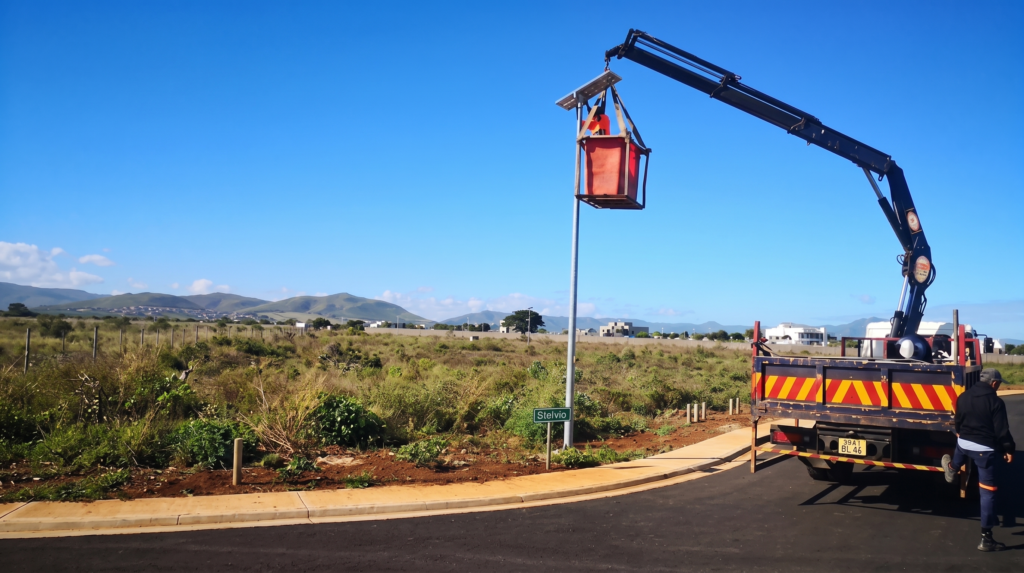
Project Snapshot
| Project Item | Project Details |
|---|---|
| Project Location | East Coast Coastal Highway, Mauritius |
| Client/Regulatory Authority | Mauritius Road Development Authority (RDA) |
| Quantity | Single-side lighting, 260 units |
| Product Series | Sresky Atlas All-in-One Solar Street Lights |
Challenge 1: Coastal Salt Fog and Hot, Humid Environments—How Can Corrosion in Solar Streetlights Be Prevented?
Mauritius’s coastal highways are constantly exposed to sea breezes, salt fog, intense UV radiation, and tropical rainfall. Salt and dust buildup increase the risk of corrosion on metal components and at connection points.
For solar streetlights, the problem often extends beyond the lamp post itself and may also affect fasteners, connectors, and interfaces.
Potential consequences include:
- Corrosion of metal surfaces, affecting equipment appearance and durability;
- Corrosion or loosening of fasteners, reducing structural reliability;
- Prolonged moisture exposure at connection points, increasing the risk of failure;
- Increased maintenance frequency, potentially affecting the continuous operation of road lighting.
Sresky Solution: Enhanced Corrosion-Resistant Design for Coastal Environments
Atlas solar streetlights are designed with both structural integrity and material selection in mind to meet the demands of coastal outdoor environments, with particular attention to areas prone to corrosion:
- Stainless steel brackets: Used at critical connection points to enhance corrosion resistance in salt fog environments;
- Aluminum + PC lamp body: Suitable for long-term outdoor use;
- Waterproof and dustproof design: Helps minimize the impact of salt fog, moisture, and dust on internal components.
Corrosion protection does not depend on a single material. During the design and selection process, the lamp body, brackets, connection points, and interfaces should be considered as an integrated system.
For long-term, unattended coastal solar streetlight projects, this design approach helps the system better adapt to the operating conditions of island roads.
Challenge 2: Coastal Roads in Remote Areas Are Spread Over Long Distances—How Can O&M Costs for Solar Streetlights Be Reduced?
When streetlights on urban roads malfunction, maintenance personnel can typically arrive at the site quickly. However, for coastal road projects in island nations such as Mauritius, on-site maintenance must account for travel distances, transportation, and spare-parts logistics.
When a solar streetlight stops working, maintenance personnel must first determine the exact source of the malfunction.
Potential issues with traditional on-site troubleshooting include:
- Difficulty quickly determining whether the fault lies with the battery, photovoltaic (PV) modules, or LED modules;
- The need for maintenance personnel to carry a large number of spare parts;
- Repeated trips to the site, increasing labor and transportation costs;
- Reduced overall maintenance efficiency for multi-kilometer road lighting projects.
Sresky Solution: Smart Monitoring to Reduce On-Site Trial and Error
Atlas solar streetlights can be equipped with smart management features (customizable options) to help O&M personnel monitor equipment operating conditions, including:
- Battery status monitoring;
- PV module operational status monitoring;
- Remote viewing and configuration via a mobile app or computer.
For example, when the system indicates declining battery performance, maintenance personnel can prepare the appropriate spare parts in advance. If PV input is abnormal, they can prioritize checking for issues such as module soiling or shading.
Key Selling Point: Diagnose First, Then Visit the Site.
For solar streetlight projects on islands, in rural areas, and along remote roads, this smart O&M approach can help reduce unnecessary on-site troubleshooting and improve maintenance efficiency.
Customer Feedback
At a project review meeting, an engineering manager from RDA expressed concerns about maintenance as follows: “We don’t lack streetlights. What we lack are streetlights that don’t require us to make repeated on-site visits.”
Frequently Asked Questions (FAQ)
1. Is corrosion protection necessary for solar streetlights installed along coastal roads in Mauritius?
We recommend prioritizing corrosion protection. Solar streetlights near the coast are continuously exposed to salt fog and hot, humid conditions. When purchasing solar streetlights, pay close attention to:
- The material grade of stainless steel fasteners and brackets;
- The surface treatment and protective coatings of the lamp body;
- Designs that isolate dissimilar metals;
- Salt fog testing and corrosion resistance.
2. How can solar streetlights in coastal areas be protected against salt fog corrosion?
Reliable coastal solar streetlights typically require corrosion-resistant design measures across multiple areas:
- Protection of the metal lamp body;
- Corrosion-resistant fasteners;
- Isolation of metal connection points;
- Moisture protection for interfaces and critical components;
- Testing and evaluation for high-salinity environments.
When assessing the corrosion resistance of coastal solar streetlights, it is recommended to evaluate the overall design comprehensively rather than focusing on a single material.
3. Are solar streetlights suitable for island nations like Mauritius?
Yes, but the specific model should be selected based on local environmental conditions.
Key evaluation factors include:
- Annual sunlight conditions;
- High temperatures and humid environments;
- Saltwater corrosion;
- Heavy tropical rainfall;
- Road lighting brightness and runtime requirements;
- Post-installation maintenance conditions.
For coastal highways, rural roads, and areas with insufficient grid coverage, solar streetlights can reduce the need for underground cables and traditional power infrastructure.
Conclusion: Coastal Solar Streetlights Are Evolving from “Grid Alternatives” to “Long-Term Infrastructure Solutions”
In Mauritius, Southeast Asia, coastal Africa, the Middle East, and other island regions, the application of solar streetlights is shifting from meeting basic off-grid lighting needs toward a greater focus on reliability, corrosion resistance, smart operation and maintenance, and lifecycle costs.
A mature coastal solar streetlight project should consider the following factors during the design phase:
Environment → Product → Power Supply → Corrosion Resistance → Operations and Maintenance → Lifecycle Costs
If you are:
- A municipal department: Focus on road lighting reliability and long-term maintenance;
- An EPC or engineering contractor: Focus on evaluating corrosion resistance, installation requirements, and O&M efficiency;
- A lighting planner: Focus on calculating lamp spacing, illuminance, and PV and energy-storage configurations;
- A solar streetlight purchaser: Focus on comparing products based on environmental adaptability and full lifecycle performance.
The 260-unit solar streetlight project in Mauritius serves as a practical reference for off-grid lighting planning along coastal roads. In high-salinity, high-humidity environments, preliminary environmental assessments and careful product selection can be critical to long-term project performance, rather than simply focusing on reducing initial procurement costs.