
Does the presence of sunlight by the sea automatically mean that an area is suitable for installing solar street lights?
Therefore, coastal solar street lights cannot be evaluated simply by comparing “watts, lumens, and IP ratings.”
What truly needs to be assessed is:
How harsh is the local environment? What type of light distribution does the road require? Is the energy storage capacity sufficient under the worst weather conditions? Can the structure withstand local wind loads? Is post-installation maintenance convenient?
This article explains how to select solar street lights for coastal areas by examining salt fog corrosion, typhoon-force winds, prolonged rainy periods, light distribution, application scenarios, and real-world project case studies. It also provides a procurement checklist that can be used directly for supplier evaluation.
I. Why Is Selecting Solar Street Lights More Challenging in Coastal Areas?
Coastal projects are characterized by the simultaneous presence of multiple environmental risks.
| Coastal Environment | Primary Risks | Key Selection Criteria |
|---|---|---|
| Seaside Roads | Salt fog, high humidity, strong winds | Corrosion resistance, sealing, structural design, light distribution |
| Typhoon-Prone Islands | Strong winds, torrential rain, prolonged overcast and rainy weather | Overall structure, foundation, energy storage |
| Seaside Parking Lots | Salt fog, lighting uniformity | Corrosion resistance, light distribution, illuminance |
| Docks/Waterfront Areas | Salt fog, humidity, difficult maintenance | Corrosion resistance, light distribution, low maintenance |
| European Coastal Regions | Weak winter sunlight, overcast and rainy weather | Energy calculations, energy storage, smart dimming |
Therefore, the selection process for coastal solar street lights should be:
First, assess the environment → Determine lighting requirements → Design the energy system → Verify the structure → Select luminaires and control solutions.
It should not be a matter of selecting a product first and then trying to adapt it to every environment.
II. Salt Fog Corrosion: IP Rating Does Not Equal Salt Fog Resistance
This is one of the most common misconceptions when selecting coastal solar street lights.
Many procurement personnel will first ask:
“Is this solar street light IP65 or IP66?”
The IP rating is certainly important, but it is primarily used to evaluate a device’s resistance to dust and water ingress.
Salt fog corrosion in coastal areas, however, is a separate issue.
Salt and moisture in marine air can have a long-term effect on the lamp body, brackets, bolts, washers, and joints between different metals.
Therefore:
IP protection ≠ resistance to salt fog corrosion.
What Should Be Prioritized in Coastal Projects?
It is not enough to simply check whether the lamp body is made of aluminum alloy. You should also confirm:
- What materials are used for the lamp body;
- What surface protection treatments are applied;
- What materials are used for the bolts, nuts, and washers;
- Whether contact points between different metals are properly isolated;
- Whether water tends to accumulate on the brackets and at connection points;
- How the battery and controller compartments are sealed;
- Whether there is an appropriate drainage design;
- Whether corroded components can be conveniently inspected and replaced in the future.
Especially in high-salt-fog environments, fasteners, seams, and metal joints can become weak points in the entire system.
Don’t Just Ask, “How Many Hours of Salt Spray Testing?”
Salt spray testing can serve as a basis for comparing different materials and products, but it should not be interpreted simplistically as:
“1,000 hours of testing equals a certain number of years of service life in the field.”
Actual service life is also influenced by factors such as distance from the coast, salt fog concentration, humidity, temperature, installation location, material combinations, and maintenance practices.
Therefore, a more reasonable approach is to consider the following factors comprehensively:
Materials + Surface Treatment + Fasteners + Sealing + Drainage + Actual Environment + Maintenance
III. Typhoons and Strong Winds: Don’t Just Look at “Wind Resistance in Meters per Second”
For islands and coastal areas prone to typhoons, structural safety is a more critical issue than brightness alone.
A solar street light consists of more than just a lamp head.
Under strong winds, the entire installation system may be subjected to wind loads:
PV Modules → Luminaire → Mounting Bracket → Light Pole → Flange/Anchor Bolts → Foundation
Insufficient design in any single component may compromise the safety of the overall system.
Why Do Photovoltaic Modules Require Special Attention?
The larger the photovoltaic panel, the greater the surface area exposed to wind forces.
This is particularly important in the following situations:
- High-mast installations;
- Large-sized photovoltaic modules;
- Photovoltaic panels with steep tilt angles;
- Open coastal areas;
- Areas with high wind speeds, such as mountain passes and straits.
Therefore, when purchasing, do not simply ask:
“How many meters per second of wind can this light withstand?”
It is even more important to verify the following:
- The design base wind speed at the project site;
- The installation height of the light pole;
- The wind-exposed area of the luminaires and photovoltaic modules;
- The installation angle of the photovoltaic modules;
- The structure of the light pole and mounting brackets;
- The flanges and anchor bolts;
- Whether the foundation design complies with local requirements.
Simply put:
The “product wind resistance rating” cannot replace a structural analysis of the entire installation system.
A reliable solution requires comprehensive design based on the project site’s wind speed, topography, installation height, and foundation conditions.
IV. Prolonged Rainy Weather: Solar Street Lights Should Be Designed for “Worst-Case Weather”
Another common concern in coastal areas is:
Will solar street lights continue to function normally after several consecutive days of rain?
The true test for solar street lights is usually not sunny weather, but rather periods of prolonged rain, heavy downpours, or the recovery period following a typhoon.
The basic energy flow of a solar street light system is:
Solar power generation during the day → Energy storage in the battery → LED power consumption at night
When there is insufficient sunlight for several consecutive days, an energy shortfall may occur if nighttime lighting demands remain unchanged.
Therefore, system design must not rely solely on local annual average sunshine data. It should also consider:
- Solar irradiance during the worst season;
- The number of consecutive rainy days;
- Nightly operating hours;
- Actual LED power consumption;
- Photovoltaic module power;
- Battery capacity;
- Overall system efficiency;
- The impact of temperature on battery performance;
- Smart dimming strategies.
Why Is Smart Dimming Important for Coastal Projects?
Traffic volume on roads does not remain constant throughout the night.
Therefore, the following control strategy can be adopted:
Higher brightness in the first half of the night → Reduced power in the late night → Increased brightness when people or vehicles pass by
This control method not only saves energy but also reduces battery consumption during prolonged periods of overcast or rainy weather, preserving more lighting capacity for the latter half of the night.
Therefore, the “endurance” of coastal solar street lights is not determined solely by battery capacity, but by the combined performance of:
Photovoltaic power generation + Battery storage + LED power consumption + Control strategies
V. Don’t Just Look at Lumens: Light Distribution Is More Important for Road Lighting
“How many lumens?”
This is one of the most common questions when purchasing solar street lights.
However, when it comes to road lighting:
High lumens do not necessarily mean high-quality lighting.
Even if a light has a very high total luminous flux, inappropriate light distribution can lead to problems such as excessive brightness in the center of the road, insufficient illumination at the roadside, and dark spots between light poles.
Therefore, coastal road projects should also focus on the following:
1. Light Distribution Curves
Confirm whether the luminaire is suitable for roads, parking lots, walkways, or open spaces.
2. Pole Height and Spacing
The actual lighting effect of the same luminaire can vary significantly depending on installation height and spacing between poles.
3. Illuminance and Uniformity
For projects such as roads, parking lots, and docks, target illuminance and uniformity levels should be determined based on applicable lighting standards.
4. Light Spill
At docks, seaside parks, and waterfront areas, unnecessary light directed toward the water’s surface should be minimized.
Therefore, the real question to ask is not:
“How many lumens does this light produce?”
but rather:
“Can this light accurately illuminate the areas that need to be lit?”
VI. Four Typical Coastal Scenarios: How Should Solar Street Lights Be Selected?
1. Tropical Coastal Roads
Typical environmental conditions include high temperatures, high humidity, salt fog, heavy rainfall, and seasonal storms.
Key selection criteria are:
Corrosion resistance + Sealing + Energy management + Smart dimming
Rather than simply increasing LED power, verify that the lamp body, fasteners, brackets, electrical enclosure, and energy system are suitable for the local environment.
2. Islands Prone to Typhoons
Projects in these areas face strong winds, torrential rain, and prolonged periods of overcast and rainy weather.
Key selection criteria include:
Structural safety + Foundation design + Energy storage capacity
In particular, the photovoltaic modules, luminaires, brackets, light poles, flanges, and foundations must be evaluated as an integrated system.
3. European Coastal Roads and Parking Lots
In addition to salt fog corrosion, some European coastal areas must also contend with shorter daylight hours in winter and prolonged periods of overcast weather.
Therefore, the focus should be on:
Seasonal energy calculations + Energy storage + Light distribution + Compliance requirements
System capacity cannot be determined simply by using annual average solar irradiance data.
4. Docks and Waterfront Public Spaces
Dock and marina environments typically involve greater exposure to salt fog and greater maintenance challenges.
Key selection criteria include:
Corrosion resistance + Light distribution + Low maintenance + Light pollution control
It is essential not only to ensure adequate lighting for roads and walkways but also to minimize unnecessary light spill onto the water’s surface.
VII. Integrated or Split-Type? Which Should Coastal Projects Choose?
There is no absolute advantage or disadvantage between integrated and split-type systems. The choice should be based on the specific project conditions.
Integrated Solar Street Lights
They are better suited for:
- Coastal roads;
- Residential communities;
- Parks;
- Parking lots;
- Walkways;
- General waterfront public areas.
They typically feature simple installation, fewer external cables, and a high degree of system integration.
Split-Type Solar Street Lights
They are better suited for:
- Higher power requirements;
- Larger photovoltaic modules;
- Special photovoltaic installation angles;
- Greater energy storage requirements;
- Projects with specific requirements for photovoltaic module placement.
The final selection should be based on:
Power demand × PV area × Energy storage demand × Installation conditions × Wind load × Maintenance method
rather than simply comparing product types.
VIII. Real-World Project Case Studies: How Should Systems Be Selected for Different Coastal Environments?
The following case studies are drawn from Sresky’s publicly available project data and are primarily used to illustrate the selection approach under different environmental conditions.
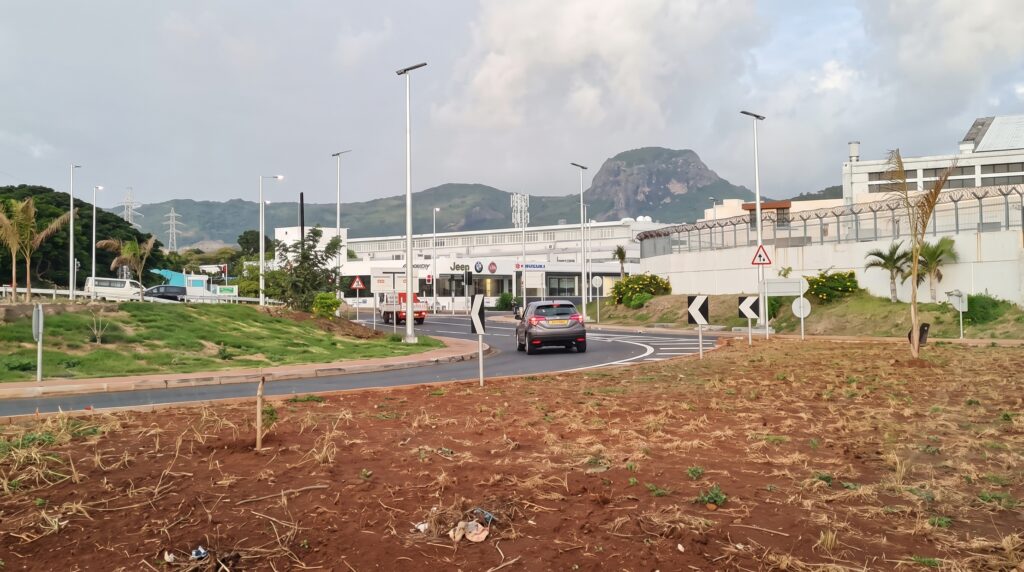
Mauritius: Salt Fog, Strong Winds, and Tropical Rainfall
According to Sresky’s publicly available project documentation, a coastal road project in Mauritius faced conditions such as salt fog, high humidity, strong winds, and heavy rainfall during the cyclone season, and utilized the Thermos Series of solar street lights.
This case demonstrates that tropical coastal projects require simultaneous attention to corrosion protection, structural safety, and energy management, rather than simply increasing the power output of the luminaires.
Croatia: Corrosion Protection and Light Distribution in a Harbor Environment
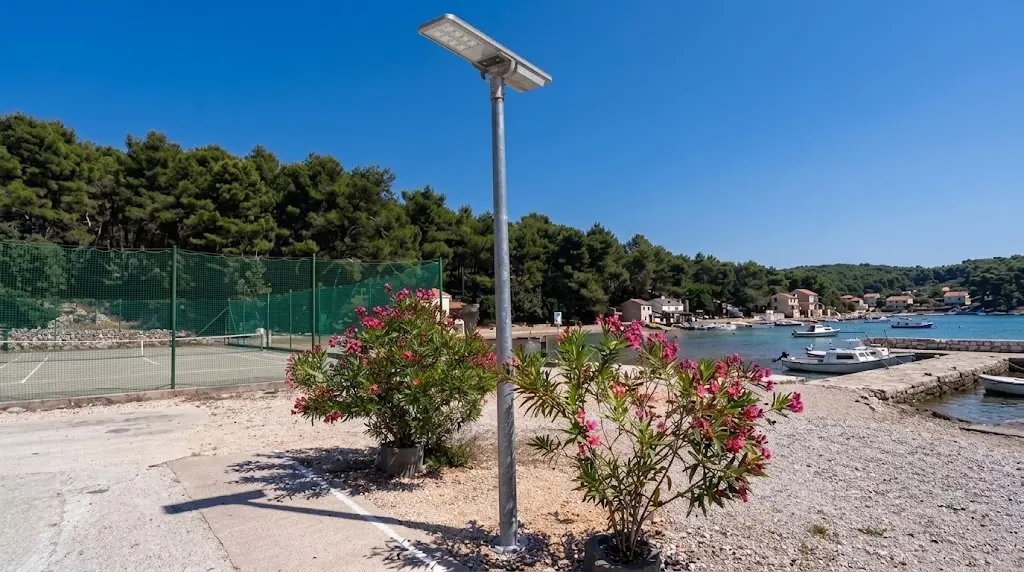
Sresky’s publicly available case study on a Croatian coastal harbor project shows that, in addition to dealing with salt fog and persistent rain, the project required light distribution design to control light spill.
For harbors and waterfront areas, product selection needs to consider more than corrosion resistance; energy storage, road lighting distribution, and ease of maintenance are also important.
Bohol, Philippines: Off-Grid Requirements for Island Projects
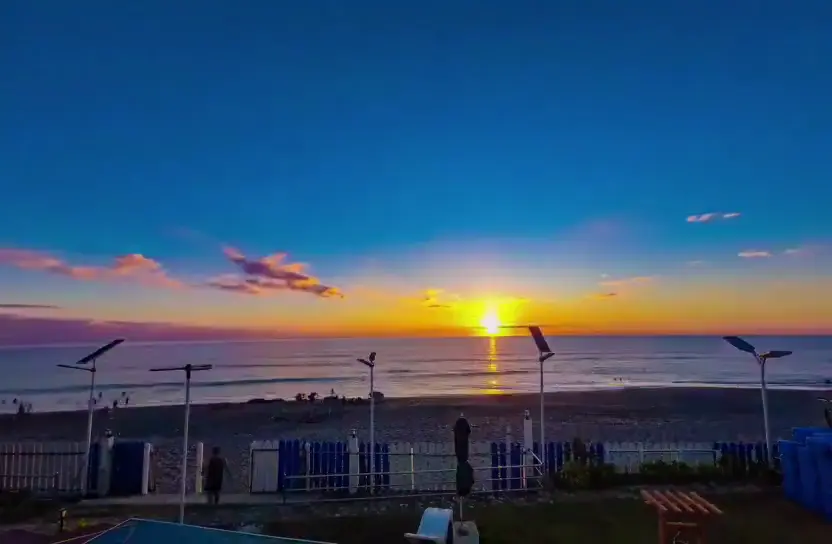
The Bohol Island project faces conditions such as high humidity, salt fog, heavy rainfall, and seasonal typhoons.
The focus for such island projects is on structural reliability, energy independence, and long-term maintenance.
The value of solar street lights lies not only in reducing the need for cables and power supply infrastructure but also in reducing construction complexity in remote areas.
IX. Procurement of Coastal Solar Street Lights: 18 Questions to Confirm with Suppliers
If you are procuring coastal solar street lights, it is not recommended to simply ask suppliers to quote “how many watts” or “how many lumens.”
You can use the checklist below directly for preliminary technical discussions:
| Category | Questions to Confirm |
|---|---|
| Environment | How far is the project from the coastline? |
| Environment | What are the local salt fog or corrosion conditions? |
| Materials | What materials are used for the lamp body? |
| Corrosion Protection | What type of anti-corrosion treatment is applied to the surface? |
| Fasteners | What materials are used for bolts, nuts, and washers? |
| Connections | Are isolation measures in place where different metals come into contact? |
| Protection | What is the IP rating? |
| Impact Resistance | What is the IK rating? |
| Wind Conditions | What is the local basic design wind speed? |
| Structure | Are structural calculations provided for the luminaire, bracket, and light pole? |
| Foundation | How are the foundation and anchor bolts designed based on site conditions? |
| Photovoltaics | How is the power output of the photovoltaic modules determined? |
| Energy Storage | How is the battery capacity calculated? |
| Cloudy and Rainy Conditions | How many consecutive days of cloudy and rainy weather are factored into the design? |
| Control | Does the system support smart dimming? |
| Light Distribution | Can you provide light distribution files such as IES or LDT? |
| Simulation | Can you provide lighting simulations using software such as DIALux? |
| Maintenance | Are the batteries, LEDs, and controllers replaceable? |
In addition, you should confirm the warranty coverage, spare parts availability, and after-sales service arrangements.
If a supplier primarily highlights “high brightness, low price, IP66, and ultra-long battery life” but cannot answer questions regarding local wind speeds, energy storage calculations, light distribution files, or corrosion protection solutions, then what you are likely receiving is merely a product quotation—not a comprehensive project solution.
X. The 5 Most Common Selection Mistakes for Coastal Solar Street Lights
Mistake 1: Assuming IP65/IP66 Equals Salt Fog Resistance
IP ratings primarily address dust and water resistance.
Coastal projects also require an assessment of materials, surface treatments, fasteners, connection structures, and long-term maintenance.
Mistake 2: Comparing Only Lumens Without Considering Light Distribution
High lumen output does not automatically translate into good road lighting.
Road width, pole height, spacing, light distribution curves, and illuminance uniformity are equally important.
Mistake 3: Using Average Sunshine Duration Instead of Worst-Case Seasonal Calculations
Solar systems are most prone to energy shortages during prolonged periods of rain and low irradiance.
Therefore, system design should account for the local worst-case season and prolonged rainy conditions.
Mistake 4: Focusing Only on Wind Resistance Ratings, Not the Overall Structure
Just because a light fixture can withstand a certain wind speed does not mean that the photovoltaic modules, mounting brackets, light poles, flanges, anchor bolts, and foundation as a whole meet the project requirements.
Mistake 5: Comparing Only Purchase Prices
In coastal environments, maintenance costs are equally important.
If low-cost products require frequent replacement of batteries, fasteners, or corroded components later on, a lower initial purchase price does not necessarily mean a lower total cost of ownership (TCO).
Therefore, for coastal projects, it is more appropriate to compare different solutions from a total cost of ownership (TCO) perspective.
XI. Five Core Principles for Selecting Coastal Solar Street Lights
The entire article can be summarized in five sentences:
The environment determines corrosion protection; wind speed determines the structure; sunlight determines energy storage; the road determines light distribution; and the project location determines maintenance.
When procuring solar street lights, you can evaluate suppliers’ solutions based on these five dimensions:
- Is the solution suitable for local salt fog and humidity conditions?
- Does it meet local wind load and foundation requirements?
- Is there sufficient energy during the worst-case season?
- Does the actual road lighting meet light distribution and uniformity requirements?
- Are the long-term maintenance requirements and total cost of ownership (TCO) reasonable?
XII. FAQ: Common Questions About Coastal Solar Street Lights
Are coastal areas suitable for installing solar street lights?
Yes, but system design must account for local salt fog, humidity, wind speed, rainfall, and solar irradiance conditions.
The advantage of coastal areas is their solar energy resources, while the main challenges are corrosion resistance, structural safety, and energy management during extreme weather.
Is an IP65/IP66 rating sufficient for coastal environments?
You cannot rely solely on the IP rating.
IP ratings primarily reflect dust and water resistance. Coastal projects also require an assessment of salt fog corrosion, materials, fasteners, surface treatments, and sealing structures.
Can solar street lights be used in areas prone to typhoons?
Yes, but structural design must be tailored to local wind conditions.
The key is not simply to find a “wind-resistant product,” but to confirm that the complete system—comprising photovoltaic modules, luminaires, mounting brackets, light poles, and foundations—meets project requirements.
Will solar street lights still work after several consecutive days of rain?
It depends on the specific system design.
A comprehensive calculation is required, taking into account photovoltaic power, battery capacity, LED power, daily operating hours, smart dimming strategies, and solar irradiance conditions during the worst season in the local area.
Therefore, the question of “how many consecutive days they can stay lit” cannot be answered independently of the specific project conditions.
Conclusion: For Coastal Solar Street Lights, Higher Specifications Aren’t Necessarily Better
Coastal regions offer favorable conditions for solar applications, but salt fog, high humidity, strong winds, heavy rain, and prolonged periods of overcast weather also create a more complex operating environment for solar street lights.
Therefore, when selecting coastal solar street lights, one should not merely compare:
Power, lumens, IP rating, and price.
A more reasonable approach is to establish a comprehensive set of interdependent factors:
The environment determines corrosion protection and structural requirements;
The climate determines energy generation and energy storage design;
The road determines light distribution and illuminance;
Wind speed determines structural calculations;
The project location determines maintenance strategies.
Whether for coastal roads, islands, parking lots, docks, or waterfront public spaces, a suitable solar streetlight solution should be based on the actual project conditions.
Ultimately, coastal solar streetlights should not be evaluated by maximizing any single parameter. Instead, the goal should be to achieve a long-term balance among lighting, safety, energy, structural integrity, and maintenance in real-world environments.