
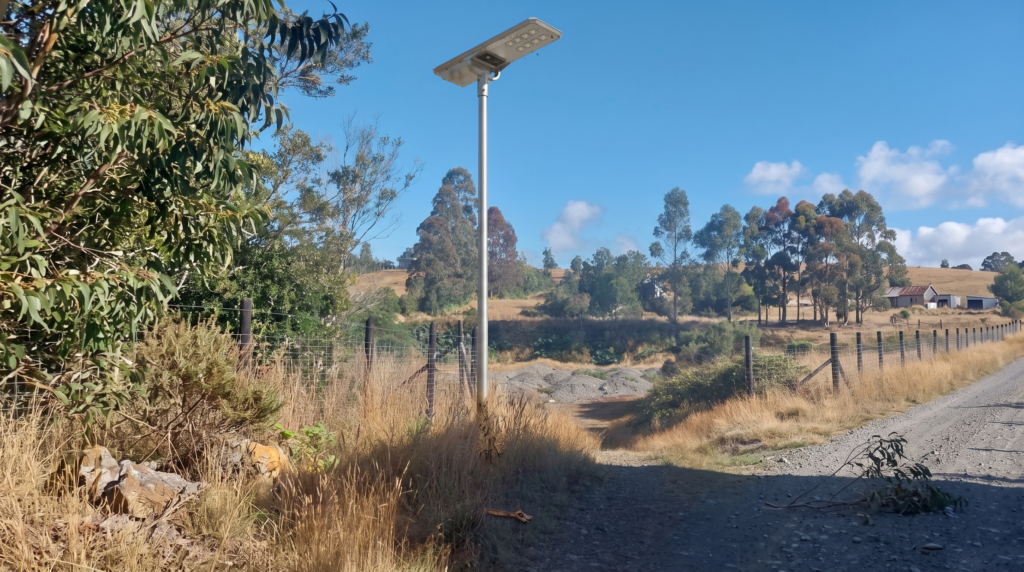
A rural road, far from the municipal power grid and surrounded by dry grasslands. The client needed to provide lighting for nighttime travel but did not want to install a complex network of cables and conduits. Even more challenging, the project involved 2,200K low-color-temperature lighting, rural road light distribution, and energy storage safety.
Project Snapshot
| Project | Information |
|---|---|
| Project Location | Rural gravel road in Central Chile, Mediterranean climate zone |
| Client Type | Tourism development / Rural land developer |
| Total Units | 55 sets |
| Product Series | Sresky ATLAS Series Solar Street Lights |
Engineering Challenge 1: 2,200K Solar Street Lights—How Can Compliance and Roadway Illumination Be Balanced?
The project needed to address Chile’s low-color-temperature lighting requirements. While 2,200K warm light reduces the proportion of blue light, its luminous efficacy is typically lower than that of higher-color-temperature white light at the same power level. Simply increasing LED power would, in turn, place greater loads on the solar panels, batteries, and light poles.
Potential consequences include:
- Insufficient road surface illuminance;
- Difficulty identifying uneven surfaces and road edges on gravel roads;
- The need to further increase the capacity of the solar system;
- Increased project costs and structural loads;
- Greater difficulty in performing illuminance calculations and preparing regulatory documentation.
Solution: Addressing the Lighting Efficiency Challenges of 2,200K Through Optical Design
Rather than simply “increasing power,” Sresky focused on optimizing the optical efficiency of the 2,200K solar street lights:
- Road Light Distribution Design: Directing more light toward the road area helps reduce ineffective light spill toward the sky, shrubs, and roadside areas.
- 2,200K Light Source Solution: Balancing color rendering and luminous efficacy under low-color-temperature conditions to improve the visibility of gravel roads and road surface contours.
- Simulated Road Illuminance Data: Providing photometric data, such as simulated road illuminance maps, as a reference for illuminance calculations and related technical submissions.
Key Selling Point: 2,200K is not merely a matter of “replacing a single LED chip”; it requires a systematic design approach that integrates the LED light source, lens, and light distribution.
Note: The specific scope of applicable regulations, submission documents, and certification requirements should be determined according to the latest regulations and requirements of the competent local authorities at the project location.
Engineering Challenge 2: In Dry Grassland Environments, How Can Solar Street Lights Reduce the Risk of Fire?
Central Chile experiences dry summers, and tall or dry grass may be present along rural roads. Since solar street lights integrate batteries, controllers, and wiring components, projects should not only consider whether the lights “work,” but also address fire safety for the energy storage system and the area surrounding the light poles.
Potential consequences include:
- Dry grass coming into contact with high-temperature components, increasing the risk of fire;
- Decentralized light poles making centralized maintenance difficult;
- Fires potentially spreading through vegetation along both sides of the road;
- In the event of an accident, potential issues related to construction, public liability, and insurance.
Solution: Multi-Layered Protection from Energy Storage Safety to Light Pole Foundations
To address the dry rural road environment, the solution focuses on enhancing the energy storage and installation safety of solar street lights:
- LiFePO4 battery cells: Compared with common ternary lithium battery systems, LiFePO4 cells typically offer better thermal stability.
- Multi-level BMS protection: Provides multiple levels of hardware-based safety protection and integrates State of Charge (SOC) and State of Health (SOH) management.
- Temperature control and thermal insulation design: Helps improve battery performance in both high- and low-temperature environments through temperature control and thermal insulation technologies.
- Integrated structure: The battery is integrated into the lamp head and installed at the top of the light pole along with the fixture, helping minimize direct contact with dry grass on the ground.
- Fire barrier at the base of the light pole: Depending on site conditions, metal protective rings and gravel covers can be used to form a fire barrier around the foundation.
If the project has specific requirements for battery safety certifications or local acceptance documentation, it is recommended to confirm each requirement with the supplier during the procurement phase.
Key Selling Point: The safety design of solar street lights should not focus solely on the battery itself, but should also encompass the battery compartment, wiring components, and environment surrounding the light pole foundation.
Project Outcomes
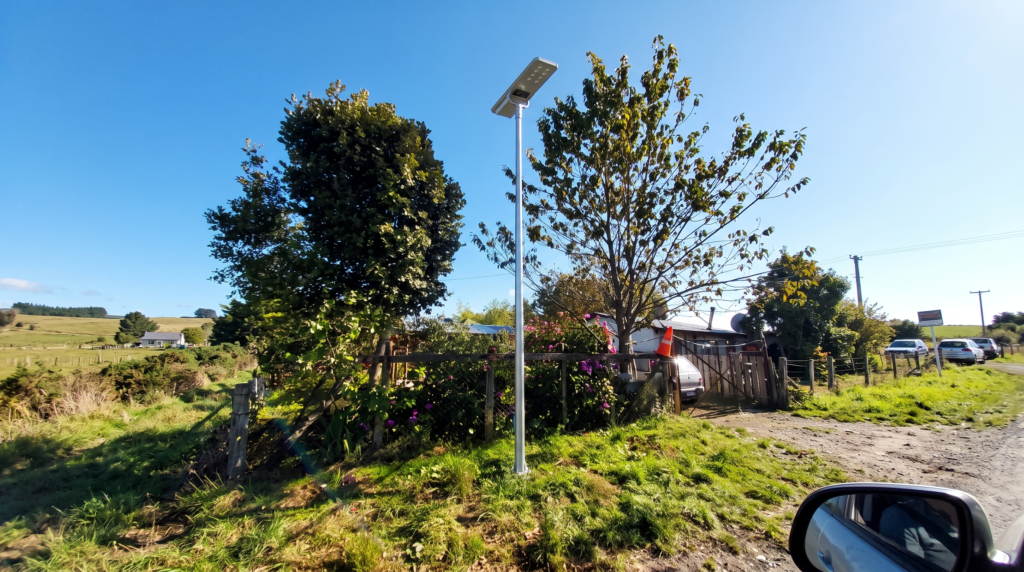
- 55 sets of solar streetlights deployed: Covering residential areas, pedestrian walkways, and public activity areas.
- 2,200K low-color-temperature solution implemented: Addressing the need for warm lighting in rural tourism environments.
- Road lighting distribution design: Directing more light toward the road area and helping reduce unnecessary light output toward roadside areas and the sky.
- LiFePO4 energy storage system: Enhanced safety design to better withstand arid rural environments.
- Reduced reliance on grid infrastructure: Minimizing the need to install a traditional power cable system along the roads.
Core Project Value: By implementing a solar streetlight solution optimized for the local climate, road conditions, and low-color-temperature requirements, this project addresses the complex engineering challenge of combining “off-grid + 2,200K lighting + arid grasslands.”
Client Feedback (Translated from Spanish)
“The two quotes we received previously both had the same issue—the illuminance calculations didn’t add up. Sresky’s solution didn’t sidestep the 2,200K limitation; instead, it addressed it through optical design.”
FAQ: Solar Street Lights for Rural Roads in Chile
1. Are rural roads in Chile suitable for installing solar street lights?
Generally, yes, especially for roads and development projects without stable access to the power grid.
Typical application scenarios include:
- Rural roads;
- Tourism developments;
- Internal roads in residential areas;
- Pedestrian paths;
- Public areas far from the power grid.
The key is to design the system based on solar radiation, road width, installation spacing, and lighting requirements.
2. Are solar street lights suitable for tourism developments and rural road projects?
They are generally suitable, especially in situations where:
- Grid connection costs are high;
- Road distances are long;
- Civil engineering work is difficult;
- There is a desire to reduce long-term maintenance costs.
In these scenarios, solar street lights can serve as a standalone lighting solution.
3. Why were 2,200K solar street lights chosen for the Chilean project?
2,200K provides warm, low-color-temperature lighting that reduces the proportion of blue light, making it potentially suitable for:
- Ecologically sensitive areas;
- Rural tourism roads;
- Areas with stringent requirements for the nighttime environment.
However, 2,200K LEDs typically require more specialized optical design; otherwise, they may result in insufficient brightness.
4. Can solar street lights function normally during winter in rural areas of Chile?
This depends on several factors, including:
- Local solar radiation conditions;
- Solar panel capacity;
- Battery capacity;
- Control system strategies.
When designing a solar streetlight project, the system must be tailored to local climate data rather than relying solely on summer operating conditions.
Conclusion: Rural Road Lighting Is Shifting from “Installing Fixtures” to “System Design”
For rural areas and tourism development projects without a stable grid connection, solar street lights are no longer merely substitutes for traditional utility-powered streetlights. The key to a project’s success often lies in balancing optical design, energy storage safety, climate adaptability, and local lighting requirements.
For municipal departments, engineering contractors, and lighting planners selecting solar street lights for rural roads in Chile, it is recommended to focus on verifying:
- Color temperature requirements (e.g., 2,200K/2,700K);
- Photometric data (e.g., IES and LM-79);
- Actual road illuminance and light distribution;
- LiFePO4 batteries and relevant safety certifications;
- Annual solar radiation and energy storage design;
- Local SEC requirements and documentation required for project acceptance.
The core value of solar street lights lies not merely in providing off-grid power, but in meeting reliable, safe, and project-specific road lighting needs with minimal infrastructure.