
Table of Contents
Before 6:00 a.m., farm vehicles have already begun traveling along rural roads in Mexico.
However, during the rainy season, unpaved roads can become muddy and waterlogged, making it difficult for maintenance vehicles to access them. If solar street lights cannot fully recharge for several consecutive days, nighttime road lighting may also be affected.
Therefore, what deserves greater attention in these rural Mexican solar street light projects is not merely “whether there are lights,” but two more practical questions:
- After prolonged periods of rain, can the solar street lights continue to provide adequate illumination?
- Given the remote locations and limited transportation access, can the equipment be repaired quickly in the event of a malfunction?
To address prolonged periods of low sunlight, unpaved roads, and complex security conditions, the engineering team adopted the Sresky Atlas Series all-in-one solar street lights, focusing on addressing the challenges of rainy-season endurance and maintenance on remote roads.
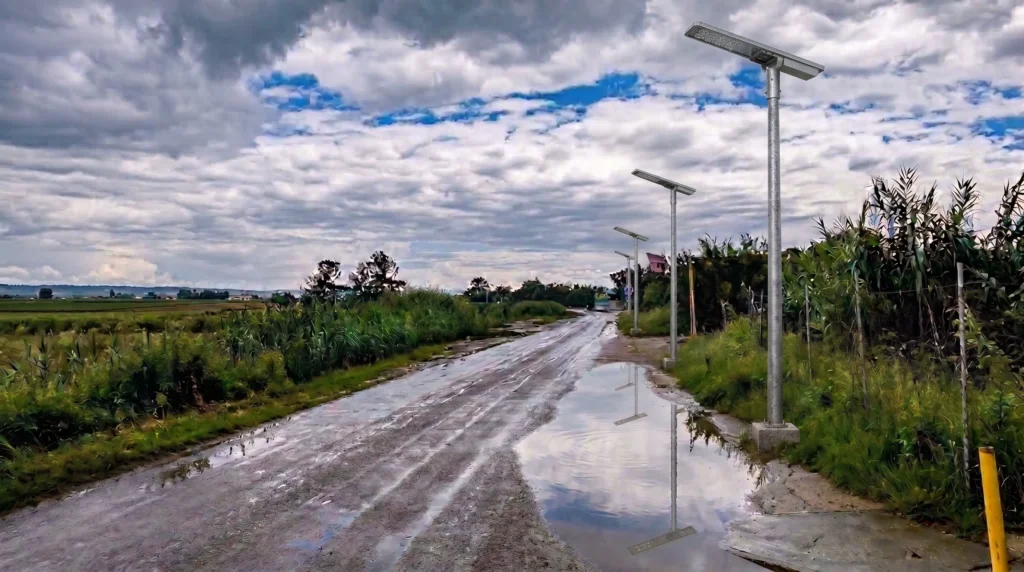
Project Snapshot
| Specifications | Details |
|---|---|
| Project Location | Agricultural and livestock corridors in south-central Mexico |
| Road Type | Camino Rural / Camino Vecinal (unpaved rural access roads) |
| Estimated Scale | 3–8 kilometers per contract section, approximately 165 units |
| Client | Rural Road Lighting Improvement Program under the State Department of Transportation and Infrastructure |
| Selected Solution | Sresky Atlas Series All-in-One Solar Street Lights |
Engineering Challenge 1: How Long Can the Solar Street Lights Remain Illuminated After Prolonged Periods of Rain?
Some lowland areas in southern Mexico experience a distinct rainy season. Taking Tabasco as an example, annual precipitation ranges roughly from 1,600 to 3,200 millimeters, with significant regional variation. The rainy season is primarily concentrated from June through October, and monthly average precipitation can exceed 300 millimeters in some months.
For solar street lights installed along rural roads, the primary risk is often not a “single day of rain,” but rather prolonged periods of low solar irradiance.
Possible Consequences
- Solar panels may be unable to fully recharge the batteries for several consecutive days;
- The battery State of Charge (SOC) may continuously decline;
- Fixed-power lighting may accelerate battery depletion;
- Nighttime road illumination may eventually be disrupted.
This is also a key consideration when designing solar street lighting systems for rural areas in Mexico.
Solution: ALS 2.4 Dynamically Manages Energy Storage and Lighting Power
The Sresky Atlas Series employs the ALS 2.4 Adaptive Lighting System, which dynamically adjusts output power based on ambient light conditions and battery status rather than operating at a fixed brightness level at all times.
The core benefits include:
- Reduced power consumption during prolonged periods of low solar irradiance;
- Dynamic adjustment of lighting output based on battery status;
- Reduced risk of complete lighting shutdown after the battery is depleted;
- Extended autonomous operation during periods of cloudy or rainy weather.
As the number of cloudy and rainy days increases, the system gradually reduces brightness during peak hours and prioritizes the saved energy for basic lighting throughout the night, helping to extend autonomous operation time.
According to project feedback, an Atlas Series project comprising approximately 200 units in an industrial zone in Mexico operated through an entire rainy season with relatively stable performance and no significant malfunctions, while the roads remained illuminated throughout the night.
Engineering Challenge 2: The Roads Are Too Remote—How Do You Repair a Broken Solar Street Light?
On urban roads, equipment failure typically means a routine repair.
However, on remote rural roads in Mexico, maintenance personnel may first have to contend with muddy surfaces, deep ruts, and standing water during the rainy season. If vehicles cannot access the site or specialized aerial work platforms are required, maintenance costs can increase significantly.
Specific Consequences
- Longer response times to equipment failures;
- Additional vehicles and labor required to replace batteries and controllers;
- Greater difficulty for heavy machinery to access unpaved roads;
- Repair costs that may far exceed the cost of the lighting components themselves.
Therefore, the maintainability of solar street lights should be incorporated into the technical specifications during the procurement phase.
Solution: Integrated Solar Street Lights Reduce On-Site Maintenance Complexity
The Sresky Atlas Series features an integrated design that combines the solar panels, energy storage system, and control system within the luminaire structure. The main housing is made of aluminum alloy and PC material.
For rural road lighting projects, the core advantages of the integrated design include reducing the need for:
- Ground-mounted battery boxes;
- Exposed wiring;
- Interfaces between separate devices;
- Additional anti-theft measures and cable protection requirements.
At the same time, the engineering design should still consider battery and controller placement, tamper-resistant features, spare-part replacement procedures, and local maintenance capabilities.
For unpaved roads, reducing the number of maintenance points is itself part of reducing lifecycle costs.
Project Results
- Improved Lighting Stability During the Rainy Season: In the Sresky Atlas Series project at an industrial park in Mexico, the system operated relatively stably during its first full rainy season without any significant malfunctions.
- Reduced Risk of Light Outages During Prolonged Rainy Periods: The ALS dynamically adjusts power output based on battery status, reducing the risk of sudden blackouts along entire road sections caused by fixed full-power discharge.
- Easier Maintenance on Remote Roads: The integrated design minimizes external equipment and cabling, reducing the complexity of on-site maintenance.
Customer Feedback
“We’ve had bad experiences with local products in the past. The quotes looked good, but by the third or fourth day of the rainy season, the entire stretch of road was in darkness. Sresky’s quote wasn’t the lowest, but it gave us more confidence in managing the risks of prolonged rainy spells.”
—Procurement Manager for a State-Level Road Project
FAQ on Solar Street Lights for Rural Mexico
1. Are Rural Roads in Mexico Suitable for Solar Street Lights?
Yes, but the system design should be based on local solar irradiance conditions during the worst month of the year.
Key Considerations
- The rainy season and prolonged periods of overcast weather;
- Battery storage capacity;
- Solar panel orientation;
- Road width and pole spacing;
- Actual nighttime traffic volume.
It is not recommended to determine the suitability of solar street lights based solely on average annual sunshine hours.
2. What Is the Purpose of the PIR Sensor in Solar Street Lights?
The PIR sensor adjusts the lighting level in response to passing vehicles or pedestrians.
According to publicly available information on the Sresky Atlas Series, the PIR detection angle is 120°, with a detection range of approximately 8–10 meters, depending on the specific model.
For rural roads with low traffic volumes, the primary benefits of the PIR sensor include:
- Reducing unnecessary high-intensity lighting;
- Reducing nighttime energy consumption;
- Extending the system’s autonomous operation time;
- Increasing illumination levels when people or vehicles pass by.
3. Why Are Integrated Solar Street Lights Suitable for Remote Rural Roads in Mexico?
The primary reason is the operational and maintenance environment.
Integrated solar street lights can reduce the need for:
- External battery boxes;
- Exposed cables;
- Interfaces between separate components;
- On-site maintenance points.
For unpaved roads, fewer maintenance points can reduce the need for vehicles, labor, and equipment access.
Therefore, when evaluating solar street lights, purchasers should not only compare the unit purchase price but also consider the full lifecycle O&M costs.
Conclusion
From an engineering perspective, the challenges of rural solar street light projects in Mexico are often more complex than simply “installing the lights.”
For purchasers and EPC contractors, greater attention should be paid to long-term operating costs and maintainability, rather than just the unit purchase price of each solar street light.
In other words, evaluating a rural solar street light system involves more than just asking “how much does each unit cost?” It also requires assessing whether the system can provide continuous illumination under real-world conditions, reduce maintenance frequency, facilitate system management, and maintain relatively predictable costs and lighting performance over a multi-year operational cycle.
These factors are also among the core considerations for rural road solar street lighting projects in Mexico.