
If you’ve ever participated in a solar street light EPC tender in Nigeria, you know where the challenge lies: lights that perform flawlessly during factory acceptance testing often fail once the Harmattan season ends; batteries rated for five years may be discarded after just eighteen months. The Nigerian market is unforgiving—extreme seasonal heat, sandstorms, and high humidity during the rainy season, combined with logistical challenges in remote areas, can quickly compromise poorly designed products. The brand you choose will determine whether your project succeeds or faces audit failures.
In 2026, the Nigerian Rural Electrification Agency allocated 8.75 billion naira for solar projects in Kano and Oyo states. The 2025 federal budget earmarked 24.74 billion naira for installing solar streetlights along major highways. Additionally, the Yobe State Government awarded a contract for 2,550 integrated solar streetlight units across 11 local government areas. Opportunities abound, but selecting the right brand is essential.
Below are five reliable brands worth considering.
1. Sresky — A Reliable Choice for Large-Scale Projects
Founded in 2004, Sresky has evolved over more than two decades into a global leader in the solar lighting sector. According to its official website, Sresky operates a sales network in over 70 countries and regions, holds more than 60 patents, and boasts over 800 international certifications. From ports in Senegal to thousands of projects across Africa, Sresky’s solar street lights have proven reliable worldwide.
Global Government Partnerships and Customization Capabilities
Sresky’s involvement in government engineering projects extends beyond the product level. High-level government delegations from Ghana and Malaysia have toured the group’s production facilities, laboratories, and showrooms, engaging in in-depth discussions with technical teams. For EPC contractors, this signals that Sresky is capable of executing government-level projects.
This capability is reflected in actual project delivery. Sresky’s products and solutions have been deployed across diverse large-scale projects, from port security to urban infrastructure, with customizable performance for different climates and application scenarios. In a Senegal port project, Sresky supplied Atlas series solar street lights, recognized for their durability in high-humidity and high-salt-fog environments.
Off-the-shelf product lines, such as Basalt and Atlas, feature modular designs enabling flexible adaptation for various project requirements. Brightness ranges from 4,000 to 12,000 lumens, with adjustable specifications via key component replacement—demonstrating the “practical flexibility” essential for large-scale EPC operations.
Core Technology for Nigeria’s Climatic Challenges
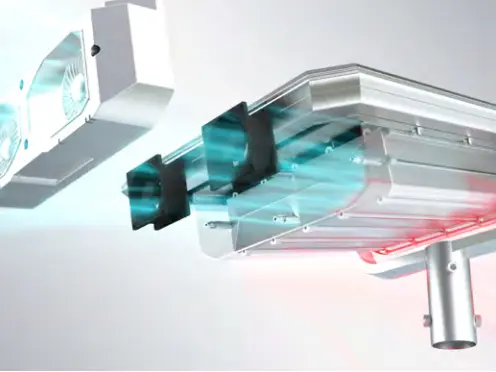
Nigeria’s primary challenge for solar street lights is heat; in northern states, ambient temperatures can exceed 45°C. Sresky’s proprietary TCS intelligent temperature control system uses internal insulation and airflow management to monitor battery temperature in real time, intelligently regulating charge and discharge rates, extending battery life by 30%–58%. Combined with ALS2.4 adaptive lighting technology, the system automatically adjusts lighting schemes based on weather and battery capacity, maintaining stable illumination during 5–7 consecutive rainy days without frequent battery replacement.
The integrated die-cast aluminum housing, combined with IP65 waterproofing and IK08 impact resistance, ensures protection against torrential rains and high humidity in southern Nigeria. Compared to traditional split-system designs, Sresky’s modular design allows rapid installation, reducing labor costs—a critical factor for large-scale projects.
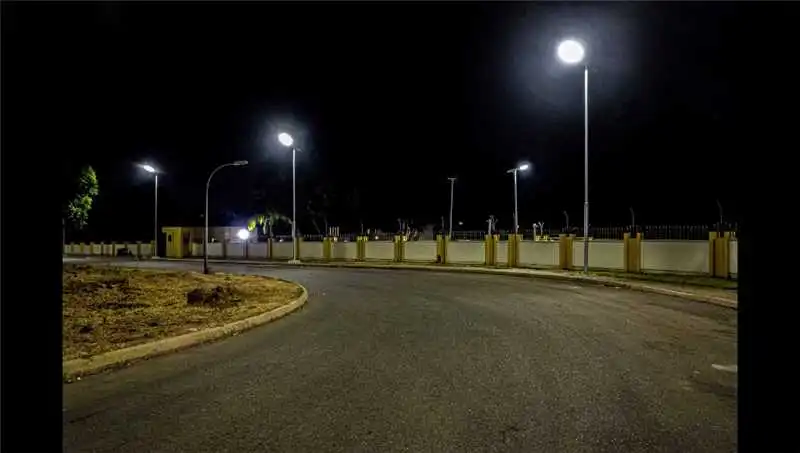
In Nigeria, the Basalt series has been deployed across urban areas, including commercial streets, residential zones, parking lots, and underpasses. Typical deployments, such as the SSL-910 all-in-one solar street lights equipped with TCS and ALS2.4 technology, achieve battery cycle life exceeding 2,000 cycles, enhancing public safety and stimulating nighttime economic activity.
| Core Technology | Problem Solved | Value for EPC Projects |
|---|---|---|
| TCS Temperature Control System | Rapid battery degradation under Nigeria’s 40°C+ high temperatures | Extends battery life, reduces replacement frequency |
| ALS2.4 Adaptive Lighting | Interruptions during prolonged rainy season | Maintains lighting even during 7+ days of rain/overcast |
| IP65/IK08 Protection | Heavy rain, dust, vandalism | Reduces maintenance costs and failure rates |
| Modular Design | Complex installation, high labor costs | 40% faster installation, simplifies overseas construction |
2. Signify (formerly Philips Lighting) — A Leading International Brand
Signify has a long-standing industry presence. Its SunStay Pro gen2 series of integrated solar street lights features lithium iron phosphate batteries, off-grid and hybrid charging options, and an IP66/IK092 protection rating.
The SunStay Pro gen2 series emphasizes circular economy principles, utilizing renewable and recycled materials. Luminous efficacy ranges from 144–158 lm/W, with brightness options from 2,700 to 7,120 lumens. While its market reputation is strong, maximum luminous efficacy is moderate compared to tropical-focused brands. EPC contractors should evaluate suitability based on project-specific factors, including urban proximity and spare part logistics.
3. Sunna Design — Lighting Solutions for Remote Areas
Sunna Design, a French brand, specializes in standalone solar street lights. Its iSSL Maxi Road series provides IP65/IK08 protection and includes the SunnApp remote monitoring system for real-time performance tracking.
In Abuja’s Durumi district, replacement of low-quality Chinese street lights with Sunna’s series improved nighttime brightness and reliability, eliminating extra maintenance costs over a ten-year cycle. Operating from -40°C to +70°C, these lights are well-suited for Nigeria’s harsh climates. Limitations include higher pricing and smaller local distribution networks compared to mainstream brands.

4. JinkoSolar — High-Efficiency PV Modules
JinkoSolar is a global leader in photovoltaic modules, supplying high-efficiency PV panels for initiatives like the World Bank’s “Lighting Africa.” Its monocrystalline silicon modules achieve conversion efficiencies above 22%, allowing smaller arrays while maintaining required backup power, reducing material and installation costs.
However, JinkoSolar is primarily a module supplier. EPC contractors must integrate modules with controllers, batteries, and LED luminaires themselves, requiring engineering coordination and more complex supply chains.
5. Nomo — Integrated Streetlights with Self-Cleaning Solar Street Light Technology
Founded in 2010, Nomo Group specializes in integrated solar streetlights equipped with auto-cleaning functionality—practical for northern Nigeria’s dusty regions (Kano, Katsina). Studies show photovoltaic module output can drop 65–73% without cleaning for 12 months. Nomo’s products have IP67 protection, operate from 5°C to 70°C, and use CATL lithium iron phosphate batteries with a cycle life exceeding 4,000 cycles. Their minimalist design has attracted attention at international solar exhibitions.
Note: Automatic cleaning is not a universal solution. Effectiveness against fine Harmattan dust needs long-term verification. Local service networks and SONCAP status should be confirmed.
Key Evaluation Criteria and Procurement Tips
Before submitting a bid, confirm:
- SONCAP Certification — Mandatory for all regulated products entering Nigeria. Lack of certification risks detention, fines, or customs refusal.
- Technical Data Sheets — Verify operating temperature, battery cycle life at high temperatures, and actual luminous efficacy. Don’t rely on brochures alone.
- Local After-Sales Support — Air freighting replacement parts from China can take 2–4 weeks. Ensure the brand has authorized Nigerian distributors and know lead times for spare parts.
Quick Reference Guide
| Project Type | Recommended Brand |
|---|---|
| Large-scale government/urban arterial road projects requiring durability and customization | Sresky |
| International tenders with strict brand requirements | Signify |
| Remote communities prioritizing zero-maintenance and remote monitoring | Sunna Design |
| Massive projects optimizing costs with high-efficiency components | JinkoSolar |
| Northern regions with severe dust and limited maintenance access | Nomo |
The Nigerian solar streetlight market continues to expand, driven by government initiatives. Contractors who select the right brands and deliver successfully will maximize project outcomes.
Contact our team to request technical data sheets or schedule compliance consulting for your next EPC tender in Nigeria.
Table of Contents