
In Desa Sukamaju, West Java Province, Indonesia, a 1.2-kilometer rural road connects the village office, mosque, elementary school, and night market. For a long time, this road was plunged into complete darkness after 6:00 p.m., forcing villagers to rely solely on their motorcycle headlights for nighttime travel.
Women attending evening prayers, students attending tutoring sessions, and villagers packing up their stalls were all hampered by the lack of lighting. Local contractor CV. Cahaya Nusantara was commissioned by the Village Self-Governance Council (BPD) to find a reliable lighting solution that did not require a grid connection and could withstand the long rainy season, high temperatures, humidity, and insect exposure.
Ultimately, 30 ATLAS Series solar street lights were installed along this village road, comprising a mix of SSL-34A and SSL-36A models. While not a large-scale demonstration project, it exemplifies the “beyond the blueprints” challenges faced in rural solar lighting projects across Southeast Asia, particularly the chronic erosion of internal components caused by environmental factors.
Table of Contents
- Project Overview
- Challenge 1: Ensuring Uninterrupted Nighttime Lighting During the Long Rainy Season
- Challenge 2: Lack of Professional O&M Capabilities in Rural Areas and Harsh Environmental Conditions
- Why Choose the ATLAS Series SSL-34A + SSL-36A Combination?
- Project Outcomes
- Client Feedback
- Frequently Asked Questions
Project Overview
| Project Information | Details |
|---|---|
| Location | Desa Sukamaju, West Java, Indonesia |
| Application | Lighting for rural secondary roads and adjacent sidewalks |
| Product Model | ATLAS Series SSL-34A/36A |
| Number Installed | 30 units, covering 1.2 kilometers |
| Installation Method | Single-side lighting, pole spacing 15–18 meters, height 4–6 meters |
| Client Type | Village government, implemented by local small and medium-sized contractors |
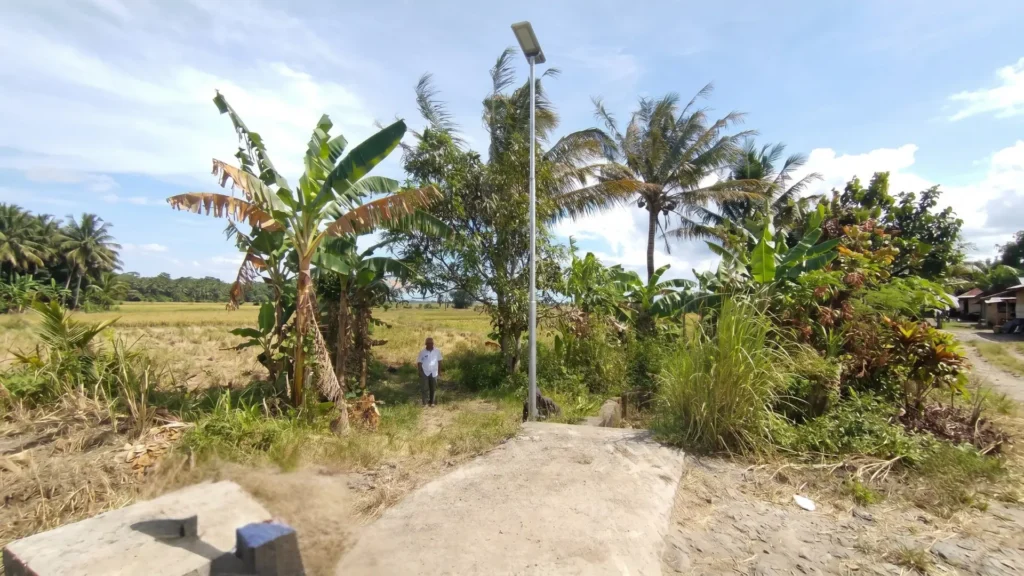
Challenge 1: Ensuring Uninterrupted Nighttime Lighting During the Long Rainy Season
West Java’s rainy season lasts 6–8 months annually, with consecutive overcast days being the norm. For village roads, the greatest risk is not low brightness but streetlights failing after prolonged cloudy and rainy weather. Previously installed conventional solar lights in some villages would lose power after several days of overcast conditions, leaving roads dark during early night hours and compromising villagers’ safety.
Solution: ALS 2.2 Intelligent Energy Management System
The project uses the ATLAS Series equipped with ALS 2.2 intelligent energy management technology. Unlike traditional fixed-power systems, ALS 2.2 automatically adjusts output based on remaining battery charge, prioritizing lighting duration during extended low-light periods rather than maintaining constant brightness.
Even under several consecutive days of low-irradiance conditions, the system maintains basic lighting and prevents outages. For rural roads lacking maintenance personnel, this resilience—ensuring lights “never go out”—is more critical than peak brightness, as it directly impacts villagers’ trust in public infrastructure.
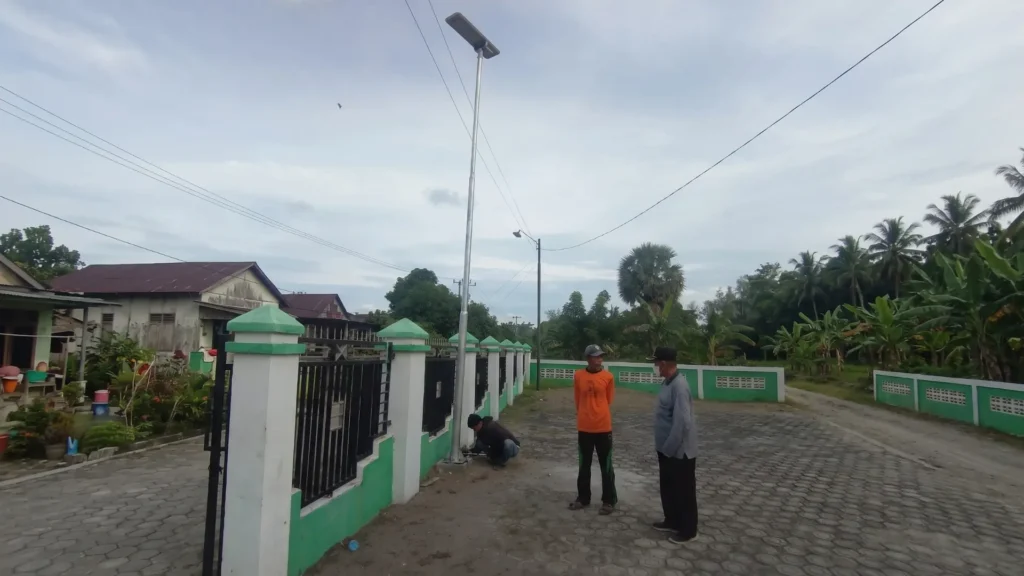
Challenge 2: Lack of Professional O&M Capabilities in Rural Areas and Harsh Environmental Conditions
Desa Sukamaju has no dedicated electrical maintenance team. Malfunctions require waiting for contractors or technicians, resulting in longer repair times than urban projects. The project team’s primary objective was to minimize potential failure points.
Additional challenges included:
- Moisture and Condensation: Diurnal temperature fluctuations cause internal condensation, slowly corroding circuit boards and electronics.
- Insect Infestation and Nesting: Ants and small flying insects can enter lamp housings, causing corrosion, wire damage, or short circuits. Accumulated carcasses can lead to poor electrical contact—common causes of sudden failures in Southeast Asia.
Solution: Integrated Fully Sealed Structure + Physical Barrier Design
The ATLAS Series integrates the solar panel, battery, controller, and LED light source into a single housing, reducing vulnerabilities found in traditional split systems.
Protection measures include:
- Physical Insect Protection: High-density silicone gaskets seal all openings, preventing insect entry. Internal cables use gnaw-resistant insulation.
- IP65-Rated Comprehensive Protection: Fully dust-tight and resistant to low-pressure water jets, protecting circuits from rain and humid conditions.
- Corrosion-Resistant Housing and Easy Maintenance: Aluminum alloy housing resists corrosion. Modular battery design allows replacement on the pole without disassembling the fixture, preserving factory seals.
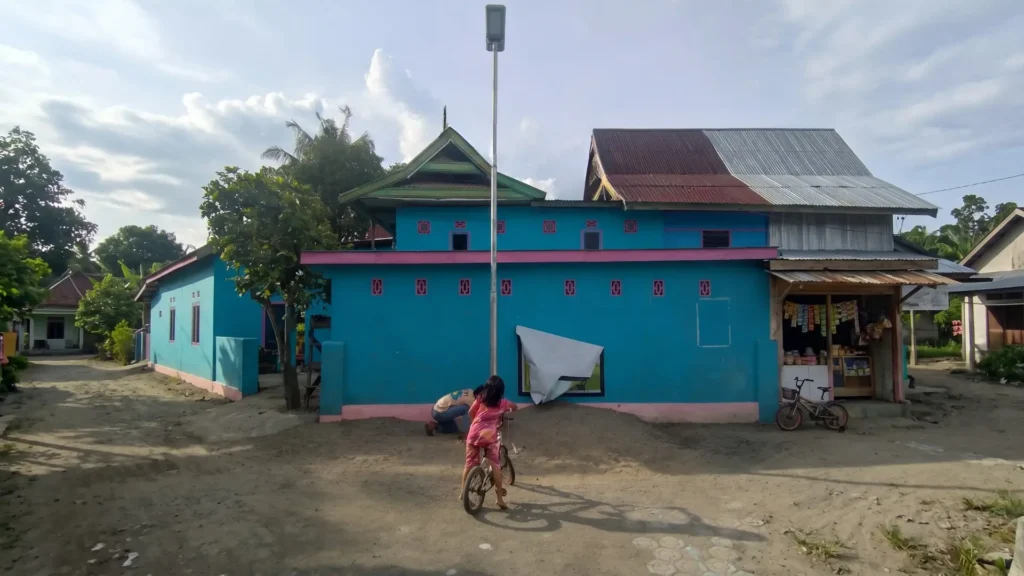
Why Choose the ATLAS Series SSL-34A + SSL-36A Combination?
The 1.2-kilometer road had varying lighting needs:
- Standard Sections: Narrow roads used mainly by motorcycles, bicycles, and pedestrians.
- Key Nodes: Village office, mosque entrances, night markets, and intersections requiring higher illuminance.
A uniform high-power solution would increase costs, while low-power lights would fail in critical areas. The project adopted a mix:
- SSL-34A – Standard sections: Meets basic lighting needs, cost-effective, 4-meter poles spaced 15–18 meters apart.
- SSL-36A – Key nodes: Higher output for intersections, offices, mosques, and night markets, improving safety.
- Budget Optimization: Allocating high-output units only where needed controls costs while ensuring quality lighting.
Project Outcomes
The 30 units illuminate a 1.2-kilometer road, community hall, and a small market. After installation:
- Villagers can travel safely without personal lighting devices.
- No internal wiring failures occurred due to insects or condensation.
- Even during five consecutive overcast days, lights performed without outage.
- The system alleviated concerns that solar lights would not survive a rainy season.
Client Feedback
“We had previously tried solar lights on another village road, but they were out half the time during the rainy season. When we opened the fixtures, we even found ants nesting inside. The ATLAS lights have remained lit consistently in all weather conditions. Even local maintenance staff can adjust modes using the remote, requiring no intervention from us.”
—Rudi, Project Coordinator at CV. Cahaya Nusantara
Frequently Asked Questions
Q1: How many days can solar street lights operate during continuous rainy weather?
The operational duration depends on:
- Battery storage capacity
- Solar panel efficiency
- Intelligent energy management (ALS 2.2)
Conventional fixed-power lights may fail after 3–5 days of continuous rain. The SRESKY Atlas Series automatically adjusts output to prioritize illumination during prolonged low-light conditions. Exact duration depends on local sunlight, luminaire power, and operating mode.
Q2: What is the recommended installation height for rural solar street lights?
| Road Type | Recommended Height |
|---|---|
| Village paths, sidewalks | 3–4 meters |
| Standard rural roads | 4–6 meters |
| Two-lane rural highways | 6–8 meters |
| Township main roads | 8–10 meters |
In this project, SSL-34A is paired with 4-meter poles, SSL-36A with 5–6-meter poles. Proper height ensures uniform illuminance, reduces glare, and controls costs.
Q3: Why are solar street lights better for rural roads than grid-connected lights?
Many rural areas have limited grid coverage, and laying cables is costly. Solar street lights operate independently, offering:
- Easy installation
- Zero electricity cost
- Low maintenance
- Flexible deployment
They are more economical, reliable, and sustainable than grid-connected solutions.