
Amid the global trend toward sustainable development, Australia, a pioneer in environmental protection, is actively promoting the green transformation of urban infrastructure. As a leading provider of solar lighting solutions, SRESKY’s Thermos series self-cleaning solar street lights have become the top choice for urban lighting retrofit projects in Australia, thanks to their exceptional adaptability to extreme environments and intelligent management capabilities. This article provides an in-depth analysis of this real-world case study involving 2,000 streetlights, combining technical specifications and application scenarios to demonstrate how innovative technology can achieve carbon-neutral lighting and enhance urban sustainability.
I. Project Background and Needs Analysis
Australia’s unique geography, featuring vast inland deserts and coastal urban clusters, results in extreme climatic diversity. In line with the Australian government’s climate policies, the country is committed to achieving net-zero emissions by 2050. Major cities such as Sydney, Melbourne, and Brisbane are accelerating the low-carbon transformation of public infrastructure.
Urban lighting systems are major energy consumers. Traditional grid-connected streetlights consume vast amounts of electricity annually and incur high maintenance costs. Data from the Australian Department of the Environment and Energy indicates that public lighting accounts for over 15% of urban energy consumption, making the transition to solar street lights with auto-cleaning function an inevitable trend.
II. Technical Solution Design: The Exceptional Adaptability of the SRESKY Thermos Series
To address Australia’s extreme environmental conditions, the project team selected the SRESKY Thermos series self-cleaning solar street lights. With a brightness range of 4,000–12,000 LM, this series is designed for urban arterial road lighting and integrates multiple patented technologies to ensure stable operation under high-temperature, cold, and rainy conditions. The products feature an aluminum alloy and Panlite PC construction with an IP65/IK08 protection rating, offering exceptional weather resistance.
Core Technology 1: TCS Temperature Control System
The TCS (Temperature Control System) is a signature innovation of the Thermos series, optimized for high-temperature environments.
- High-Temperature Protection: During Australian summers, extremely high surface temperatures can overheat batteries. The TCS monitors battery temperature in real time and automatically stops charging above 45°C to prevent thermal runaway. The battery’s charging temperature range is 0–45°C, and the discharge range is -20–60°C. This design extends lithium-ion battery lifespan and ensures uninterrupted streetlight illumination during heatwaves.
- Automatic Heating Function: A built-in heating plate ensures the battery charges and operates normally at low temperatures. Even in environments as cold as -20°C, the system maintains high-efficiency performance, preventing freezing and failure common in traditional batteries.
Core Technology 2: ALS 2.3 Smart Dimming
ALS (Adaptive Lighting System) 2.3 is SRESKY’s exclusive patent, intelligently adjusting brightness in response to weather changes.
- Extended Battery Life: During prolonged rain or overcast conditions, ALS optimizes power distribution to ensure lighting duration exceeds 10 days. The SSL-72A lithium-ion battery supports 8–9.6 hours of fast charging.
- Multi-Mode Lighting: Supports three modes:
- M1: 30% PIR sensing until dawn
- M2: 100% for first 5 hours + 25% PIR for middle 5 hours + 70% until dawn
- M3: 70% until dawn
These modes flexibly adapt to Australia’s variable sunlight conditions.
Core Technology 3: Ultimate Luminous Efficiency and Light Distribution
- High-Efficiency LEDs: Utilizes OSRAM 3030 LEDs with luminous efficacy up to 230 lm/W, color temperature 4000K, and CRI >70, ensuring soft, natural light. The Type 4 light distribution pattern optimizes street coverage (installation distance 18–54 meters), preventing uneven illumination.
- PIR Sensor: With a 120° detection angle and maximum range of 8m, the system automatically increases brightness when pedestrians or vehicles approach, enhancing energy efficiency and safety.
- Self-Cleaning Feature: The Thermos series integrates solar street light with auto-cleaning function, ensuring solar panels remain free of dust and debris, maintaining high energy efficiency with minimal maintenance.
III. Project Implementation and Deployment
From equipment selection to installation, the project prioritized efficiency and safety, ensuring minimal urban traffic disruption.
- Equipment Selection: Based on a 6-meter installation height, the primary models were SSL-72A (4,000 LM, height 4 m / coverage 18 m) and SSL-73A (6,000 LM, height 6 m / coverage 27 m). Higher-lumen models (SSL-74A to SSL-76A) supplemented lighting on main roads.
- Installation Process:
- Bracket Mounting: Adjustable brackets (0°–180°) optimize solar panel orientation for Australia’s abundant sunlight.
- Luminaire Installation: Mounted on a Φ60mm pole and aligned via manual or mechanical hoisting, then secured with screws. Integrated design eliminates wiring, allowing installation in minutes.
The deployment of 2,000 streetlights was rapid and efficient, minimizing traffic disruptions.
IV. Project Outcomes and Impact
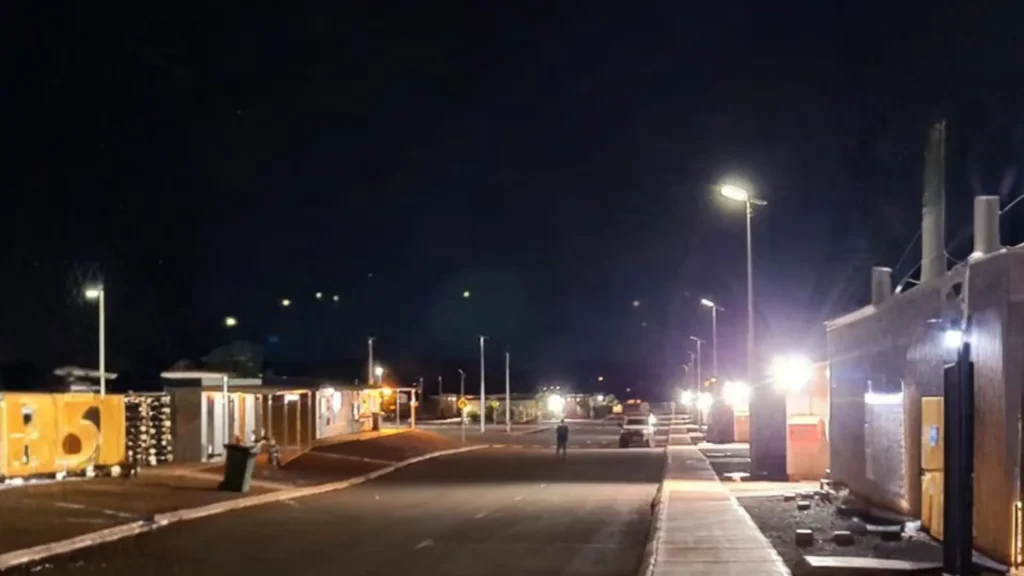
Following implementation, Australia’s urban lighting achieved a qualitative leap, providing visual, safety, environmental, and economic benefits.
- Enhanced Aesthetics and Safety:
- Serene Beauty: The Thermos series’ sleek, modern design blends seamlessly with urban landscapes. Light is evenly distributed, eliminating glare common with traditional streetlights.
- Community Safety: PIR sensors increase brightness when pedestrians pass. Combined with Type 4 distribution, streets and sidewalks enjoy full coverage. Residents report increased nighttime safety, and crime rates have declined.
- Environmental Benefits:
Powered entirely by solar energy, the 2,000 streetlights save millions of kWh annually, reduce carbon emissions by thousands of tons, and support Australia’s carbon neutrality goals. The solar street light with auto-cleaning function ensures that panels remain efficient throughout the year, further enhancing environmental benefits. - Smart Upgrades:
Remote monitoring allows city administrators to optimize lighting modes in real time, with projected annual maintenance cost savings exceeding 20%. The project has become a benchmark for Australian smart cities, inspiring other regions to follow suit.
Conclusion
This urban energy-saving renovation project represents not only a lighting technology upgrade but also a deep implementation of smart city and sustainable development concepts. The SRESKY Thermos series, with its robust performance in extreme environments and integrated self-cleaning solar street light technology, has once again proven to be the preferred solution for urban lighting projects worldwide.