
In the coastal areas of the Lima Metropolitan Area in Peru, environmental conditions such as high humidity, salt fog (locally known as “garúa”), and prolonged periods of low sunlight during winter pose severe challenges to outdoor lighting infrastructure.
A large commercial parking lot serving retail and industrial users in a coastal business district previously faced the following recurring issues with its traditional grid-connected lighting system:
- Salt-laden air caused frequent corrosion of metal components
- Increasing maintenance frequency and operating costs
- Unstable nighttime lighting performance
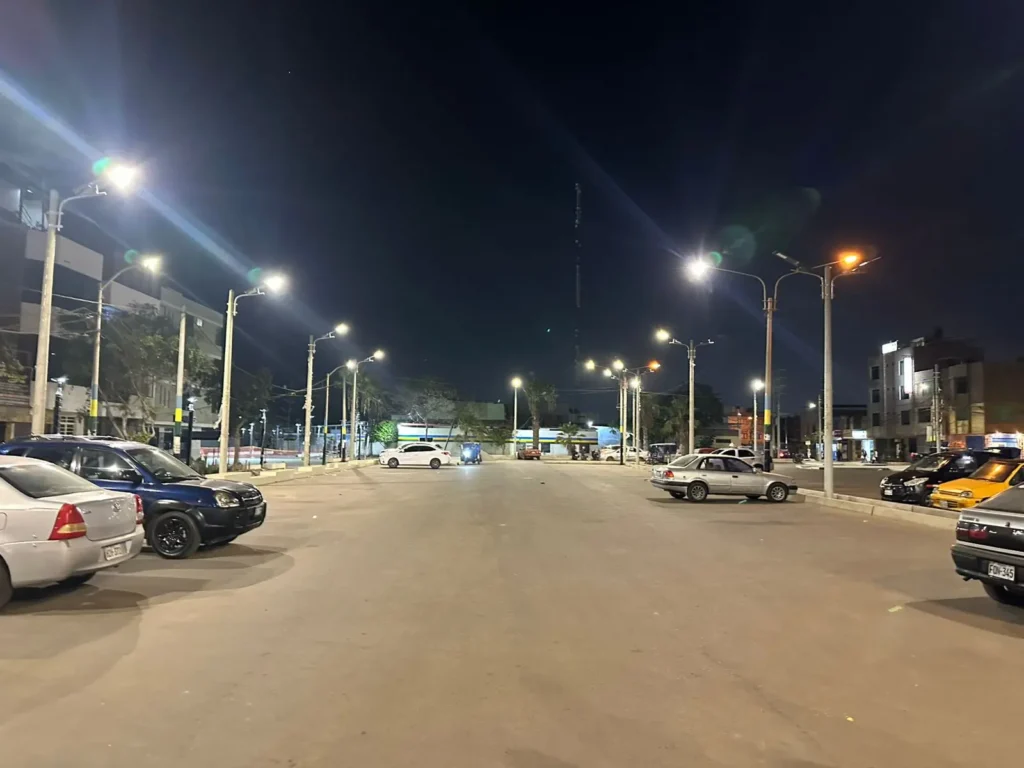
To address these issues, the operator decided to switch to an off-grid solar lighting system, adopting the Basalt Series SSL-910 solar street lights and deploying a total of 30 units throughout the parking lot area.
Table of Contents
- Project Details
- Key Challenges Facing Solar Lighting in Peru’s Coastal Regions
- Technical Solution: How the Basalt Series SSL-910 Addresses Key Challenges
- Project Results – Real-World Coastal Performance
- Customer Feedback
- Frequently Asked Questions (FAQ) – Solar Street Lights in Coastal and Low-Sunlight Areas
Project Details
| Item | Details |
|---|---|
| Project Location | Coastal commercial district, Lima Metropolitan Area, Peru |
| Application | Commercial parking lot (outdoor open area) |
| System Type | Off-grid solar streetlight system |
| Model Used | Basalt Series SSL-910 |
| Number Deployed | 30 units |
| Natural Environment | High humidity + coastal salt fog |
This project serves as a typical example of solar streetlight application in a low-solar-radiation coastal environment, where corrosion resistance and energy reliability are critical.
Key Challenges Facing Solar Lighting in Peru’s Coastal Regions
1. Salt Fog Corrosion in High-Humidity Coastal Environments
Lima’s coastal climate is characterized by relative humidity exceeding 80%, accompanied by seasonal dense fog (“garúa”) containing microscopic salt particles. This environment accelerates:
- Electrochemical corrosion of exposed metal components
- Oxidation of electrical connectors
- Failure of traditional wiring systems
Why Do Traditional Lighting Systems Fail?
Grid-powered lighting systems typically rely on external wiring, junction boxes, and standalone distribution cabinets. These components are highly susceptible to corrosion in salt fog environments, leading to frequent maintenance and system downtime.
2. Low Solar Irradiance and Extended Nighttime Lighting Requirements
During Lima’s winter:
- Solar irradiance is significantly reduced due to persistent garúa
- Parking lots require lighting for more than 12 consecutive hours at night
Despite reduced charging conditions, energy demand remains high. Traditional solar lighting systems often struggle under these conditions, resulting in insufficient battery charging during prolonged overcast periods, premature nighttime power depletion, and a lack of adaptive energy management.
3. Safety Risks in Public Parking Lot Infrastructure
In semi-open commercial environments:
- Externally mounted batteries are vulnerable to theft
- Frequent maintenance increases operational risks
- Exposed components reduce overall system reliability
Technical Solution: How the Basalt Series SSL-910 Addresses Key Challenges
To overcome these issues, the project adopted the Basalt Series SSL-910 integrated solar lighting system, specifically designed for coastal, high-humidity, and off-grid environments.
1. Corrosion-Resistant Integrated Structure
The system features a die-cast aluminum integrated housing with:
- Fully sealed structural design
- No external wiring or exposed junction boxes
- Fewer mechanical connection points where moisture can enter
This significantly reduces the risk of salt fog intrusion and long-term corrosion.
2. Fully Integrated Internal Components
All core components—including the battery, controller, and wiring connections—are fully enclosed within the luminaire.
Benefits: Eliminates external battery boxes, reduces maintenance points, and improves durability in coastal environments.
3. Intelligent Energy Management for Low-Sunlight Conditions
To ensure stable operation during winter low-light conditions, the system uses an intelligent PIR-based dimming strategy:
- Equipped with a 120° wide-angle PIR sensor
- Operates at 25–30% brightness in low-power mode when no activity is detected
- Instantly switches to 100% brightness when movement is detected
This adaptive strategy reduces energy consumption by up to 50%, significantly extending nighttime runtime.
4. Ultra-Long Battery Backup for Continuous Operation
The system is equipped with a high-capacity battery (346–461 Wh), capable of:
- Up to 10 days of backup operation during cloudy or rainy periods
- Stable performance during extended low-sunlight conditions
- Fully off-grid operation independent of the municipal power supply
5. Integrated Anti-Theft Design
Unlike split-type systems, this product has no external battery compartments or removable control modules. The fully sealed structure significantly reduces theft risk in unattended commercial parking lots.
Project Results – Real-World Coastal Performance
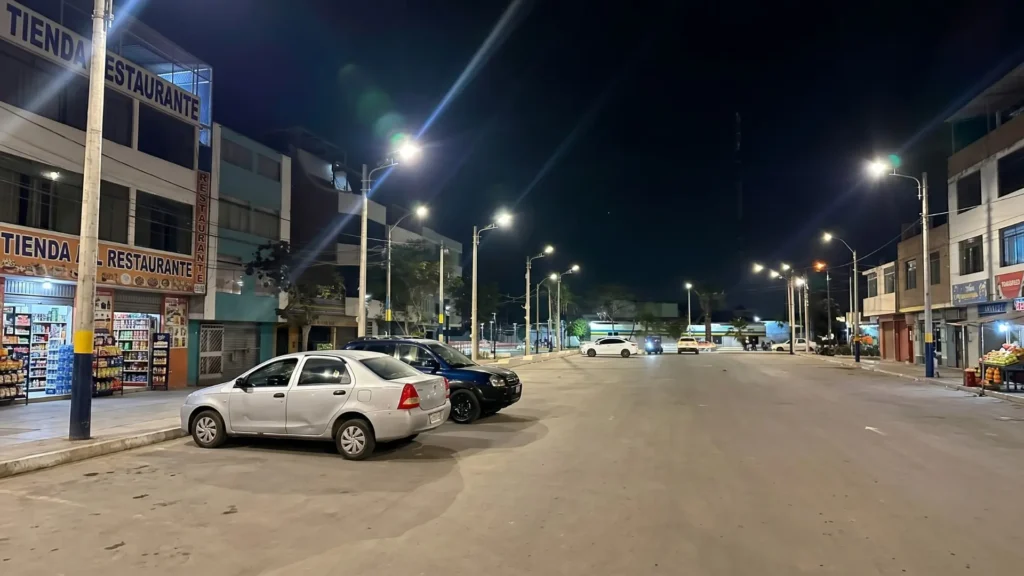
After 12 months of operation, the project achieved the following results:
- Stable off-grid lighting across the entire parking lot
- No interruptions during the winter fog season
- No visible corrosion or structural degradation
- Significantly reduced maintenance frequency compared to the previous grid-powered system
- Reduced dependence on external power infrastructure
Customer Feedback
“The most noticeable improvement is the significant reduction in maintenance frequency. Corrosion issues that previously required frequent attention are now virtually nonexistent. Nighttime lighting stability has also improved significantly; we no longer have to worry about power outages.”
— Operations Manager, Parking Facilities, Lima Coastal Business District
Frequently Asked Questions (FAQ) – Solar Street Lights in Coastal and Low-Sunlight Areas
Q1: What is the biggest maintenance challenge for solar lighting in coastal parking lots?
A: Many people assume it is battery life. In reality, the most common issues in coastal environments are:
- Salt fog accumulation
- Dust and pollutant buildup
- Corrosion at connection points
- Reduced solar panel efficiency
Therefore, during the design phase, greater emphasis is placed on corrosion resistance, sealing performance, easy maintenance, and long-term O&M costs rather than only initial brightness.
Q2: Are solar street lights suitable for large commercial parking lots?
A: Yes. Parking lot lighting typically requires:
- Long nighttime operation
- Wide-area illumination
- Low operating costs
- Simple maintenance
With sufficient solar resources and a well-designed system, solar street lights can provide a stable off-grid lighting solution while reducing dependence on the grid.
Q3: Can solar street lights still function during Lima’s winter “garúa” season?
A: Yes, provided the system has sufficient energy storage and intelligent energy management.
Although rainfall is limited, persistent fog reduces solar irradiance. Key design considerations include:
- Battery capacity
- Solar panel sizing
- Intelligent dimming strategies
- System endurance
The adaptive sensor-based dimming system in this project reduces energy consumption during low-activity periods, helping maintain stable operation under low irradiance conditions.
Conclusion
This project demonstrates that solar street lighting is a highly effective solution for coastal parking lots in Peru, particularly under conditions of high salt fog exposure, low winter solar radiation, and high nighttime usage demand.
Through integrated corrosion-resistant design and intelligent energy management, solar lighting systems can deliver stable, low-maintenance, and cost-effective outdoor lighting for commercial infrastructure.