
When working on infrastructure projects in Mauritius, consultants from Europe and the United States often make a critical miscalculation. They focus on equipment unit prices in Excel spreadsheets while overlooking the island’s “hidden logistics costs”: shipping delays that can stretch for months, high labor costs for skilled technicians, and the operational cost of simply waiting for replacement parts to arrive.
The procurement team for the Black River District coastal highway project raised a highly practical question early in the bidding process:
“We don’t want to carry out major maintenance over the next 10 years. Can your streetlights withstand everything here?”
“Everything here” refers not only to the Indian Ocean’s high temperatures, salt spray, and cyclones, but also to a less obvious threat that has damaged countless outdoor electrical systems—large flocks of birds and their highly corrosive droppings.
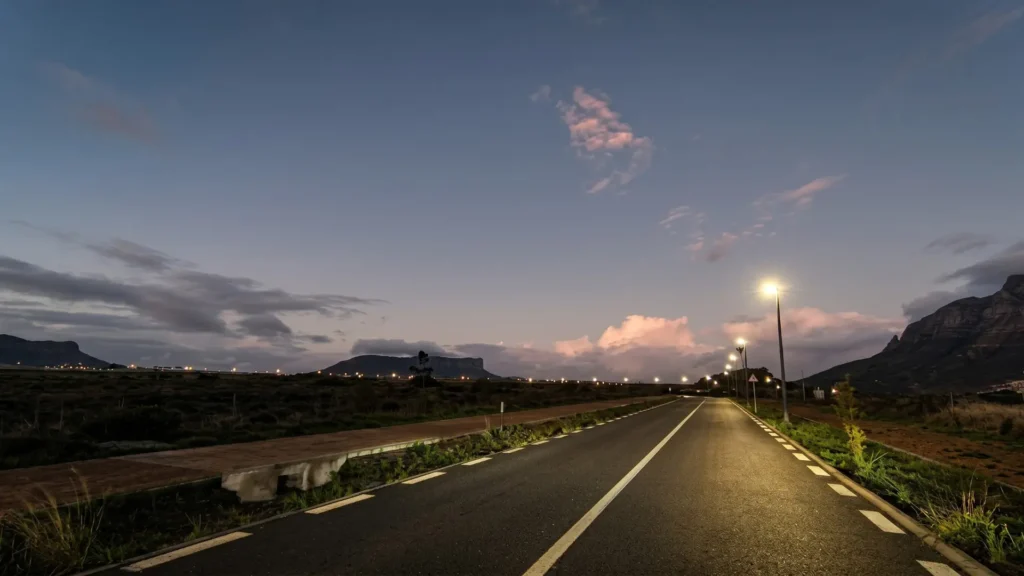
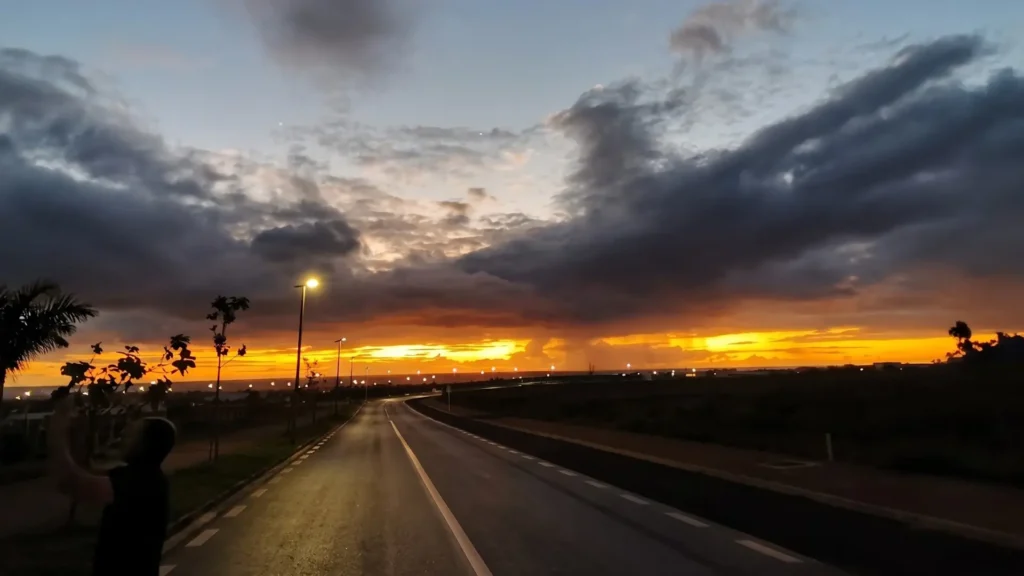
This coastal road connects Flic en Flac and Black River and serves as one of the region’s key transportation arteries. After multiple rounds of technical evaluations and on-site testing, the project ultimately selected 100 sets of Sresky THERMOS Series integrated solar street lights to meet the road’s long-term operational requirements.
Table of Contents
- Project Details
- Three Major Engineering Challenges and Advanced Solutions
- Project Operation Status
- Client Testimonial
- Frequently Asked Questions (FAQ)
Project Details
| Item | Details |
|---|---|
| Location | Coastal Arterial Road, Black River District, Mauritius |
| Application Scenario | Continuous roadway lighting in high salt-fog and high bird-activity environments |
| Product Used | Sresky THERMOS Series SSL-74A/75A |
| Installation Scale | Approximately 100 units, covering 3.5–5 kilometers |
| Client Type | Municipal Road Department / Local Engineering Contractor |
| Lighting Objective | Stable overnight lighting with no major maintenance requiring the lamp housing to be opened for 10 years |
Three Major Engineering Challenges and Advanced Solutions
Streetlight failures are rarely caused by a single catastrophic issue. More often, they result from small problems accumulating over time. In this project, three major environmental challenges had to be addressed simultaneously.
Challenge 1: Tropical Heat Causing “Slow Battery Death”
The west coast of Mauritius experiences intense solar exposure year-round. Under direct sunlight, the internal temperature of the luminaires can become significantly higher than the surrounding air temperature.
Many conventional solar streetlights still use standard PWM controllers with fixed-voltage charging logic. Under prolonged high-temperature conditions, batteries are continuously overcharged, causing electrolyte evaporation and accelerated aging. Within 18 months, brightness often drops dramatically during the early morning hours, or the lights fail completely.
For a multi-kilometer municipal roadway, the labor and logistics costs associated with large-scale battery replacement can quickly exceed the cost of the batteries themselves.
THERMOS Series Solution: TCS Thermal Management System
The built-in TCS (Thermal Charging System) in the THERMOS Series is not simply a protective feature—it is an active battery lifespan management system.
The controller continuously monitors battery surface temperature. When temperatures become excessively high, the charging current is automatically reduced. Once the battery cools down, efficient charging resumes.
For project owners, this means battery lifespan can be extended from the typical 3–5 years to approximately 8–10 years, effectively eliminating one of the largest hidden maintenance costs throughout the project lifecycle.
Challenge 2: Dual Corrosion from Salt Fog and Bird Droppings
Coastal regions are naturally exposed to salt fog, but this project faced an additional challenge: large numbers of birds gathering along the waterfront corridor.
Streetlight housings, solar panel frames, and lamp arms quickly became favored perching locations.
Bird droppings create two major forms of damage:
- Physical Blockage and Hot Spot Formation
Dried droppings on solar panels behave like opaque coatings, blocking sunlight and causing localized solar cell failure. Over time, this creates irreversible hot spots that reduce panel performance. - Chemical Corrosion
Bird droppings are highly acidic and can rapidly corrode protective coatings and aluminum alloy components. If structural designs allow contaminants and rainwater to accumulate together, corrosion accelerates dramatically.
A luminaire that might normally survive five years in a salt-fog environment could fail within only three years when combined with constant bird contamination.
Traditional cleaning methods are simply impractical. Assigning workers to manually clean several kilometers of coastal roadway every few days would be expensive, inefficient, and unsafe.
THERMOS Series Solution: Mechanical Self-Cleaning + Anti-Accumulation Structural Design
Active Protection: Mechanical Self-Cleaning Brush System
The automatic brush system integrated into the THERMOS Series is designed for real operational use—not cosmetic marketing.
The system performs scheduled cleaning cycles similar to windshield wipers, using silicone scrapers to remove dust, salt crystals, and fresh bird droppings from the panel surface.
This significantly reduces the need for manual cleaning and makes routine inspections far more manageable.
Passive Protection: Fully Sealed and Hydrophobic Structural Design
The luminaire housing features a fully sealed structure with minimal exposed surfaces where birds can perch.
Even when contaminants land on the fixture, the smooth hydrophobic exterior and corrosion-resistant materials allow rainwater to wash away residues more effectively, preventing long-term buildup and corrosion.
This is a practical example of using industrial design principles to solve biological contamination challenges.
Challenge 3: Salt Mist and Fine Dust Causing Gradual Efficiency Loss
This issue is even more difficult to detect than bird droppings.
Coastal air contains microscopic salt particles and traffic dust that gradually form a thin layer over the solar panels. During long dry periods without rainfall, charging efficiency can decline by 15%–20% without being immediately noticeable.
Because the performance decline happens slowly, maintenance teams often struggle to determine whether reduced lighting duration is caused by battery aging or panel contamination.
THERMOS Series Solution: Continuous Automated Cleaning
The same automatic brush system used to remove bird droppings also continuously removes fine salt deposits and dust buildup.
This transforms panel cleaning from a periodic maintenance task into a built-in daily operating routine.
After more than one year of operation, the system’s power generation efficiency has remained remarkably stable. For a roadway spanning nearly 5 kilometers with luminaires spaced 36 meters apart, this translates into measurable savings in labor hours, vehicle usage, and maintenance costs.
Project Operation Status
Since commissioning, the project has successfully endured three full rainy seasons.
On-site feedback has been exactly what long-term infrastructure managers hope for: uneventful and stable operation.
There have been no large-scale nighttime outages, and the automatic cleaning system has effectively transformed maintenance personnel from “monthly cleaning crews” into “annual inspection teams.”
Routine inspections now require little more than visual confirmation during regular drive-by checks.
Client Testimonial
“We installed lights from another brand on a different road in the district, and problems started appearing within the first year. This road has remained trouble-free so far. We no longer need to clean the panels every few weeks, which has significantly reduced our workload.”
— Infrastructure Project Coordinator, Black River District
Frequently Asked Questions (FAQ)
Q1: What maintenance challenges do solar street lights face in coastal and island environments?
In coastal and island environments, the primary threats to long-term solar streetlight performance include salt-fog corrosion, bird droppings, dust accumulation, pollen, and traffic-related particulate pollution.
These contaminants gradually reduce solar panel light transmittance and power generation efficiency.
Bird droppings are especially problematic because they not only block sunlight but can also create localized hot spots. Long-term accumulation may also accelerate coating degradation and metal corrosion.
For island infrastructure projects like those in Mauritius, minimizing maintenance caused by panel contamination is essential for ensuring stable long-term performance.
Q2: Does coastal salt fog affect the lifespan of solar street lights?
Yes. Salt fog accelerates corrosion on lamp housings and gradually forms deposits on solar panel surfaces, reducing charging efficiency and lighting performance.
For coastal solar lighting projects, corrosion-resistant structural design and contamination resistance are among the most important factors affecting long-term maintenance costs.
Q3: How can rapid battery degradation in solar street lights be prevented?
High temperatures can cause batteries to degrade rapidly due to continuous overcharging, often leading to lights shutting off during the early morning hours within 18–24 months.
The Sresky THERMOS Series includes a built-in TCS thermal charging system that dynamically adjusts charging parameters according to battery temperature. This prevents high-temperature overcharging, significantly extends battery lifespan, and reduces the large-scale replacement costs commonly associated with municipal roadway projects.