
Project Overview
In Chile’s Valparaíso Region, coastal road lighting faces a dual challenge that is fundamentally different from inland environments.
The region is continuously exposed to Pacific salt fog, high UV radiation, and significant daily temperature fluctuations. For municipal maintenance teams, the greatest cost associated with street lighting is often not the initial installation, but the long-term maintenance that follows. In addition, Chile’s “Dark Sky Law”—which regulates light pollution and protects astronomical observation conditions—imposes extremely strict requirements on outdoor lighting systems.
On this 12-kilometer road connecting several coastal towns, the existing grid-connected street lighting system had been in operation for many years. The equipment had aged and no longer complied with updated environmental regulations. In 2025, the local municipal engineering department decided to upgrade the lighting system along this corridor and ultimately selected the SRESKY ATLAS series of solar street lights (custom-designed via professional ODM), deploying a total of 120 units.
Table of Contents
Project Details
| Item | Details |
|---|---|
| Location | Chilean coast, Valparaíso Region |
| Client | Local municipal government (Municipalidad) |
| Application | Road lighting for urban–rural connecting routes |
| Product Series | SRESKY ATLAS SSL-310A |
| Number Installed | 120 units |
| Road Length | Approximately 12 kilometers |
| Natural Environment | High UV radiation, coastal salt fog, moderate temperature fluctuations |
| Special Regulatory Requirements | Strict anti-glare cutoff design; 2200K color temperature (implemented as 1800K amber light); blue light content < 1% |
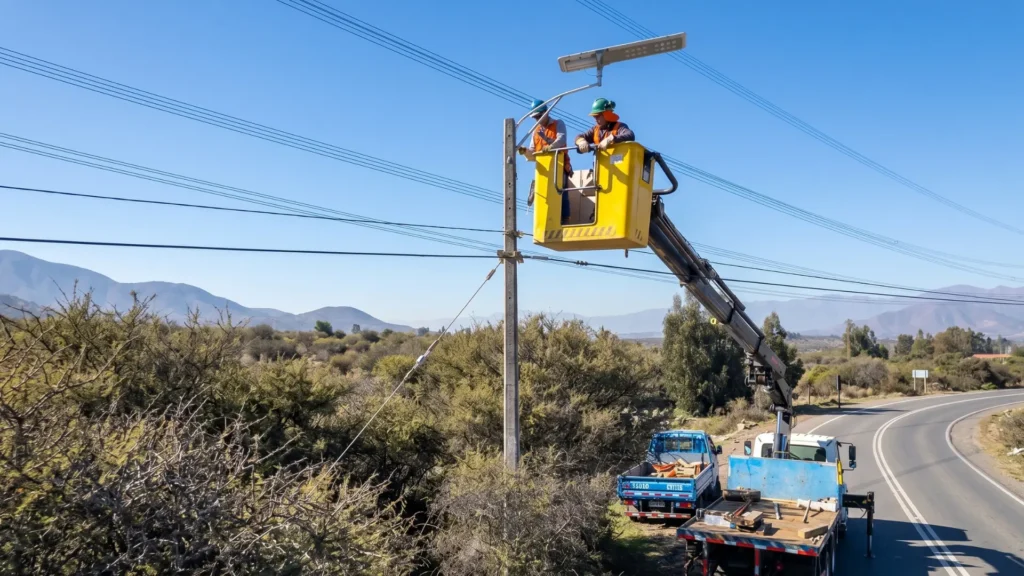
Why Do Traditional Streetlights Fail Easily in Coastal Environments?
Coastal municipal roads are exposed to multiple overlapping environmental stress factors that significantly shorten lighting system lifespan. In traditional grid-powered streetlights, these issues typically appear within 18–24 months and manifest as:
- Salt fog corrosion (C5-level coastal corrosion environment), accelerating oxidation of metal housings and connectors and leading to structural failure
- High UV radiation, causing degradation and aging of sealing materials and protective coatings
- Frequent temperature fluctuations, creating thermal stress on batteries and internal electronic components
For municipal operators, this shifts infrastructure investment from a one-time capital expense into a long-term operational burden.
Core Engineering Challenges and Customized Solutions
Challenge 1: Long-Term Durability Under Complex Coastal Conditions
The key concern was not whether the system could operate after installation, but whether it could remain stable after 2–3 years of continuous coastal exposure.
Along the Chilean coast, corrosion and material aging occur simultaneously rather than independently: salt fog gradually erodes metal structures, UV radiation weakens sealing materials, and temperature fluctuations stress battery electrochemical stability.
Solutions from the SRESKY ATLAS Series
The SRESKY ATLAS system is designed with a focus on system-level resilience rather than isolated component protection:
- Corrosion-resistant aluminum alloy housing with anti-corrosion surface treatment
- IP65-rated sealed structure optimized for coastal environments
- Structural design adapted for C5 high-corrosion conditions
- Integrated TCS thermal management system to stabilize battery temperature under extreme fluctuations
- High-efficiency monocrystalline solar panels combined with MPPT controllers for stable energy harvesting
This integrated design extends autonomous operation capability in environments with limited maintenance access.
Challenge 2: Compliance with Chile’s Strict “Dark Sky” Regulations
Chile hosts some of the world’s most important astronomical observatories, leading to extremely strict light pollution regulations for outdoor lighting systems. During technical review and procurement discussions, municipal engineers specified stringent requirements:
- Ultra-low color temperature: Must not exceed 2200K; ultimately implemented at 1800K ultra-warm amber light
- Blue light control: Blue light content must be < 1%
- Strict cutoff design (zero upward light): No upward or lateral light leakage is permitted
Additionally, the rear of the solar panel must be fully black and non-reflective. Except for the LED emission core, all other lens areas are masked using precision coating to eliminate stray light.
SRESKY ODM Customization Solution
To meet Chile’s regulatory requirements, the SRESKY R&D team fully customized the ATLAS series:
- 1800K exclusive spectral configuration: Uses specially designed low-color-temperature, high-efficiency LED chips to strictly control blue light below 1% at the source while maintaining acceptable road visibility
- Full light-blocking structural design: Precision masking is applied to optical components, combined with a fully black, non-transmissive solar backplate, ensuring zero upward or lateral light leakage and full compliance with Dark Sky certification requirements
Project Outcomes: From “Frequent Repairs” to “Stable Operation”
After completion, the 12-kilometer coastal corridor achieved stable and continuous nighttime lighting coverage.
Field measurements confirmed that the customized 1800K lighting system fully complies with Chile’s Dark Sky regulations, with blue light emission significantly below permitted thresholds.
Operational feedback indicates that the failure rate in the coastal environment is substantially lower than that of the previous grid-powered system. After months of exposure to Pacific salt spray, no major clustered failures or significant corrosion issues have been observed.
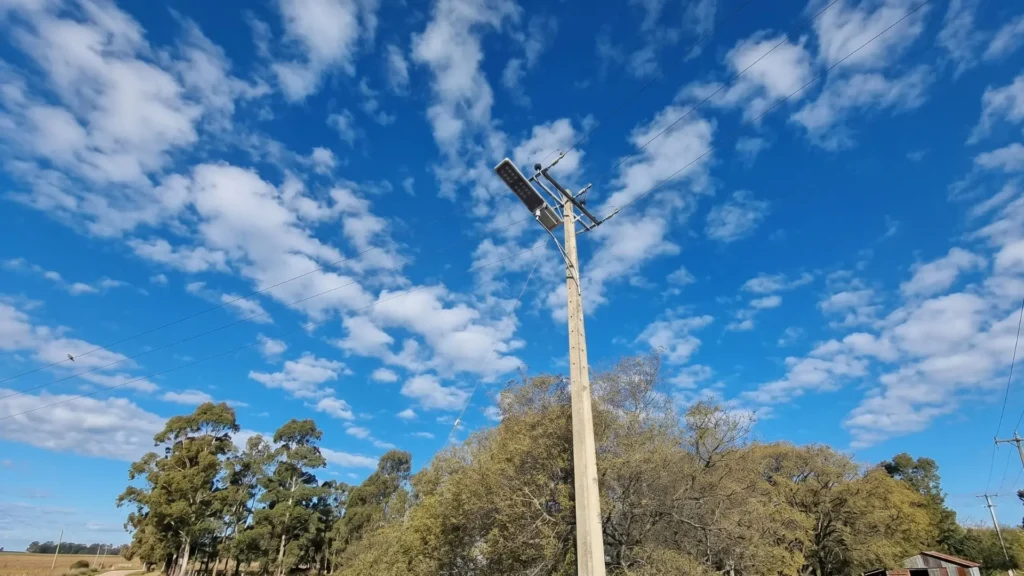
Customer Feedback
“This road is the main connection between several small towns. The old lighting system was expensive to operate, difficult to maintain, and no longer compliant with our updated dark sky regulations. After switching to SRESKY customized solar streetlights, we eliminated electricity costs and successfully passed environmental inspections. The 1800K warm light penetrates sea fog very well, and the lamp housings show no signs of corrosion so far. The ODM customization capability has been extremely valuable for us.”
— On-site Project Manager, Department of Municipal Engineering, Valparaíso Region, Chile
Frequently Asked Questions (FAQ): Solar Street Lights in Coastal Environments
Q: What impact do Chile’s “Dark Sky” regulations have on solar street lights?
A: In regions near astronomical observatories, regulations require color temperatures below 2200K (typically 1800K–2000K amber light) and blue light content under 1%. Lighting must also have a strict cutoff design with zero upward light emission.
Q: What are the maintenance requirements for municipal solar streetlight systems?
A: Maintenance is generally limited to modular replacements such as LED modules, batteries, or controllers. Well-designed systems reduce the need for full fixture replacement and minimize high-altitude maintenance work.
Q: What is the most commonly overlooked risk in coastal solar lighting projects?
A: The most underestimated factor is long-term combined environmental stress, including salt fog corrosion, UV aging, and thermal cycling. If not addressed at the design stage, these effects accumulate over 2–3 years and significantly reduce system reliability.
Conclusion
The Valparaíso Region project demonstrates that the success of modern municipal street lighting depends not only on brightness or initial cost, but on long-term reliability in harsh environments and the ability to meet strict local environmental regulations.
By integrating corrosion-resistant structures, a fully shielded dark-sky design, ultra-low 1800K color temperature lighting, and a modular maintenance strategy, SRESKY delivers a more sustainable and regulation-compliant solution for coastal roads and astronomical protection zones.