
SRESKY has delivered 2,000 Atlas solar street lights for a highway project by the Philippine Department of Public Works and Highways (DPWH). This article details how the product passed dual tests—withstanding typhoons at 180 km/h and high-grade salt fog resistance—to achieve an outstanding performance of zero structural failures and 99% availability over 18 months in a dual-arm installation scenario on a coastal median strip, setting a new technical benchmark for coastal infrastructure lighting.
Table of Contents
- Project Overview
- Why Half the Bidders Were Immediately Eliminated
- Key Points—Technical Specifications for Coastal Solar Lighting
- Median Strip Configuration: Efficiency and Complexity Coexist
- 18-Month Performance Results
- Evaluation by Public Works Department Field Engineers
- Implications for Similar Coastal Infrastructure Projects
When the Cebu Regional Office of the Philippine Department of Public Works and Highways (DPWH) began evaluating solar lighting solutions for the Southern Coastal Highway, engineers had one overriding requirement: these street lights must continue to operate throughout typhoon season—not merely “survive” it. Before on-site testing even began, three out of four competing products were eliminated.
Project Overview
| Specifications | Details |
|---|---|
| Location | Southern Coastal Highway, Cebu, Philippines |
| Client | Department of Public Works and Highways (DPWH), Philippines |
| Quantity | 2,000 units |
| Product | Atlas SSL-310A Integrated Solar Street Light |
| Pole Height / Configuration | 10 meters, dual-arm median installation |
| Key Challenges | Coastal salt fog corrosion + typhoon wind loads (180 km/h) |
| Core Technologies | ALS 2.2 Adaptive Lighting System, TCS Battery Management, BMS Charging Management |
| Contract Duration | 14 weeks (three-phase installation) |
| Monitoring Period | 18 months post-installation |
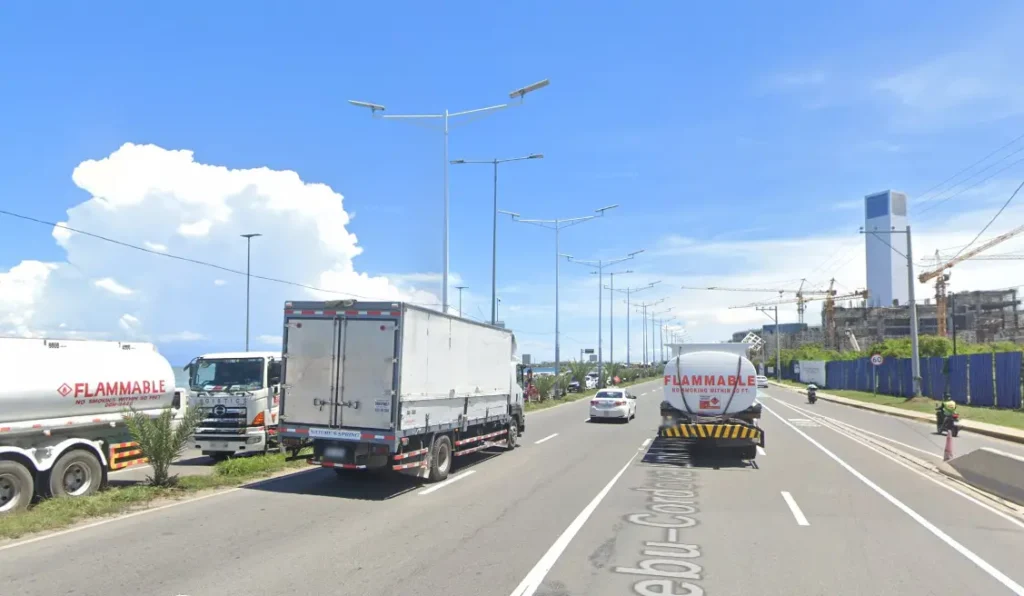
Why Half the Bidders Were Immediately Eliminated
The Southern Coastal Highway runs along the southwest coastline of Cebu. The installation site is less than 500 meters from open water—exposing the system to salty air, constant wind, and a typhoon season with historically sustained wind speeds exceeding 150 km/h.
The DPWH set two non-negotiable technical thresholds:
- Salt Fog Corrosion Resistance: Compliance with IEC 60068-2-52 Class Kb test requirements, with corrosion propagation not exceeding Grade 1 (per ISO 4628-8) after 96 hours of continuous salt fog testing. The SSL-310A’s dual-layer process—internal phosphating plus electrostatic powder coating—passed the test. Single-layer coating products did not.
- Typhoon Wind Loads for Specific Configurations: Designed for wind speeds of 180 km/h and validated in a dual-arm median strip configuration. This eliminated a bidder that had only tested single-arm roadside installations. Eccentric loads on two oppositely oriented arms create fundamentally different structural stress distributions—data from one configuration cannot be directly applied to another.
Key Points—Technical Specifications for Coastal Solar Lighting
- Single-layer powder coating is not suitable within 500 meters of tropical coastlines. Surface oxidation is expected within 8–12 months.
- Wind load testing must match the actual installation configuration (single-arm roadside ≠ double-arm median strip).
- For typhoon-prone areas in the Philippines, the minimum design wind speed should be 180 km/h according to DPWH structural standards.
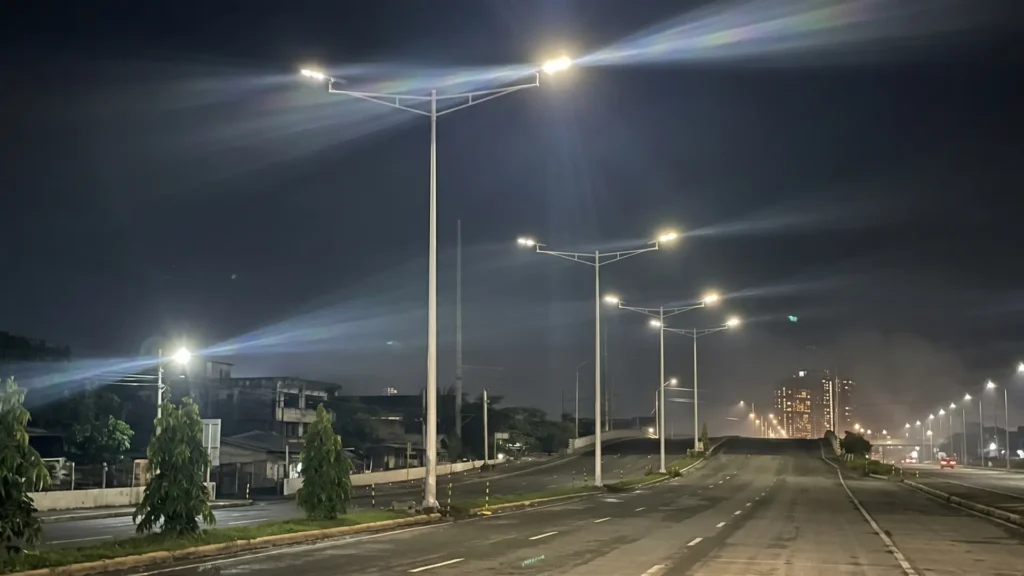
Median Strip Configuration: Efficiency and Complexity Coexist
Instead of installing single-arm poles alternately along each roadside, this project employs 10-meter-high median poles with dual arms—each pole providing one luminaire for each direction of traffic. Compared to a single-arm roadside layout, this reduces the total number of poles by approximately 40% and relocates luminaires away from the road shoulder—where vehicle collisions caused by storm debris pose significant operational risk.
The trade-off: optimizing the angle of the solar panels became even more critical. Each SSL-310A panel was set to face 15° east of south. Shading analysis confirmed that, given Cebu’s annual solar trajectory (10.3° N), there was no mutual shading between the two panel arrays.
18-Month Performance Results
| Metric | Result |
|---|---|
| 6-Month Luminaire Availability | 99.1% |
| 18-Month Fixture Availability | 98.6% |
| 18-Month Battery Capacity Retention | 94.3% of rated capacity |
| Comparison of TCS-Equipped vs. Non-TCS Units (Same Period) | 20.2% reduction in capacity degradation |
| Structural / Corrosion Failures | 0 |
| Units Requiring Replacement | 3 (damaged by vehicle impact; not product-related) |
The 1.4% unavailability rate at 18 months breaks down as follows: 19 units with controller firmware issues (resolved remotely), 6 units with PIR sensors requiring cleaning due to dust accumulation, and 3 units with physical damage caused by vehicle accidents.
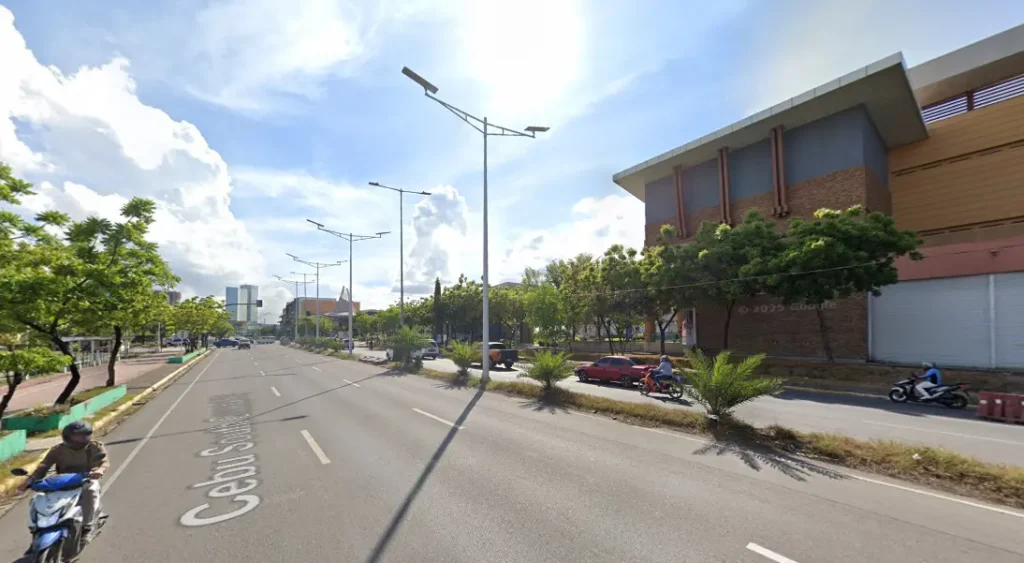
Evaluation by Public Works Department Field Engineers
The project’s supervising engineer noted during the 12-month review: the installation team was initially skeptical of the integrated design used for the median strip, particularly whether the integrated housing could maintain structural rigidity under double-arm loads during high-wind events. After surviving the first typhoon season without any incidents, this concern was alleviated.
Implications for Similar Coastal Infrastructure Projects
- Dual-layer corrosion protection should be explicitly stated. In tropical climates, single-layer powder coating is insufficient for installations within 500 meters of the coastline. Phosphating plus powder coating—or anodizing plus powder coating—should be the minimum requirement.
- Typhoon wind load verification must match the installation configuration. Passing a 180 km/h test in a single-arm roadside layout does not automatically validate performance in a double-arm median strip. Structural test data specific to the configuration must be provided or required in the bid.
- Battery capacity calculations in monsoon climates differ from arid regions. The standard 3–5 consecutive rainy day buffer is insufficient for the southwest monsoon. Design should ensure 8–10 days of operation without recharging through battery capacity and adaptive discharge management.
- Remote commissioning capabilities can significantly reduce post-installation costs. Application-based batch configuration reduces setup time for 2,000 lights from 18 days to 4 days.
- Documentation and pre-shipment inspections: Sresky has supplied over 3,500 government tender projects. Documentation packages tailored to specific project specifications can be provided within 48 hours. For projects with 500+ units, factory acceptance testing and pre-shipment inspection are standard.
If you have tender specifications for DPWH or other Southeast Asian government road lighting projects, send them to Sresky, and photometric simulation data and configuration recommendations can be provided.