
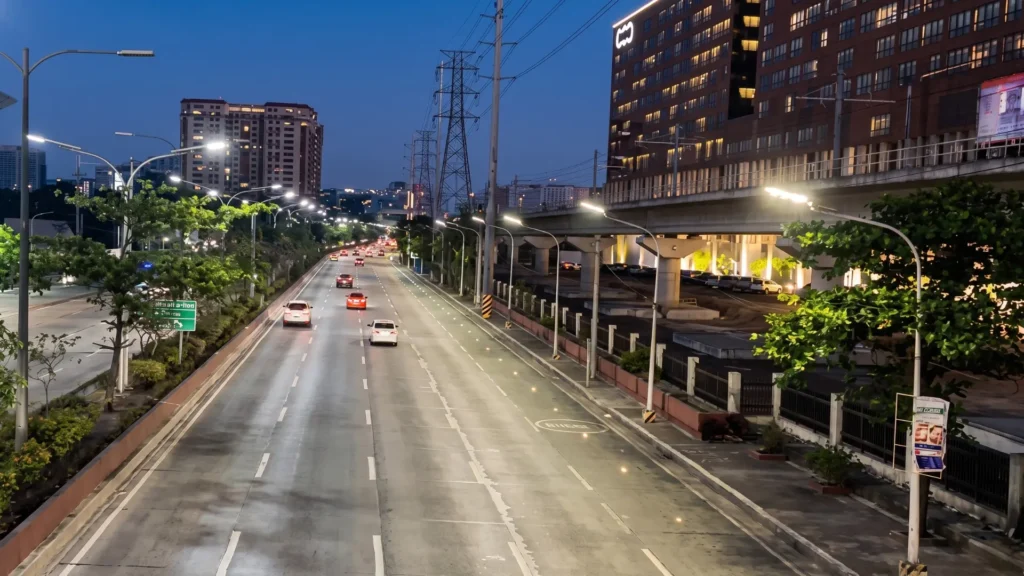
4,500 SRESKY THERMOS solar streetlights have been deployed along EDSA Avenue in Manila. Addressing the challenges of oil-based particulate matter and high temperatures on major urban thoroughfares, the project utilizes automatic cleaning technology and the TCS thermal management system. After six months of operation, the charging efficiency remained above 91%, effectively resolving the issue of long-term maintenance for streetlights and setting a new benchmark for B2B projects in highly polluted environments.
Table of Contents
- Project Snapshot
- The Real Challenge Isn’t Rain—It’s Oil
- Why THERMOS Was Chosen
- Electric Side-Brush Automatic Cleaning: A Proactive Mechanism Against Oily Contamination
- TCS Thermal Control System: A Real Guarantee for Battery Life in Tropical Climates
- Six-Month Data Comparison
- MMDA Project Manager Feedback
- Lessons for Similar Projects
To be honest, when we first heard about this project, we had an internal discussion: Is EDSA really the right place for solar streetlights?
EDSA is Manila’s main urban artery, with over 300,000 vehicles passing through daily. Traffic jams are the norm, and diesel vehicles dominate the roads. What drifts through the air isn’t just dust—it’s sticky particulate matter mixed with exhaust fumes and oil. When this substance lands on solar panels, rain cannot wash it away, nor can the wind blow it off—it clings firmly, causing the panels’ charging efficiency to decline week by week.
The MMDA (Metropolitan Manila Development Authority) launched this lighting upgrade with the goal of replacing all outdated high-pressure sodium lamps along the main EDSA corridor and several connecting arterial roads with integrated solar LED fixtures. When the local infrastructure contractor who won the bid approached us, they got straight to the point: their biggest concern wasn’t whether the lights would be bright enough, but rather, “Will they still be able to charge properly six months after installation?”
That’s a very professional question.
Project Snapshot
| Parameters | Details |
|---|---|
| Location | EDSA Avenue and major thoroughfares under MMDA jurisdiction, Manila, Philippines |
| Client | Metropolitan Manila Development Authority (MMDA) |
| Total Quantity | 4,500 solar street lights |
| Product Model | SRESKY THERMOS SSL Series |
| Pole Height | 8 meters, single-arm bracket |
| Installation Configuration | Dual-side installation (opposite sides of a two-way roadway) |
| Key Challenges | Rapid efficiency degradation of solar panels due to oily dust adhesion and high-temperature cell degradation |
Installation proceeded in phases, prioritizing the central corridor of EDSA followed by connecting roads, with the entire project completed in 14 weeks.
The Real Challenge Isn’t Rain—It’s Oil
When discussing the maintenance of solar street lights, many people’s first reaction is “fear of dirt and reliance on rainwater to wash it away.” This logic generally holds true for rural roads or low-density areas, but it completely fails on EDSA.
Exhaust from diesel engines contains a large amount of unburned oily particles. When these settle on the surface of solar panels, they form a thin, hydrophobic oil film. Rainwater simply rolls off and fails to remove this layer of oil. Over time, the panel’s light transmittance declines, and the charging current visibly drops.
Our field data from high-traffic urban road sections shows that without active cleaning, the actual charging efficiency of solar panels typically drops to just 54%–58% of the rated value after six months. This is not a theoretical calculation, but a figure obtained from comparative testing.
A 50% drop in efficiency means that backup power originally sufficient for 10 days may now last less than 5 days. The tender requirement for “10 consecutive days of operation during overcast or rainy weather” then becomes an empty promise.
Therefore, when selecting products, the contractor’s technical lead posed a practical question:
“I’m not concerned with rated parameters. I want to know if this light will still be able to charge at full capacity in the 18th month.”
Why THERMOS Was Chosen
The contractor evaluated five manufacturers. Two failed to meet the 10,000-lumen illuminance requirement at an 8-meter installation height and were immediately eliminated. Another had decent optical performance, but when asked about reliability in dusty conditions, their only answer was “IP65 protection”—showing they didn’t truly understand the application scenario. IP65 protects against liquid and particle ingress into the housing, but it cannot address oil films adhering to the panel surface and continuously blocking light. These are two distinct issues.
The final shortlist included SRESKY THERMOS and another manufacturer with higher panel wattage. While the latter’s panels had higher wattage, they lacked an active cleaning mechanism. After on-site inspections of several comparable installations, the contractor selected THERMOS.
Two key design features of THERMOS address EDSA’s real challenges:
Electric Side-Brush Automatic Cleaning: A Proactive Mechanism Against Oily Contamination
THERMOS is equipped with an electric side-brush cleaning system that automatically activates four times every 24 hours, mechanically removing layers of oily particles that rainwater cannot wash away. Each cleaning cycle takes approximately 90 seconds and consumes less than 0.3% of the battery’s rated capacity—a negligible amount.
The value of this mechanism lies not in “preventing dirt,” but in interrupting accumulation. An oil film does not form overnight; it gradually builds up over time. Cleaning four times every 24 hours fundamentally disrupts this process.
Six-month field test results: Panels equipped with a cleaning mechanism maintained a charging efficiency of 91.4%, approximately 32 percentage points higher than comparable products without such a mechanism. These 32 points represent the difference between “fulfilling the 10-day backup promise” and “running out of power in just 5 days.”
TCS Thermal Control System: A Real Guarantee for Battery Life in Tropical Climates
During Manila’s dry season, road surface temperatures often exceed 50°C, and temperatures inside the battery compartment can reach 55–60°C. Continuous operation under these conditions accelerates lithium-ion battery degradation.
TCS is a systematic thermal management solution, not merely a sensor with a power-off protection mechanism. It monitors temperature in real time, intervenes during charging, and incorporates high-performance thermal insulation. By treating the entire battery pack, it ensures safe continuous operation, fundamentally reducing degradation under high temperatures.
Comparative test data: At 55°C operating temperature, batteries equipped with TCS achieve over 1,000 cycles, whereas standard lithium-ion batteries reach approximately 500 cycles—a lifespan difference exceeding 100%. For a government project planned for over five years, this directly impacts replacement costs and maintenance frequency.
Six-Month Data Comparison
| Metric | Original HPS Fixtures | THERMOS Month 1 | THERMOS Month 6 |
|---|---|---|---|
| Monthly electricity cost per unit | PHP 380–420 | PHP 0 | PHP 0 |
| Solar panel charging efficiency | — (grid power) | Rated 94.2% | Rated 91.4% |
| Maintenance calls due to panel soiling | — | 0 | 0 |
| Average nightly runtime | 11.5 hours | 11.2 hours | 11.4 hours |
Maintenance calls due to panel soiling within six months: zero.
MMDA Project Manager Feedback
“We had two concerns at the start: whether the lights would charge properly on EDSA, and whether we would constantly receive maintenance complaints. Six months have passed, and neither concern has materialized. The cleaning mechanism is effective, battery status is normal, and we have not dispatched a maintenance team even once due to panel dirt.”
Lessons for Similar Projects
- Ask about real-world efficiency under panel contamination; don’t just rely on rated power.
- Require manufacturers to provide degradation data under comparable environmental conditions; IP rating and resistance to oil contamination are separate issues.
- “10-day backup” should be calculated based on actual charging input, not depth of discharge from a fully charged state. In polluted environments, a product rated for 10 days may only last 5 days.
- Thermal management is critical in tropical climates to avoid accelerated battery degradation and higher replacement costs.
- Request IES photometric files, not just lumen figures. Proper light distribution is key for tender compliance.
The EDSA project isn’t the most complex, but its environmental conditions leave no room for error. With 300,000 vehicles daily, oil-based exhaust, and tropical heat—six months of real-world data speaks louder than any lab test.