
When our field engineer arrived in Tonga, the local project manager did not present light distribution charts or technical specifications. Instead, he pointed to a crooked, aging light pole and said:
“Since the hurricane, we’ve repaired it three times. Each time, the connectors loosened first, water entered the battery box, and then the light stopped working.”
This is a typical South Pacific coastal community—off-grid, exposed to high salt fog, and located within a hurricane-prone region. The community required reliable lighting for roads, sidewalks, and gardens in a low-density residential area, with two key requirements: a 10-year service life and minimal ongoing maintenance.
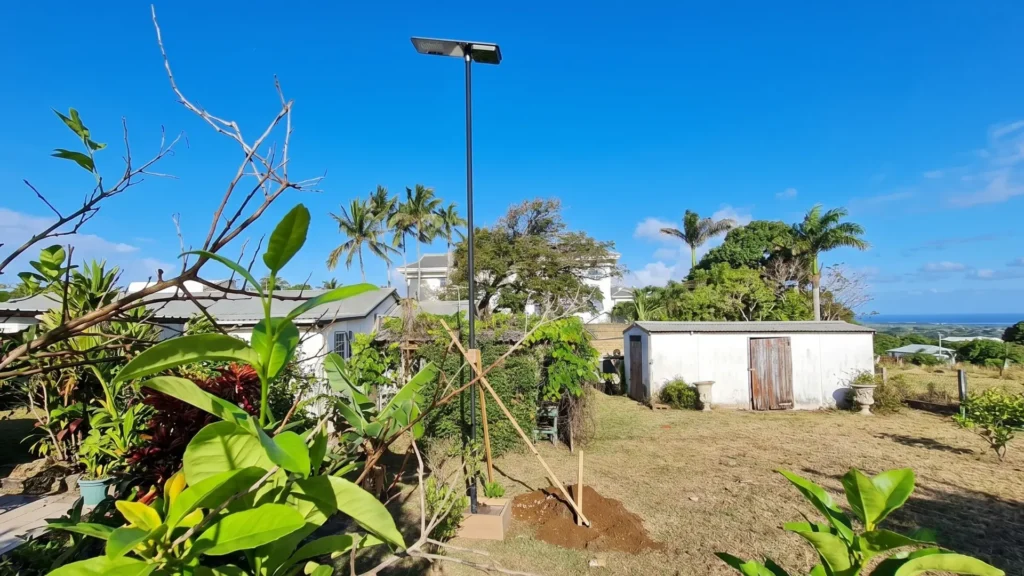
Ultimately, we supplied 30 sets of SRESKY Basalt Series all-in-one solar street lights. The following is a complete review of the product selection logic and engineering validation behind this project.
Project Snapshot
| Parameters | Details |
|---|---|
| Location | Coastal community in Tonga (within 150 meters of the shoreline) |
| Application | Off-grid roads, sidewalks, and community gardens |
| Number of Fixtures | Approximately 30 sets |
| Model | SRESKY Basalt All-in-One Solar Street Lights |
| Key Requirements | Hurricane resistance + high-temperature battery protection |
| Technical Requirements | All-in-one aluminum structure, IP65/IK08 protection, thermal management, low-irradiance endurance exceeding 7 days |
Two Critical Engineering Challenges
Challenge 1: Structural Reliability Under Hurricanes and Salt Fog Corrosion
Hurricanes generate rapidly fluctuating wind loads that change intensity several times per second. Conventional split-type streetlights—where the solar panel, battery box, and luminaire are installed separately—create multiple concentrated stress points.
Over time, screws loosen, mounting clips crack, and seals fail. Salt fog then accelerates corrosion, often damaging circuit boards within weeks.
Challenge 2: Battery Degradation in High-Temperature, High-Humidity Sealed Environments
To achieve waterproof protection, streetlights are typically fully sealed. During tropical summers, internal temperatures can exceed ambient temperatures by 15–20°C.
When lithium batteries continuously operate above 55°C, cycle life can drop dramatically—from approximately 3,000 cycles to fewer than 1,200 cycles. After only two years, many systems can no longer provide lighting throughout the night.
The core logic behind product selection was therefore not “maximum brightness,” but rather “maximum resistance to Tonga’s two biggest environmental threats.”
Solution 1: Structural Fatigue Resistance Through a Seamless Integrated Design
The Basalt series uses a one-piece die-cast aluminum housing. Instead of relying on adhesive mounting, the solar panel is embedded directly into an aluminum alloy frame.
During hurricanes, wind stress is distributed evenly through the pole flange structure rather than concentrated on individual screws or brackets.
Third-party laboratory testing under simulated 180 km/h wind gusts showed:
- No housing deformation
- No seal displacement
- No structural loosening
Additional Corrosion Protection Measures
- All exposed fasteners are manufactured from 316 stainless steel
- The housing undergoes passivation treatment and outdoor-grade powder coating
- The fixture successfully passed a 720-hour salt spray test
Solution 2: Battery Protection Through Thermal Insulation and Passive Cooling
Instead of using active cooling fans—which can become clogged by salt deposits—the system uses three passive thermal management strategies:
Independent Thermal Insulation for the Battery Compartment
An air-gap insulation layer combined with reflective aluminum foil reduces external radiant heat transfer into the battery chamber.
Passive Convection Cooling Channels
Concealed heat-dissipation fins on the rear housing utilize the chimney effect to create continuous micro-air circulation.
Weather-Resistant Sealing Materials
Automotive-grade EPDM foam gaskets maintain elasticity across temperatures ranging from -30°C to +120°C.
Field Test Results in Tonga
During summer field testing with ambient temperatures reaching 38°C:
- Conventional lamp interior temperature: 61°C
- Basalt battery core temperature: 49°C
This 12°C reduction significantly improves battery longevity, extending estimated cycle life from fewer than 1,500 cycles to more than 2,200 cycles.
Project Operation Results
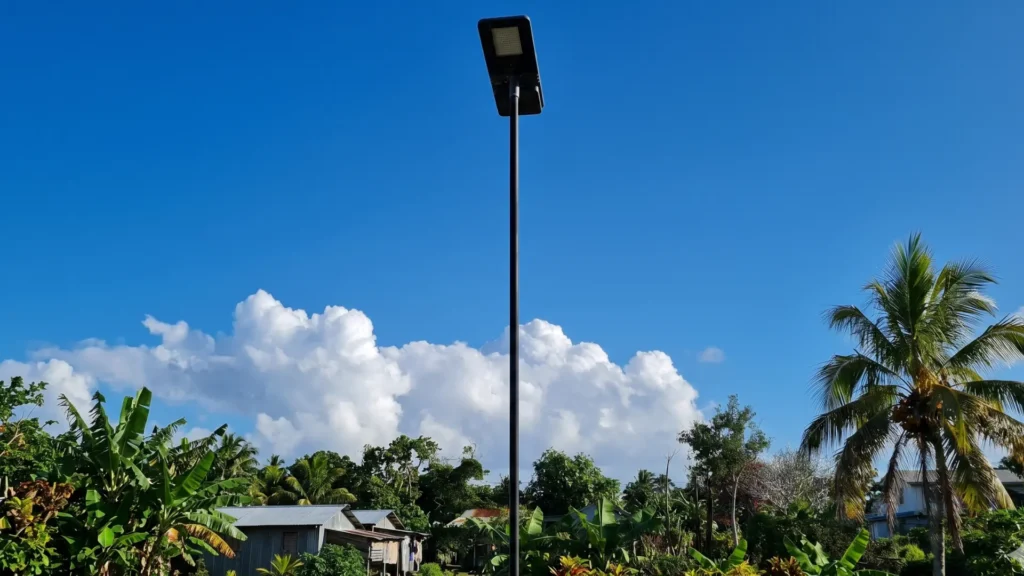
An 18-month follow-up inspection showed that all 30 Basalt streetlights continued operating normally, with:
- No outages caused by structural loosening
- No water-ingress failures
- No battery-related shutdowns
Community Feedback
As the local project manager stated:
“Since installation, we haven’t spent a single penny on maintenance. We almost forgot the lights were there—until they turned on every night.”
Frequently Asked Questions (FAQ)
Q: How do solar street lights resist salt fog corrosion?
A: Marine-grade durability depends on multiple protective measures, including die-cast aluminum housings, outdoor anti-corrosion coatings, 316 stainless steel fasteners, sealed electrical compartments, and UV-resistant sealing materials. Together, these features significantly reduce rust and material degradation in coastal environments.
Q: What structural requirements are necessary for solar street lights in hurricane-prone coastal areas?
A: Solar streetlights in coastal hurricane zones must withstand strong winds, heavy rain, salt fog, and long-term humidity exposure. Key considerations include:
- High wind-load resistance
- IP65 or higher waterproof protection
- IK08 impact resistance
- Corrosion-resistant materials
- Long-term sealing reliability
In these environments, structural durability is more critical than maximum brightness output.
Conclusion
On islands located within hurricane belts, the most expensive repairs are the ones that must be performed on-site.
Rather than investing heavily in unnecessary smart features, this project prioritized three critical engineering areas:
- Monocoque die-cast structural design
- Thermal insulation and heat dissipation for the battery compartment
- 316 stainless steel corrosion-resistant fasteners
The success of Basalt does not rely on flashy technology. It comes from carefully solving the practical challenges found in two fundamental engineering disciplines: structural mechanics and material corrosion resistance.
For projects located in Pacific hurricane zones, high-temperature tropical islands, or heavy salt-fog environments, remember this:
The material specification of every screw and the temperature tolerance of every sealing component are often far more important than remote dimming functions or advanced smart controls.
Table of Contents