
Table of Contents
Around 6:00 p.m., foot traffic begins to increase in coastal communities. Drivers need to see the road clearly, pedestrians need a safe environment, and palm trees and green spaces should not become dark areas.
However, for public spaces like these, solar streetlights are not simply a matter of “installing them and letting them illuminate the area.” The fixtures must withstand humidity, salt fog, and intense sunlight while ensuring that light effectively reaches roads, pedestrian areas, and activity spaces.
These were precisely the challenges addressed by the public space lighting renovation project at a hotel and residential complex on Brazil’s coast. The project utilized 35 units of the Sresky ATLAS SSL-315/316/318/320 Series all-in-one solar street lights, primarily covering walkways, hotel entrances and exits, children’s play areas, and residential connecting pathways.
Project Snapshot
| Project | Details |
|---|---|
| Project Location | A coastal resort city in southeastern Brazil |
| Project Type | Public space lighting for a hotel and residential complex |
| Client | Regional Development Group |
| Product Model | SRESKY ATLAS All-in-One Solar Street Lights |
| Number Installed | 35 units |
| Covered Areas | Walkways, hotel entrances and exits, children’s play areas, and residential connecting pathways |
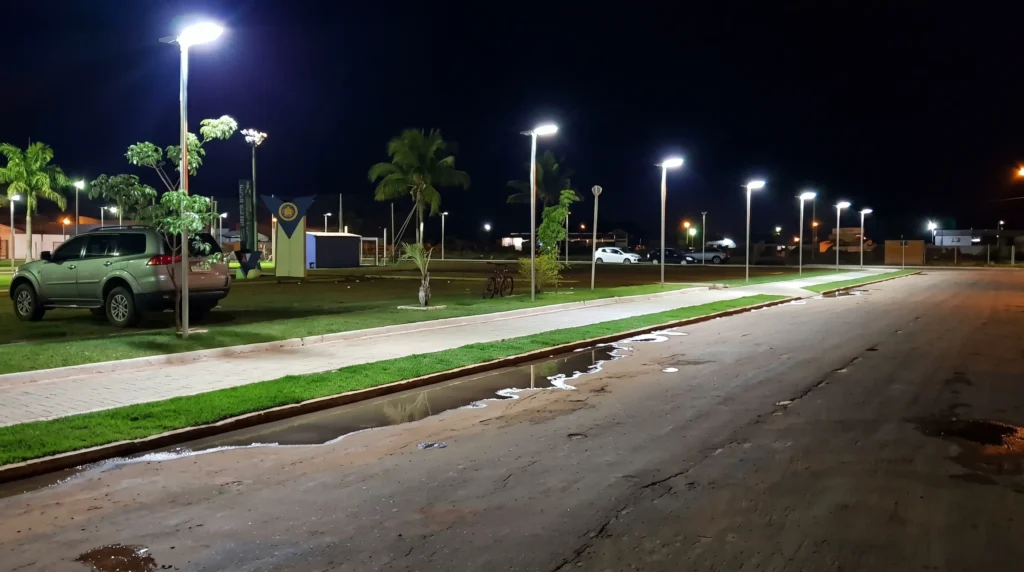
Two Major Engineering Challenges: Tropical Coastal Environment / Mixed-Use Spaces
Challenge 1: C4/C5 Salt Fog + Intense UV Radiation—Ensuring Long-Term Weather Resistance
For coastal projects, the engineering team’s primary concern is often not whether the luminaires will function properly immediately after installation, but rather how they will perform after long-term use. Salt carried by sea breezes, humid air, and ultraviolet radiation continuously put the luminaire bodies, fasteners, connection points, and internal electrical components to the test.
If the equipment’s sealing and corrosion-resistant design are inadequate, the following issues may arise over time:
- Corrosion of metal components;
- Moisture ingress at wiring and connection points;
- Condensation caused by seal aging;
- Increased maintenance frequency;
- Greater difficulty and higher costs associated with repairs in coastal public areas.
Therefore, such projects require more than just “waterproofing”; they demand a multi-faceted approach covering structure, sealing, and materials to minimize potential failure points.
Solution: Integrated Design + Corrosion-Resistant Structure to Reduce Exposed Points in Coastal Environments
The project utilizes the ATLAS SSL-315/316/318/320 Series of integrated solar street lights. The core concept is to integrate the battery, controller, and lighting module inside the lamp body, thereby reducing the external connections and exposed components found in traditional split-type designs.
Additionally, the main body of the lamp features a structure combining aluminum alloy and polycarbonate (PC) materials, with an IP66 protection rating. The structural design balances heat dissipation and moisture protection requirements, helping to reduce the risk of component aging and internal condensation in high-humidity, high-salt-fog coastal environments.
Coastal solar streetlights must not only provide illumination but also account for long-term outdoor use and ease of maintenance.
Challenge 2: Complex Mixed-Use Spaces—How to Achieve Precise Light Distribution and Low Glare
The spatial layout of this project is relatively complex. On one side is the vehicular traffic area, while the other side features sidewalks, lawns, a children’s play area, and residential recreational spaces.
Simply increasing the power of the luminaires would not necessarily solve the problem. Light might be concentrated on the roadway, leaving pedestrian areas still dim; alternatively, excessive lateral light spill could occur, compromising the comfort of recreational spaces.
The primary challenges to be addressed on-site are:
- Aligning lighting coverage with actual activity areas;
- Reducing dark zones created by greenery and buildings;
- Controlling unnecessary light spill;
- Striking a balance between road safety and pedestrian comfort.
Solution: Asymmetric Light Distribution—Directing Light Where It Is Needed Most
For this type of mixed-use public space, the project adopted the ATLAS Series Type II road-grade light distribution solution. By utilizing the luminaires’ built-in optical design to adjust the direction of light distribution, the lighting covers both the roadway and pedestrian areas rather than simply spreading outward in all directions.
In practical applications, the luminaires can be configured based on road width, pole height, pole spacing, and the surrounding environment, ensuring that even a single-sided lighting layout can effectively serve both the roadway and public activity areas.
The key lies in precise light distribution: rather than simply pursuing greater brightness, the goal is to direct light where it is needed most.
This approach to light distribution is particularly important in scenarios with obstructions such as palm trees, lawns, and building entrances, as it helps reduce noticeable dark spots while minimizing unnecessary glare and light pollution.
Project Outcomes
- Completed Lighting Coverage for Public Areas: Walkways, hotel entrances, children’s play areas, and residential access areas were all included in the lighting scope.
- Optimized Lighting Distribution Across Different Zones: Asymmetric light distribution was adopted to balance the lighting needs of vehicular, pedestrian, and recreational spaces.
- Adapted to the Rainy Coastal Environment: Despite continuous rainfall and overcast conditions during the project’s operation, the luminaires generally performed well.
- Simplified Equipment Installation and Maintenance: The integrated design reduces external connections and exposure of components such as batteries and controllers.
Client Feedback
“We were particularly concerned about durability in a coastal environment and light distribution in complex public spaces. ATLAS’s integrated design and asymmetric light distribution provided us with excellent solutions in both areas.”
— Engineering Coordination Director, Brazil Project Site
FAQ: Selection of Solar Street Lights for Coastal Areas in Brazil—Frequently Asked Questions
1. Are solar street lights suitable for coastal public space projects in Brazil?
Yes, but selection should not be based solely on standard lighting parameters. For coastal projects, it is recommended to prioritize the following factors:
- Salt fog and air humidity levels;
- UV intensity and high-temperature environments;
- Battery performance during the rainy season and periods of continuous overcast weather;
- The luminaire’s IP rating and the corrosion-resistant treatment of materials;
- Ease of maintenance.
All-in-one solar street lights, which reduce the number of external connection points, are among the leading solutions to consider for these types of projects.
2. When selecting solar street lights for coastal areas, how should lumens and power be determined?
It is not recommended to rely solely on lumen values; you must also consider:
- Road width and pole height;
- Pole spacing;
- The actual use of the road and public space, such as vehicular traffic, pedestrian walkways, or recreational areas;
- The extent of shading from vegetation;
- The light distribution pattern.
It is recommended to first define the lighting area and lamp layout before determining specific power and brightness levels. This helps avoid situations where “the specifications look good but the on-site results are unsatisfactory.”
3. Are solar street lights near the coast prone to corrosion? What should be considered in corrosion-resistant design?
Corrosion protection is indeed a key concern in coastal environments. Taking the ATLAS Series as an example:
- The main body of the luminaire features a structure combining aluminum alloy and PC (polycarbonate) materials;
- The entire unit meets the IP66 protection rating;
- The integrated design reduces external electrical connection points, lowering the risk of moisture ingress during wiring.
For project environments with more pronounced salt fog, it is recommended to further confirm specific surface treatment and fastener solutions with the supplier to ensure compatibility with local climatic conditions.
Conclusion: For Coastal Solar Street Lights, the Key Is “Reliability + Proper Lighting Placement”
As cities, resort areas, hotels, and residential projects place greater emphasis on green infrastructure, solar street lights are evolving from simple lighting fixtures into more comprehensive public space lighting solutions.
For projects in coastal and island areas, as well as those with limited grid access, the following factors should be prioritized during selection:
- Environmental Adaptability: Capability to withstand coastal environments characterized by high humidity and high salt-fog exposure;
- Integrated Design: Simplified installation and reduced maintenance complexity;
- Precise Light Distribution: Focusing light on the areas that truly need illumination;
- Long-Term Maintenance: Addressing operational and maintenance needs throughout the project’s entire lifecycle.
Municipal departments, engineering contractors, and lighting planners can begin by asking three questions:
- How harsh is the environment?
- Where does the lighting need to be?
- Where should the light fall?
First, clarify the specific application scenario, then select the luminaires, light distribution, and energy storage solutions accordingly. The value of coastal solar street lights lies not merely in “providing light,” but in reliably directing that light to the right places.