
Table of Contents
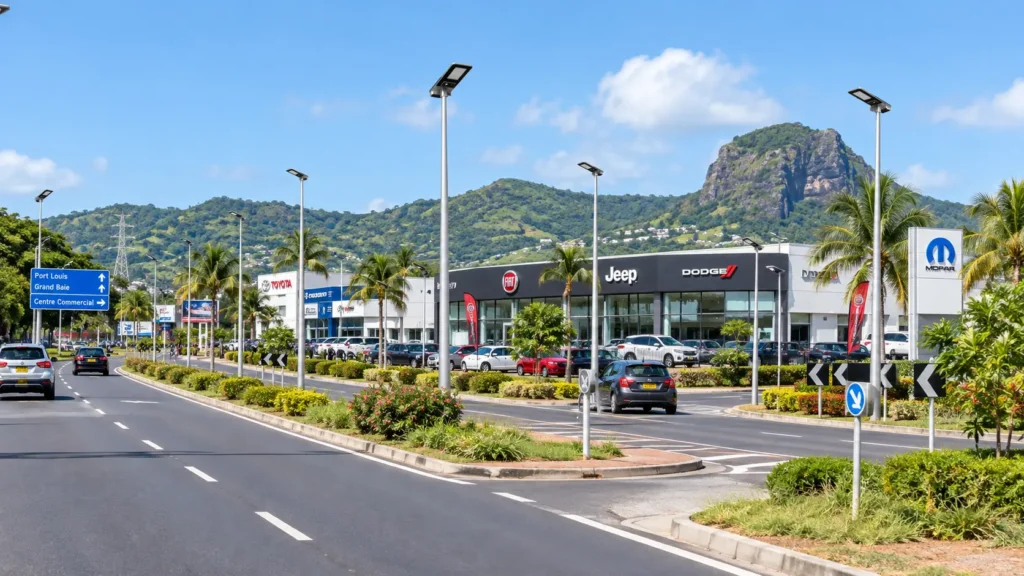
At dusk, traffic gradually increases in the central highlands of Mauritius. Mountain roads are prone to strong wind gusts, while the car showrooms along the roadside need to maintain effective nighttime displays. Traditional grid-connected lighting not only requires cable installation but may also disrupt existing commercial traffic patterns.
Faced with multiple requirements—including mountain road lighting, strong wind conditions, glare control in commercial areas, and construction constraints—the Mauritius Road Development Authority (RDA) and the commercial complex developer ultimately selected approximately 50 Sresky Basalt all-in-one solar street lights to provide off-grid lighting for main thoroughfares and surrounding commercial roads.
Project Snapshot
Project Information
- Project Area: Commercial road areas in the Central Highlands of Mauritius leading toward the capital
- Application Scenarios: Main roads, commercial service roads, and automotive trade zones
- Planned Quantity: Approximately 50 units
- Pole Height: Approximately 8–10 meters, subject to the final lighting design
- Pole Spacing: Approximately 36–45 meters, to be verified based on road conditions
- Recommended Products: Sresky Basalt SSL-98A / SSL-910A, etc.
Two Major Engineering Challenges: Strong Mountain Winds + Glare in Commercial Areas
Challenge 1: Structural Fatigue Resistance in High-Wind Environments
The project road is located in a transitional zone between hilly terrain and open roads. Seasonal strong winds and tropical cyclones in the area subject road lighting equipment to complex outdoor wind conditions.
If solar street lights incorporate a large number of external components—such as standalone photovoltaic panels, external battery boxes, and long cantilever arms—the overall equipment structure becomes more complex, increasing the workload for on-site installation and future maintenance.
Consequently, the project team prioritized low-drag structures, structural integrity, and ease of long-term maintenance.
Key risks include significant wind loads on luminaires during strong winds; the need for regular inspections of exposed brackets and connecting components; the potential increase in maintenance points associated with multi-component assemblies; and the high construction costs of road repairs and equipment replacement in mountainous areas.
Solution: Adoption of the Basalt Integrated Low-Drag Structure
Sresky Basalt features an integrated aluminum alloy frame design that combines the photovoltaic modules, luminaires, and control system into a single unit, resulting in a more compact overall structure.
Its core advantages lie in three areas:
- Integrated structure: Reduces the number of external components and connecting parts.
- Low-wind-resistance design: Minimizes the impact of wind on the equipment in high-wind environments.
- IK08 protection: Provides excellent mechanical impact resistance for outdoor road lighting.
In mountainous, coastal, and other regions with seasonal strong winds, integrated solar street lights can reduce structural complexity and make installation, inspection, and maintenance easier for project teams.
Challenge 2: Balancing Multi-Lane Lighting with Zero Glare for Showrooms
The project road not only serves as a thoroughfare for vehicles but is also flanked by automotive brand showrooms and open-air vehicle display areas. Road lighting must cover the driving area, but if light spreads excessively to both sides of the road, it may illuminate glass curtain walls and vehicle surfaces.
This presents two problems: on the one hand, drivers may be distracted by unnecessary reflected light; on the other hand, commercial showrooms aim to maintain a clean and comfortable nighttime visual environment.
Therefore, the project’s challenge is not whether “the lights are bright enough,” but rather where the light should be directed.
The main impacts include variations in brightness across different areas of the road; light spilling toward commercial buildings; noticeable reflections from glass curtain walls; and glare caused by the high-gloss surfaces of display vehicles.
Solution: Adopt a Type III Asymmetric Light Distribution Pattern to Focus Illumination on the Roadway
Basalt employs a Type III asymmetric light distribution scheme. Through directional lighting, it concentrates light on the areas of the roadway that require illumination, rather than allowing it to spread extensively toward buildings and commercial display areas.
Key design considerations include:
- Directional roadway lighting: Lighting design based on pole heights of approximately 8–10 meters and spacing of approximately 36–45 meters.
- Reducing rearward light spill: Controlling unnecessary light directed toward commercial buildings.
- Improving lighting uniformity: Reducing noticeable variations in brightness through appropriate lamp placement and light distribution.
- Balancing road and commercial environments: Ensuring that road traffic needs are met while minimizing visual interference with showrooms and display vehicles.
This also highlights the key value of solar street lights in mixed road-and-commercial-area scenarios: they must not only provide illumination but also control the boundaries of light.
Project Outcomes
- Roadway Lighting Deployment Completed: Illumination levels and roadway lighting uniformity generally meet the project’s design expectations.
- Improved Lighting Environment in Commercial Areas: Directional light distribution reduces light spill from the roadway into exhibition hall areas.
- Simplified Long-Term Maintenance: The integrated design minimizes external components and potential maintenance points.
- Off-Grid Lighting Deployment Completed: No additional utility cables are required along the roadway, reducing excavation and wiring work.
- Adaptation to Tropical Environments: Technologies such as ALS and TCS were integrated to address energy storage and lighting requirements under high temperatures and overcast or rainy weather conditions.
Client Feedback
“The integrated structure has reduced maintenance pressure following the strong wind season, while precise light distribution has also alleviated the conflict between road lighting and exhibition hall lighting control.”
— Engineering Manager, Project Owner
Frequently Asked Questions (FAQ) for Buyers
1. Are solar street lights suitable for use in Mauritius?
Yes, but system design should be based on specific road conditions rather than simply assessing whether “the local sunlight is good or not.” We recommend focusing on the following factors:
- Local solar irradiance and periods of continuous rain
- Required nightly lighting duration and luminaire power
- Matching battery capacity with pole height and lamp spacing
2. Do tropical coastal regions affect the battery life of solar street lights?
High temperatures, humid conditions, and salt-fog environments typically require special consideration during the battery and overall luminaire design phases. Basalt employs TCS temperature control technology to help batteries maintain an optimal charge/discharge state under various environmental conditions.
When selecting models, also consider:
- Luminaire heat dissipation and IP rating for water and dust resistance
- Corrosion protection for metal components
- Ease of battery replacement and maintenance
3. In windy or coastal areas, should you choose an integrated or split-type solar street light?
Both solutions are viable. A comprehensive comparison should be made based on structural complexity and maintenance requirements:
- Split-type: Components such as the PV panel, mounting bracket, and battery box are separate, offering greater installation flexibility but requiring maintenance at multiple points.
- Integrated-type: Components are highly integrated, with fewer external components, making this configuration more suitable for projects in high-wind, coastal, or otherwise challenging maintenance environments.
For mountain roads and island projects, low-drag integrated structures are typically the preferred choice for simplifying installation and O&M.
Conclusion: Adapting Solar Street Lights to Real-World Road Environments
As road lighting evolves toward off-grid, low-maintenance, and scenario-based solutions, solar street lights are transitioning from mere alternatives to grid power toward more sophisticated outdoor lighting applications.
The Sresky Basalt project in Mauritius demonstrates that an excellent solar street light solution must not only “provide bright illumination” but also:
- Feature a low-wind-drag structure to adapt to complex outdoor environments.
- Provide precise light distribution that balances road safety with light control in commercial areas.
- Deliver stable energy storage to better meet lighting demands under varying weather conditions.
- Simplify installation to reduce wiring and on-site construction burdens.
Municipal departments, engineering contractors, and road planners should prioritize evaluating road environments, lighting requirements, light distribution, energy storage, and O&M conditions when selecting solutions.
The core value of solar street lights lies not in achieving the highest individual parameter, but in ensuring that the overall solution truly matches the specific application scenario.