
Table of Contents
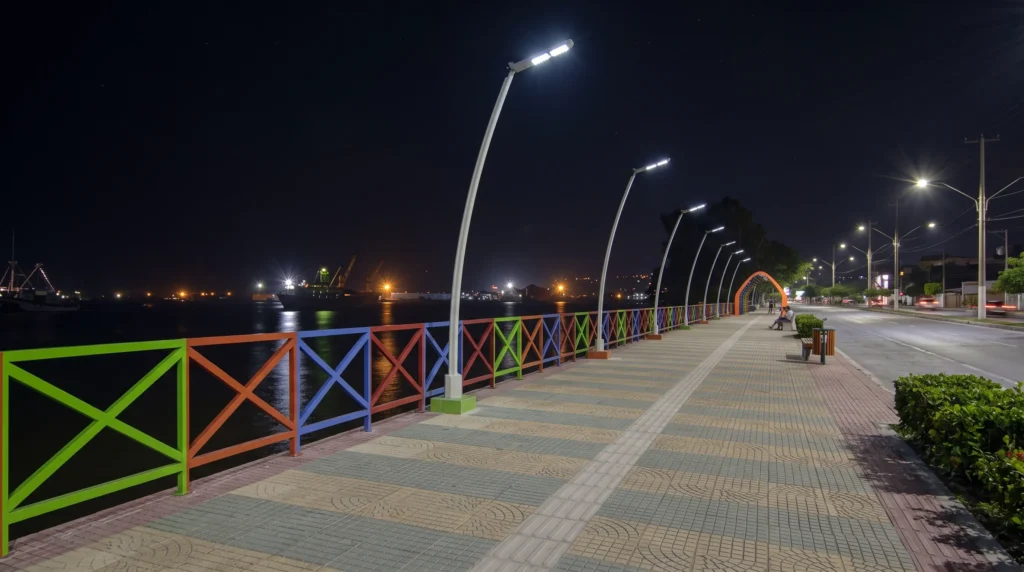
After 7:00 p.m., Barranquilla’s Gran Malecón waterfront promenade gradually comes to life.
With people walking and jogging, families enjoying leisure time, and commercial activities taking place along the promenade, the lighting requirements here far exceed those of ordinary roads. Late at night, foot traffic decreases, but a new wave of early-morning exercisers arrives at dawn.
For a public waterfront space like this, solar streetlights must address more than simply whether the area is adequately lit at night. They must also account for salt fog, humidity, overcast and rainy weather, as well as fluctuations in foot traffic throughout the day.
Therefore, this project utilizes approximately 85 Sresky Atlas Series all-in-one solar streetlights to provide off-grid lighting for key areas of the promenade.
Project Snapshot
Project Information
- Project Location: Barranquilla, Colombia; Gran Malecón Seaside Promenade Area
- Application Scenario: Seaside public promenade, nighttime recreational and pedestrian spaces
- Project Scale: Approximately 85 solar street lights
- Coverage: Approximately 1.5–3 km, depending on the on-site lighting layout
- Product Line: Sresky Atlas Series All-in-One Solar Street Lights
Two Major Engineering Challenges: Seaside Environment / Municipal Landmark
Challenge 1: High-Salt, High-Humidity Coastal Environment—Ensuring Long-Term Corrosion Resistance of Lighting Fixtures
The waterfront promenade is constantly exposed to sea breezes, salt spray, and humidity. The lamp bodies, poles, brackets, and fasteners must all withstand outdoor conditions that are more demanding than those typically found on inland roads.
Particularly in public promenade projects, lighting fixtures must not only withstand long-term environmental exposure but also account for minor impacts that may occur during construction. If the protective surface coating is damaged, subsequent maintenance can become significantly more complicated.
If corrosion protection and sealing solutions are inadequate, this may result in:
- Corrosion of light poles, brackets, and fasteners;
- Gradual deterioration of the luminaire’s surface coating;
- Moisture penetration into the interior, increasing maintenance requirements for electrical components;
- The need for more frequent inspections and component replacements in the future;
- Disruption to the normal use of walkways if repairs are required after construction in coastal public spaces.
Solution: Develop a Protection Plan Tailored to the Coastal Environment—from Materials and Protection to Construction
Designed for coastal environments, Sresky Atlas Series luminaires primarily feature aluminum alloy structural components paired with PC (polycarbonate) lens covers, providing dust- and water-resistant protection. The brackets undergo dual anti-corrosion treatment to help reduce the risk of corrosion in salt-fog and humid environments.
During the project construction phase, attention must also be paid to protecting the surfaces of the luminaires and poles. Minor scratches that may occur during transportation or hoisting can be repaired in accordance with on-site maintenance guidelines.
The core value of this solution lies not in a single “high protection rating,” but in creating a comprehensive solar streetlight solution better suited to the coastal environment—encompassing product materials, sealing, corrosion protection, and on-site construction.
Challenge 2: Balancing Lighting Needs and Energy Storage Amid Fluctuating Foot Traffic
Nighttime foot traffic along the Gran Malecón is not constant.
From dusk to late evening, there is a high volume of family visitors, joggers, and commercial activity. Foot traffic drops significantly late at night, while early morning brings people out for exercise.
If solar streetlights operate at high power throughout the night, battery consumption is likely to increase. However, simply adopting a fixed “bright earlier, dim later” mode may fail to adequately match actual foot traffic patterns.
Such dynamic foot traffic patterns may present several issues:
- Better lighting is needed during peak hours, but the same brightness is not required during off-peak hours;
- Prolonged high-power operation increases the strain on energy storage;
- After prolonged periods of rain or overcast weather, the amount of available solar power may decrease;
- An inappropriate lighting strategy may affect lighting continuity during the latter half of the night or in the early morning.
Solution: Use Smart Dimming to Match Foot Traffic and Available Power
The Sresky Atlas Series is equipped with the Adaptive Lighting System (ALS), whose core concept is to dynamically adjust luminaire output based on preset time periods, lighting requirements, and battery status.
In scenarios such as the Gran Malecón, a similar lighting strategy can be applied:
- Evening through nighttime peak hours: Maintain higher lighting output to meet the needs of primary pedestrian activity;
- Late-night off-peak hours: Reduce output while retaining basic safety lighting;
- Early morning activity periods: Increase lighting levels again according to preset programs;
- During prolonged periods of rain or overcast weather: Adjust the lighting strategy based on actual battery levels to help reduce energy consumption.
The key is not to keep the lights at maximum brightness at all times, but to better align solar power generation with actual lighting needs.
For seaside promenades, scenic areas, parks, and municipal public spaces, this intelligent dimming method is particularly suitable for projects where foot traffic patterns vary significantly over time.
Project Outcomes
The value of this project is primarily reflected in the following aspects:
- Approximately 85 solar streetlights deployed: Covering key lighting areas along the Gran Malecón boardwalk;
- Independent, off-grid power supply: Reducing the need for underground cables, power distribution facilities, and related construction work;
- Adaptation to the coastal environment: Features such as corrosion resistance and sealing help address the challenges posed by salt fog and humid conditions;
- Time-based smart lighting mode implemented: Adjusting luminaire output according to nighttime foot traffic fluctuations while balancing lighting needs with energy efficiency.
Client Feedback
“We were particularly concerned about long-term reliability in a coastal environment, as well as the need for lighting adjustments due to peak and off-peak foot traffic. Atlas‘s weather-resistant design and smart dimming provided practical solutions to both of these challenges.”
— Project Manager, Department of Public Works and Infrastructure, Barranquilla City Government
FAQ on Selecting Solar Street Lights for Coastal Areas
1. What factors should be considered when installing solar street lights in coastal areas?
While solar streetlights are generally suitable for coastal areas, selection should not be based solely on luminaire brightness. For coastal projects, it is recommended to prioritize the following factors:
- Local solar resources and conditions regarding cloudy and rainy weather;
- Salt fog and humid environments;
- Luminaire sealing and protection, as well as corrosion-resistant solutions for lamp posts and brackets;
- Adaptability of the battery and control systems;
- Post-installation maintenance conditions.
The IP protection rating is worth noting, but it does not alone determine a luminaire’s resistance to coastal weather conditions.
2. Can solar street lights continue to provide normal illumination during prolonged periods of overcast or rainy weather?
This depends on the entire system, not just individual components. The following factors must be considered comprehensively:
- Photovoltaic module configuration and local solar irradiance conditions;
- Battery storage capacity;
- Luminaire power and nightly lighting duration;
- Smart dimming strategies.
When purchasing, rather than focusing solely on the “number of consecutive days of illumination” advertised, it is better to ask suppliers to provide system configuration recommendations based on the actual project location, load, and lighting plan.
3. For coastal projects, should you choose integrated or split-type solar street lights?
Both solutions have their appropriate applications.
- Integrated solar street lights: Compact structure, relatively simple installation, and fewer external connections, but they place higher demands on the luminaire’s sealing and internal design;
- Split-type solar street lights: More flexible configuration of photovoltaic panels, batteries, and luminaires, with easier maintenance and component replacement in some scenarios, but on-site wiring and installation are typically more complex.
For coastal projects, what matters more than the selection method itself is whether the supplier can provide a systematic solution covering corrosion resistance, sealing, energy storage, and maintenance.
Conclusion: Coastal Solar Street Lights—Moving from Simple Lighting to System-Level Design
As coastal walkways, tourist attractions, and waterfront public spaces continue to be upgraded, solar street lights are evolving from simple replacements for grid-connected lighting toward systematic applications that are weather-resistant, energy-efficient, smart, and low-maintenance.
For waterfront projects, the following factors should be prioritized during the selection process:
- Salt-fog resistance: Adaptability to high-humidity, high-salinity environments;
- Solar energy utilization: Alignment with local sunlight conditions and energy storage requirements;
- Smart lighting: Adaptability to changes in foot traffic at different times of day;
- Simplified construction: Reduced reliance on grid power wiring and reduced construction requirements;
- Long-term maintenance: Reduced operation and maintenance burdens.
For municipal departments, engineering contractors, and urban planners, the Gran Malecón project offers a practical reference: when facing conditions such as high salt fog, dynamic foot traffic, and limitations on grid-connected installation, solutions can be evaluated holistically across environmental, energy, lighting, construction, and maintenance aspects.
The core value of waterfront solar streetlights lies not merely in solar power supply, but in how weather-resistant design, smart lighting, and off-grid systems can better serve the long-term operation of public spaces.