
The main internal road in an expanded industrial park in Mexico is 12 meters wide and serves as a critical route for container trucks operating at night. The project faced severe time constraints: with only eight weeks remaining before the rainy season, the grid connection for the expanded area was still delayed in a lengthy approval process. Temporary lighting solutions could not cover the entire route, and repeated safety inspections had already issued risk warnings.
To solve the problem, the project team installed 196 SRESKY Atlas SSL-36A units along the main thoroughfare. After the rainy season ended, the entire system had operated without a single failure, and the road remained illuminated throughout the night.
Table of Contents
Project Snapshot
| Parameters | Details |
|---|---|
| Location | Main thoroughfare within a gated industrial park in Mexico |
| Road Width | 12 meters |
| Number Deployed | 196 units × SRESKY Atlas SSL-36A |
| Installation Height / Spacing | 5.5 meters / 25–35 meters |
| Lighting Configuration | Symmetrical arrangement on both sides |
| Key Achievement | Zero-failure lighting performance throughout the first rainy season |
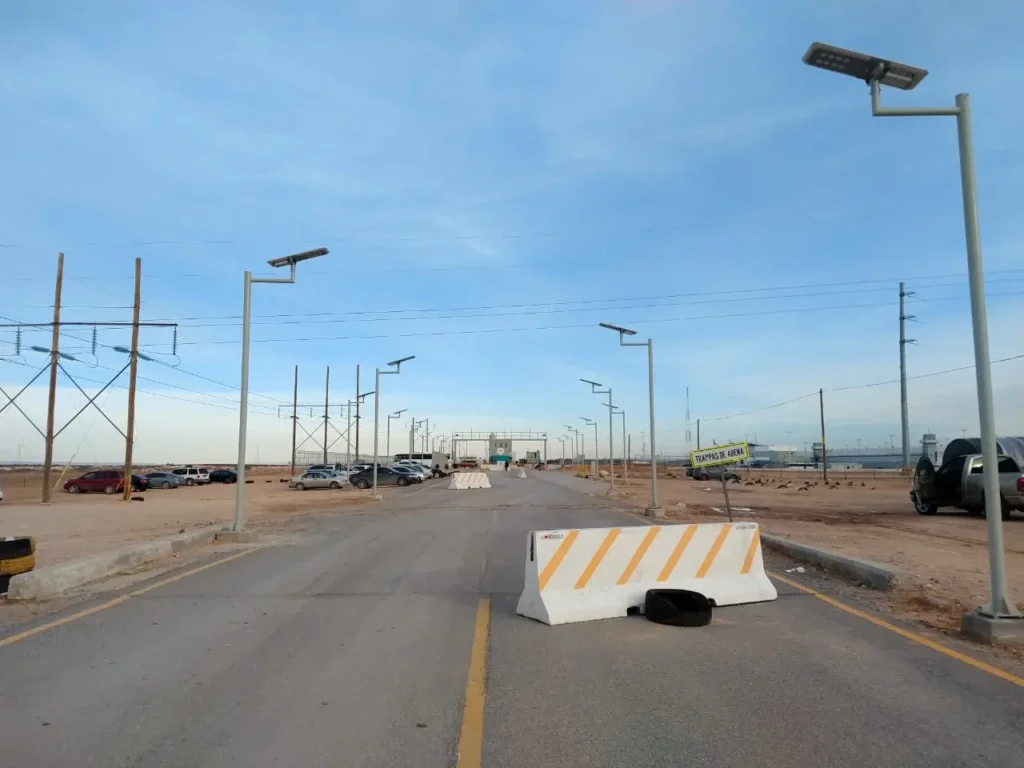
Engineering Challenges
Challenge 1: Maintaining Uninterrupted Lighting During Extended Rainy Periods
During Mexico’s rainy season, low-sunlight conditions can persist for more than 10 consecutive days. Most conventional solar street lights exhaust their stored power after only two or three nights, leaving roads completely dark. In a gated industrial zone, lighting failure represents not only a visibility issue but also a major security risk.
Challenge 2: Illuminating a 12-Meter-Wide Road with 5.5-Meter Poles
The combination of low installation height and wide roadway coverage creates a difficult lighting scenario. Standard light distribution often leaves a noticeable dark strip in the center of the road—precisely where container truck tires travel most frequently.
Challenge 3: High Ambient Temperatures Accelerating Battery Degradation
Industrial zones experience strong heat island effects during the day, causing battery compartment temperatures to remain elevated for long periods. Without thermal protection, lithium battery lifespan can decline rapidly, creating significant long-term replacement and maintenance costs.
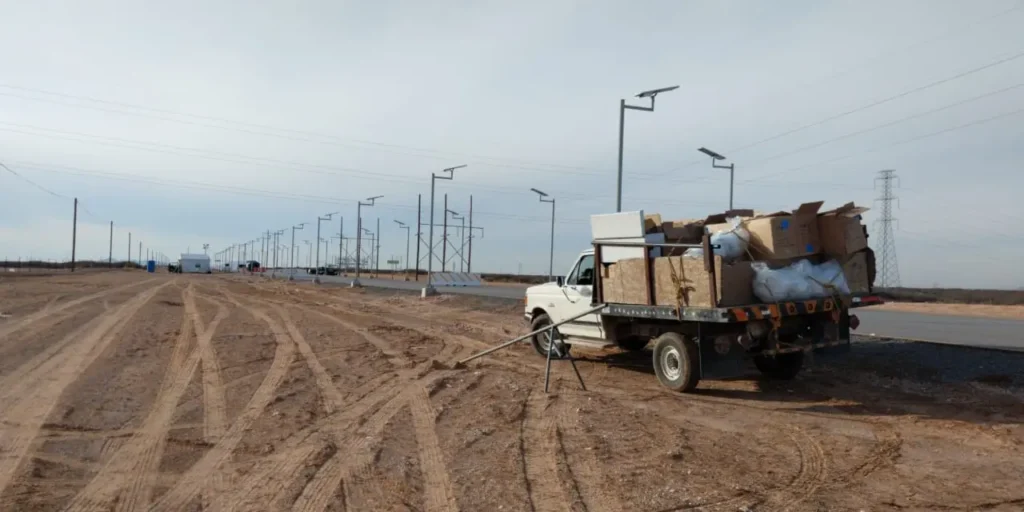
Why Traditional Solutions Fail
Utility-Grid Street Lights
The expansion area was not included in the local power supply plan. Extending grid infrastructure would require trenching, transformer installation, cable deployment, and multiple approval stages—far too slow to meet the project timeline before the rainy season.
Conventional Solar Street Lights
Traditional solar lighting systems typically use fixed discharge logic, operating at full brightness until battery depletion. During prolonged rainy periods, this “discharge-only, no-reserve” strategy leads to premature shutdowns.
Non-Modular Lighting Systems
Maintenance access within enclosed industrial zones is often limited. Non-modular fixtures require full disassembly during repairs, significantly increasing maintenance time and operational disruption. If individual components cannot be replaced separately, even minor failures can leave a light offline for days.
Why Choose the Atlas SSL-36A
This project ultimately had one core requirement: the road had to remain illuminated even under the worst weather conditions.
The Atlas SSL-36A was specifically engineered for continuous low-irradiance and high-temperature environments. Instead of relying solely on oversized battery capacity, the system integrates three critical engineering strategies:
- Adaptive energy management
- Thermal protection
- Optimized light distribution
This approach ensures that every watt-hour of stored energy is used efficiently and strategically. For contractors and facility operators, it delivers more predictable lighting performance while reducing operational risks caused by weather fluctuations.
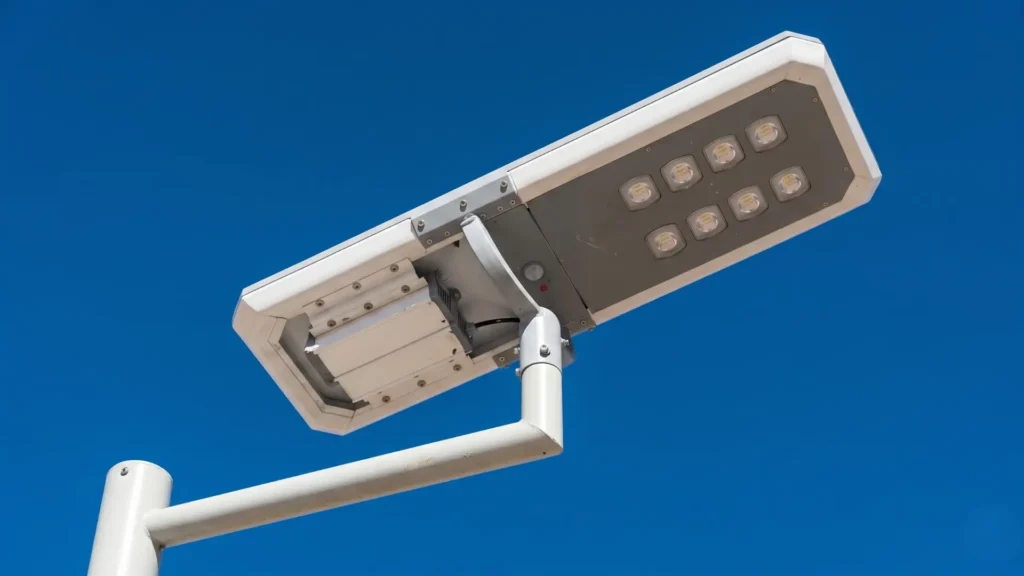
How Atlas Solves These Challenges
Continuous Rainy Days → Adaptive Lighting Strategy
The ALS 2.2 technology integrated into Atlas does more than simply reduce power consumption. It continuously monitors remaining battery capacity in real time.
During extended rainy periods, the system automatically enters an energy-management mode that gradually adjusts brightness output. Even after more than 10 consecutive days of low irradiance, the street lights continue providing essential nighttime visibility instead of shutting down abruptly.
High Temperatures → Thermal Protection During Charging
The TCS thermal control system actively intervenes during the charging process. When excessive ambient temperatures are detected, the system adjusts charging current and cut-off voltage to suppress battery temperature rise.
As a result, Atlas achieves significantly longer battery cycle life compared to conventional products without temperature management, particularly in consistently hot industrial environments such as those found in Mexico.
Wide-Road Dark Spots → Professional Light Distribution + Symmetrical Layout
Atlas uses a Type II IES light distribution pattern designed for extended horizontal coverage. Combined with a symmetrical bilateral installation layout, the lighting patterns from both sides overlap effectively at the road center.
This eliminates dark zones beneath low-height poles and ensures uniform illumination across the entire roadway, meeting the visibility requirements necessary for container truck operation.
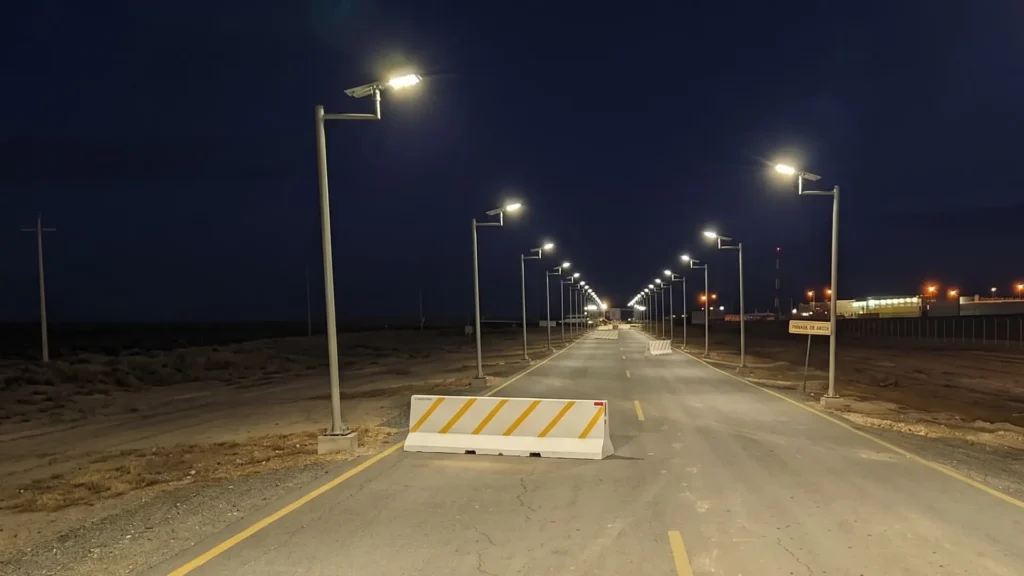
Project Results
After enduring a full rainy season—including more than 10 consecutive days of rainfall—all 196 lights achieved:
- Zero power-loss shutdowns
- Zero service calls
- Stable nighttime illumination without grid dependency
The project also eliminated electricity costs, underground cable maintenance, and unexpected battery replacement expenses.
Frequently Asked Questions (FAQ)
Q: Can solar street lights continue operating during 10 consecutive rainy days?
A: Yes. The ALS 2.2 system dynamically adjusts brightness according to available battery capacity, allowing the lights to continue operating through more than 10 consecutive cloudy or rainy days without sudden shutdowns.
Q: What is the recommended pole spacing for a 12-meter-wide industrial road?
A: For a 12-meter-wide industrial roadway using 5.5-meter poles and Type II light distribution, the typical recommended spacing is 25–30 meters. Wider spacing may require higher-lumen fixtures or customized lighting calculations.
Q: Is maintenance difficult in enclosed industrial zones?
A: No. The modular design supports fast on-pole component replacement, allowing standard maintenance teams to complete repairs efficiently while significantly reducing maintenance complexity and downtime.
Technical Experience Summary
When selecting solar street lights for enclosed industrial zones, the true risk is not how bright the system performs on sunny days, but whether it can maintain reliable operation under the worst environmental conditions.
This project demonstrates a critical engineering principle: a dependable off-grid lighting system is not defined by a single specification. Reliable performance depends on the precise integration of:
- Energy management strategies
- Thermal protection systems
- Professional lighting design
When these three elements are properly adapted to the project’s climate conditions and roadway requirements, the lighting system evolves from being merely “functional” into one of the most reliable components of the entire infrastructure project.