
Table of Contents
In certain ecotourism areas of Tanzania, nighttime road lighting has long presented unique challenges.
These areas are typically located far from urban power grids, and traditional AC-powered lighting not only involves high installation costs but also requires careful consideration of the ecological environment, maintenance conditions, and long-term operational reliability.
As a key gateway to ecotourism, this road section is subject to strict environmental protection requirements: traditional AC power grids cannot be installed, and lighting equipment must avoid causing significant impacts on the surrounding ecosystem. Additionally, persistent natural contaminants such as dust and bird droppings place higher demands on equipment reliability and continuous operation.
After multiple rounds of technical evaluation, the project team ultimately selected more than 120 sets of Sresky Thermos Series solar street lights to provide off-grid lighting for the scenic area’s main access roads and two visitor campsites. While meeting road safety requirements, the project also complies with the ecological and environmental management standards of the local protected area.
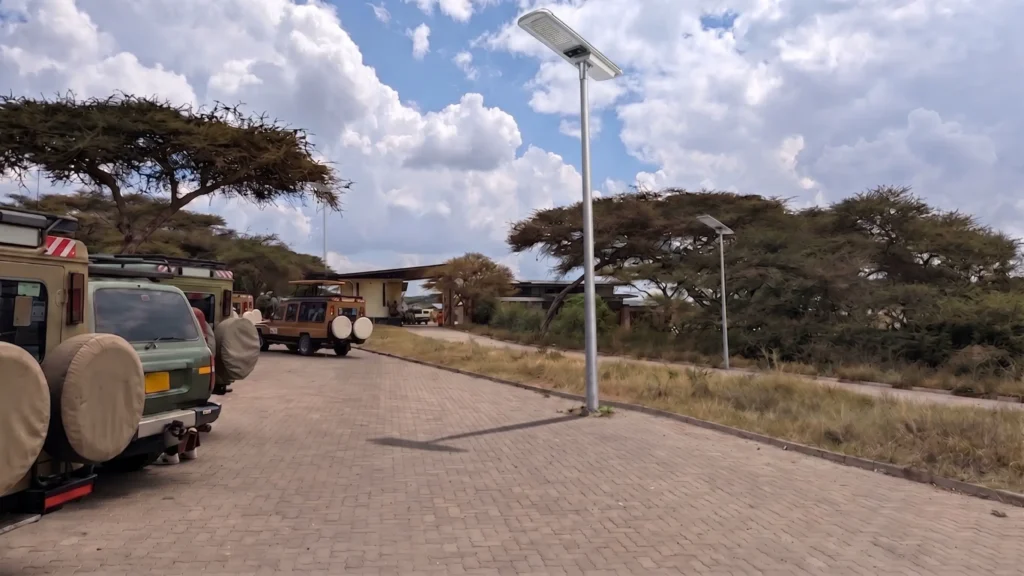
Project Overview
Project Information Details
| Field | Details |
|---|---|
| Project Name | Ecological Solar Road Lighting Project for the Buffer Zone of a Tanzanian National Nature Reserve |
| Project Location | A core wildlife reserve in Tanzania |
| Client | Local municipal authorities, national park management agencies, and the Ecological Tourism Alliance |
| Installation Quantity | More than 120 sets of Sresky Thermos Series solar street lights |
Project Challenges and Solutions
Challenge 1: Dust and Bird Droppings on Remote Off-Road Trails
Most roads within the reserve are unpaved gravel roads. The relatively dry climate, combined with the frequent passage of 4×4 off-road vehicle convoys, results in significant dust accumulation.
Dust generated by passing vehicles continuously settles on the surface of solar panels. Additionally, in some areas with frequent bird activity, natural contaminants such as bird droppings may adhere to photovoltaic panels, reducing their ability to capture sunlight effectively.
If pollutants such as dust and bird droppings remain on the panels for extended periods, they may reduce solar power generation efficiency and affect the system’s ability to recharge during daylight hours. In remote nature reserves, frequent manual maintenance is impractical due to limited access and challenging inspection conditions.
Sresky Technical Solution
To address the persistent issues of dust and natural contaminants on nature reserve roads, the Thermos Series is equipped with an automatic dust-cleaning system.
Key functions include:
- Automatically performing cleaning cycles at preset intervals to remove dust and some debris from solar panel surfaces;
- Reducing the need for frequent manual inspections and cleaning, thereby lowering maintenance pressure in remote areas;
- Maintaining solar panel surface cleanliness to improve the stability of energy generation.
Compared with traditional solutions that rely on periodic manual cleaning, this approach focuses on proactively reducing the impact of contaminants before they significantly affect equipment performance, rather than waiting until dust or stains accumulate and require intensive maintenance.
For roads in protected areas with limited operation and maintenance resources, automated cleaning provides a more suitable and sustainable solution for the local environment.
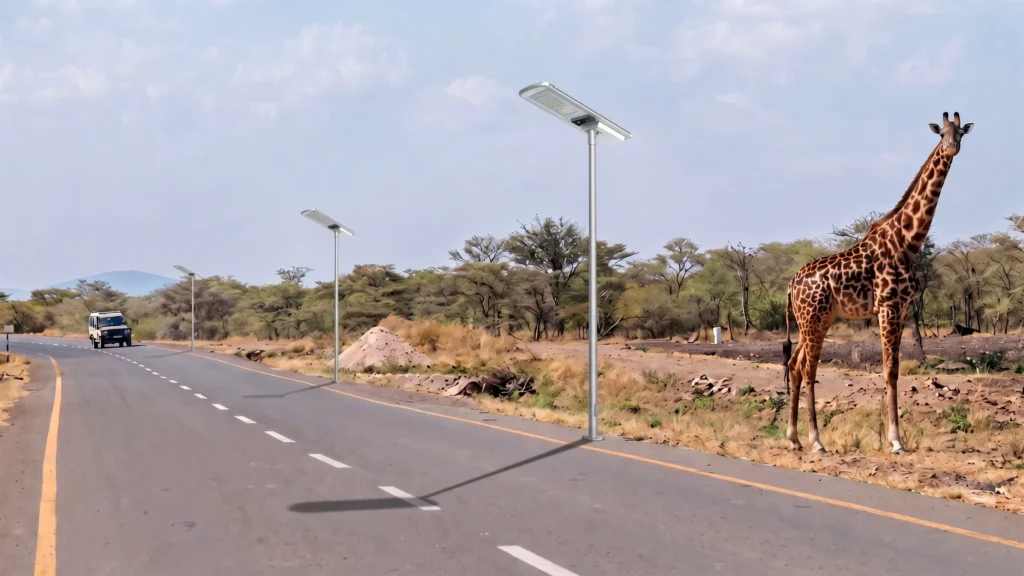
Challenge 2: The Impact of Day-Night Temperature Fluctuations on Energy Storage Systems in Plateau Regions
Some locations within the project area experience significant day-night temperature variations and high-temperature conditions, placing higher demands on the internal energy storage systems of solar street lights.
During the day, direct sunlight may increase the internal temperature of the equipment. At night, as temperatures drop, the operating conditions of the batteries change accordingly.
Conventional solar street lights operating in such environments may face the following challenges:
- High temperatures accelerating battery performance degradation;
- Low temperatures reducing battery discharge efficiency;
- Long-term temperature fluctuations affecting the stability of the energy storage system.
For roads in nature reserves, stable nighttime lighting directly affects visitor experiences and the safety of area management.
Sresky Technical Solution
The Thermos Series uses TCS intelligent temperature control technology to manage the temperature of the energy storage system.
Key features include:
- Real-time monitoring of battery cell temperature changes;
- Adjustment of charging and discharging strategies based on ambient temperature;
- Optimization of battery operating conditions in high- and low-temperature environments;
- Enhanced heat dissipation through a dedicated battery compartment design and aluminum alloy structure.
Based on operational feedback from the project, the equipment has maintained stable overall performance after experiencing the local rainy season and seasonal temperature fluctuations, with the energy storage system performing as expected.
Project Outcomes
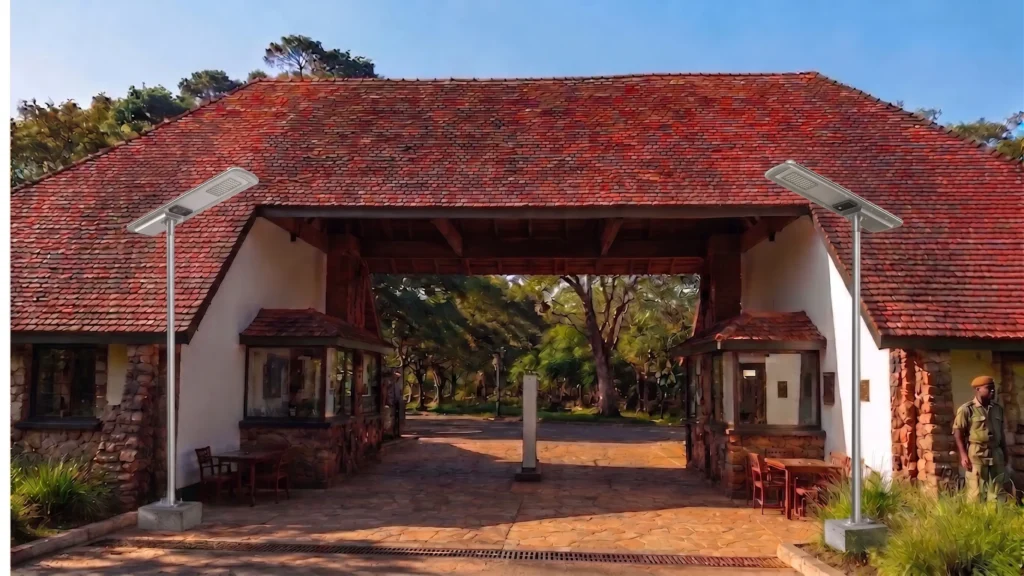
Since the project was put into operation, it has successfully withstood challenges including the rainy season, high temperatures, and long-term outdoor exposure, demonstrating stable overall performance:
- Nighttime lighting conditions along the road section have improved compared with previous conditions, reducing related traffic safety risks;
- The entire system is operating normally, and the energy storage system has not shown any significant abnormal degradation;
- The automatic cleaning system has reduced the impact of pollutants such as dust and bird droppings on solar panels, thereby easing daily maintenance requirements;
- The project meets the ecological reserve’s comprehensive requirements for off-grid lighting, environmental adaptability, and ease of maintenance.
For projects of this nature—where both lighting requirements and ecological management standards must be satisfied—success is not measured only by whether the roads are illuminated. More importantly, it depends on whether the equipment can maintain stable long-term operation under special environmental conditions while balancing environmental protection requirements with practical usage needs.
Customer Testimonial
“The roads in the reserve are long and remote, making manual cleaning and maintenance inconvenient. The automatic cleaning design of Thermos has reduced our daily maintenance workload and made solar lighting more suitable for these remote environments.”
Frequently Asked Questions (FAQ)
How long will solar street lights last in high-temperature regions?
The service life of solar street lights primarily depends on battery quality, temperature control design, product structure, and the actual installation environment.
In high-temperature regions such as Africa and the Middle East, it is recommended to select solar street lights with temperature management capabilities to reduce the risk of performance degradation during long-term operation.
How do solar street lights handle outdoor environments with high levels of dust and bird droppings?
In environments such as nature reserves, desert roads, and scenic area roads, solar panels may be affected by contaminants including dust, sand, and bird droppings.
It is recommended to prioritize solar street lights equipped with automatic cleaning functions. Automatic cleaning systems can remove some contaminants from solar panel surfaces at preset intervals, reducing the frequency of manual maintenance. This helps maintain energy-harvesting efficiency and is better suited for remote areas with limited maintenance resources.
How can solar street lights in remote areas reduce long-term maintenance costs?
Maintenance costs for remote projects typically come from:
- Personnel transportation;
- Solar panel cleaning;
- Troubleshooting;
- Repair and replacement of components.
Therefore, when selecting project solutions, attention should be given not only to lighting brightness but also to:
- Automated maintenance capabilities;
- Battery temperature control and energy management;
- Structural reliability;
- Ease of component maintenance.
For nature reserves and remote road projects, reducing even a single unnecessary on-site maintenance visit is often more valuable than simply lowering the initial purchase cost.
Conclusion
The ecological solar road lighting project in the buffer zones of Tanzania’s national protected areas demonstrates that solar street lights are more than just an alternative to traditional grid-connected lighting.
In unique environments far from urban power grids and subject to strict ecological conservation requirements, reliable off-grid lighting requires comprehensive consideration of multiple factors, including energy supply, environmental adaptability, equipment maintenance, and long-term operational stability.
For government infrastructure projects, ecotourism roads, and remote-area lighting projects, selecting an engineering-grade solar streetlight solution that meets local environmental conditions is more important than simply focusing on initial investment. Only by fully considering actual application scenarios and long-term operation and maintenance requirements can a lighting system continue to deliver value in complex environments.