
Table of Contents
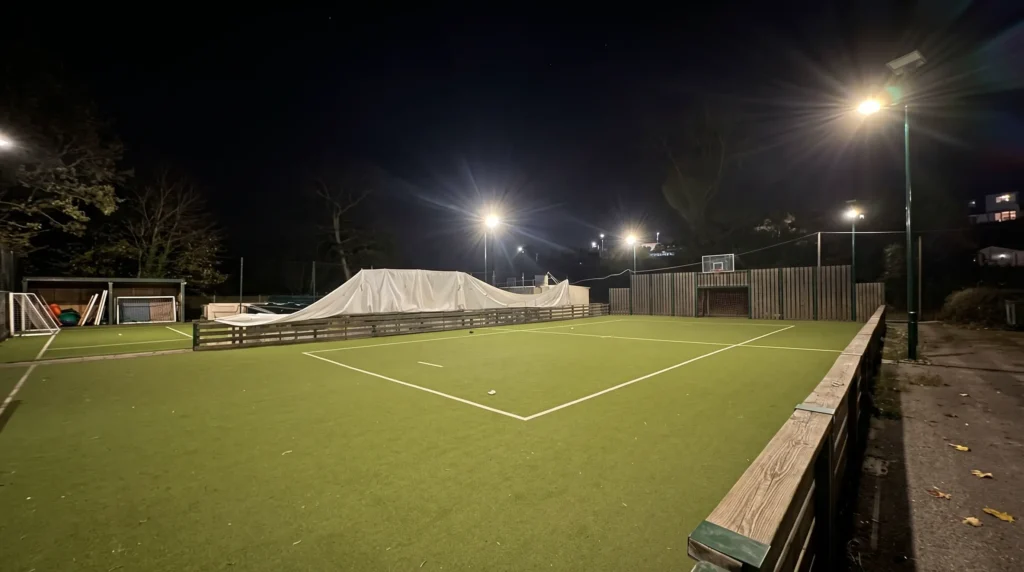
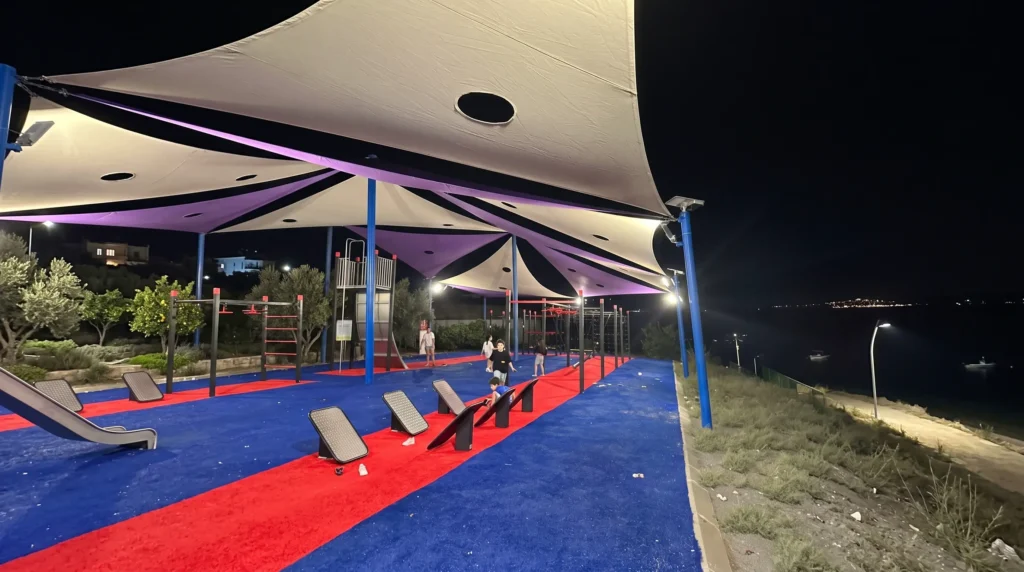
At dusk, the outdoor areas of a high-end residential community in central Israel remain bustling with activity. The children’s play areas, sports fields, and community walking paths require reliable nighttime lighting. However, installing new underground cables is not only a complex process but could also disrupt the existing landscape design.
Faced with the challenges of a high-temperature climate, tree shading, and long-term maintenance requirements, the project team sought a more flexible lighting solution. Consequently, the community deployed approximately 40 Sresky TITAN 2 Series solar street lights, configured with the SSL-64A and SSL-66A models, to provide lighting for outdoor sports and recreational spaces.
Project Snapshot
| Project Information | Details |
|---|---|
| Project Name | Solar Lighting Project for Outdoor Sports Fields and Play Areas in a Community in Israel |
| Project Location | Residential community in central Israel |
| Project Owner | Community developer and property management company |
| Product Model | Sresky TITAN 2 Series Solar Street Lights (SSL-64A / SSL-66A) |
| Installation Scale | Approximately 40 units |
Engineering Challenges and Solutions
In projects involving communities, landscaped areas, and public outdoor spaces, the selection of solar street lights must not only focus on initial lighting performance but also consider local climatic conditions, installation environments, and future maintenance requirements.
Certain regions of Israel experience high temperatures and intense sunlight, while the community’s landscaping design also imposes specific requirements on the installation of solar equipment.
Challenge 1: How can battery stability be improved in high-temperature environments?
Central Israel experiences hot summers with intense solar radiation. This project includes large open spaces such as sports fields, children’s play areas, and community walking paths.
Unlike typical green spaces, materials surrounding sports fields—such as rubber surfacing, asphalt pavement, and artificial turf—can easily absorb and accumulate heat under prolonged direct sunlight. After continuous exposure to sunlight during the day, both surface temperatures and local ambient temperatures may rise further, subjecting solar lighting equipment to greater thermal stress.
For solar street lights, the impact of high temperatures extends beyond short-term operational changes. When batteries are exposed to high temperatures over an extended period, performance degradation may accelerate, affecting both energy storage capacity and service life.
The project needed to address the following challenges:
- Mitigate the impact of high temperatures on battery performance;
- Maintain nighttime lighting requirements;
- Reduce the frequency of future maintenance.
Sresky Technical Solution: TITAN 2 Series + TCS Intelligent Temperature Control Technology
To meet the application requirements of high-temperature regions, the project employs Sresky’s TITAN 2 Series solar street lights (SSL-64A / SSL-66A), equipped with TCS (Thermal Control System) intelligent temperature control technology.
By managing battery operating conditions, this technology helps mitigate the effects of high-temperature environments and enhances the long-term operational stability of the equipment in hot regions.
The application of TCS technology primarily helps to:
- Optimize battery operating conditions in high-temperature environments;
- Reduce the risk of performance degradation caused by temperature fluctuations;
- Enhance operational reliability in unattended scenarios.
By configuring products according to local climatic conditions, the TITAN 2 Series is better suited for outdoor lighting applications in environments with intense sunlight and high temperatures.
Challenge 2: How can solar power generation and lighting performance be balanced under tree-shading conditions?
High-end residential communities typically enhance the living experience through carefully designed trees and greenery. However, trees can also restrict the installation locations of solar street lights.
The project’s planning needed to simultaneously meet the following requirements:
- Lighting needs for children’s play areas;
- Pedestrian safety within the community;
- Lighting coverage for sports areas;
- Preservation of the landscape environment.
If traditional fixed-structure solar street lights were used, solar panels could be obstructed by tree canopies, and the installation locations of the luminaires would also be significantly restricted.
Sresky Technical Solution: Modular Design Enhances Installation Flexibility
The Sresky TITAN 2 Series features a modular design, allowing greater flexibility in the layout of solar panels and luminaires.
During actual installation, the project team can adjust equipment placement based on:
- On-site greenery distribution;
- Road layout;
- Lighting coverage area.
At the same time, the solar panel mounts support multi-angle adjustment, helping avoid partially shaded areas and improve solar energy collection efficiency.
This design better meets the solar lighting needs of communities, parks, and areas with high aesthetic requirements.
Project Outcomes
- Meeting Sports Lighting Needs: 40 TITAN 2 Series systems were installed in community sports and recreational areas to meet daily lighting requirements while ensuring optimal illuminance distribution and glare control.
- Enhanced Adaptability to Complex Environments: The TCS temperature control system and the ALS 2.2 core algorithm work together to improve power supply stability under high-temperature and overcast or rainy weather conditions.
- Ensuring Long-Term Performance: The system can operate continuously for more than 10 days during overcast or rainy weather, supporting lighting operations under adverse weather conditions.
- Improving Project Delivery Efficiency: Standardized design helps streamline on-site installation and commissioning processes, improving overall project implementation efficiency.
Customer Testimonial
“With extensive landscaping in the community, there were significant restrictions on where to install the solar panels. Sresky’s split-type design allows for flexible placement of photovoltaic panels and luminaires while maintaining stable operation even in high-temperature environments, which perfectly meets our practical needs.”
FAQ: Common Questions Regarding the Procurement of High-End Community Solar Street Lights
1. Are solar street lights suitable for installation in high-temperature regions like Israel?
Yes, they can be considered.
However, when deploying solar street lights in high-temperature regions, special attention should be paid to:
- Battery management methods;
- Product structural design;
- Long-term environmental adaptability.
One of the main challenges posed by Israel’s high summer temperatures is the impact of long-term temperature fluctuations on solar street light battery performance.
Products with temperature management designs help improve system stability in high-temperature environments.
2. Why choose solar street lights for residential communities?
For:
- Newly built communities;
- Landscape renovation projects;
- Outdoor space upgrade projects;
Solar street lights do not require extensive underground cable installation, offering greater installation flexibility.
Key advantages include:
- Reduced impact on greenery and roads;
- Simplified construction processes;
- Easier future adjustments and expansion;
- Suitability for areas with high aesthetic requirements.
3. Does tree shade affect the charging efficiency of solar street lights?
Yes.
In areas with dense tree coverage, the installation locations of solar street lights must be planned according to the on-site environment.
Adopting a split-type design and adjustable photovoltaic mounting methods can help projects better balance:
- Solar energy collection;
- Light fixture placement;
- Aesthetic requirements.
Conclusion
The Israeli community solar lighting project exemplifies a practical trend:
Solar street lights are not merely an alternative to traditional lighting; they are an outdoor infrastructure solution that must be designed according to local climate conditions, spatial planning, and long-term operational needs.
In community environments characterized by high temperatures, abundant greenery, and a strong focus on landscape quality:
- Battery management capabilities;
- Installation flexibility;
- Long-term operational stability;
all influence the project’s long-term value.
By tailoring designs to specific application environments, solar lighting can provide more flexible and sustainable solutions for upgrading community outdoor spaces.