
On the northwest coast of Bali at dusk, the sea breeze carries thick salt fog over the newly built eco-resort.
Standing beside the seaside promenade, the project director looks out at the landscaped area that is about to be put into use, yet one concern remains—will the lights here withstand the erosion caused by the sea breeze in the years to come?
In previous island projects, standard streetlights often suffered from corroded brackets, peeling surfaces, or even internal malfunctions within less than two years. A single repair trip across the island could cost far more than the equipment itself.
For this high-end resort, which prioritizes natural aesthetics and low-maintenance operations, what they needed was not just a single light, but a long-term lighting solution truly adapted to the island environment.
Based on this requirement, Sresky custom-deployed 85 sets of Titan 1 solar streetlight systems for Phase I of the project, creating a solution that balances coastal durability, aesthetic appeal, and low O&M costs.
Project Snapshot
| Project Elements | Details |
|---|---|
| Project Name | Solar Streetlight Project for an Indonesian Waterfront Eco-Resort (Phase I) |
| Project Location | High-end coastal resorts in Bali and Lombok, Indonesia |
| Client/Lead Party | High-end private eco-resort hotel group and landscape design consulting team |
| Deployment Scale | 85 sets of Sresky Titan 1 customized solar streetlight systems |
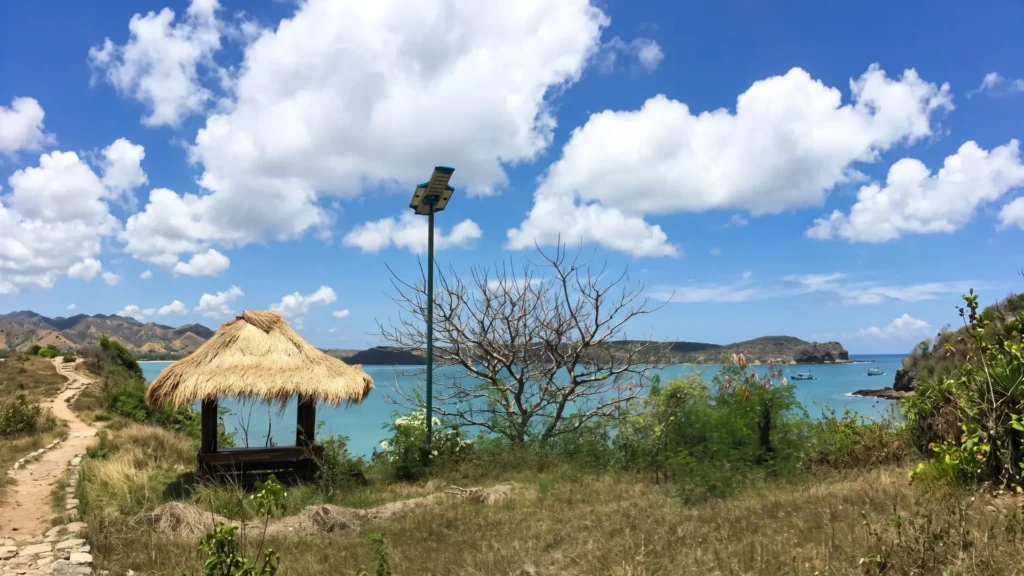
Engineering Challenges and Targeted Solutions
Challenge 1: Structural Reliability Challenges Caused by High Corrosion and High Wind Loads in Waterfront Areas
Located in a waterfront area on an island, the project is continuously exposed to high humidity and heavy salt fog, meeting the typical C5-M marine corrosion classification.
Additionally, the installation area features soft soil foundations and is subject to strong sea winds, placing higher demands on the structural stability of the light poles.
Key risks include:
- Salt fog corrosion reducing the service life of light poles and fasteners;
- Soft soil foundations causing foundation settlement and potential light pole tilting;
- Strong winds of up to Force 14 increasing stress risks for photovoltaic modules;
- Traditional foundation construction damaging the ecological landscape and increasing construction costs.
Sresky Solution: C5-M Corrosion Protection + Wind Resistance Up to Force 14 + Trenchless Installation
The Titan 1 features a comprehensive C5-M-grade corrosion protection design:
- A corrosion-resistant aluminum alloy lamp body structure reduces the risk of long-term corrosion in salt fog environments;
- Dual protection through anodizing and fluorocarbon coating;
- SUS316 stainless steel fasteners.
It also features an integrated top-mounted structure that minimizes the impact of underground moisture.
Depending on on-site soil conditions, a low-disturbance foundation solution can be adopted to reduce large-scale excavation in landscaped areas.
Through C5-M marine-grade corrosion protection, wind resistance up to Force 14, and trenchless installation, the Titan 1 meets the requirements for long-term, stable operation in waterfront environments.
Challenge 2: Supply Chain Constraints and Inter-Island O&M Cost Pressures in Indonesian Island Projects
Located on a remote Indonesian island, the project faces not only product supply constraints during the procurement phase but also long-term maintenance pressures.
The local solar streetlight market is dominated by traditional government-project-oriented products:
- Limited options for high-end integrated solar streetlights;
- Difficulty meeting the customization requirements of landscape projects in terms of appearance and color temperature;
- Suppliers are typically reluctant to complete additional certifications and customized development for small-batch projects.
At the same time, the island environment increases the difficulty of post-installation operation and maintenance:
- Technical personnel must be dispatched across islands to address malfunctions;
- Labor, transportation, and costs associated with streetlight outages continue to rise;
- Standard products are prone to premature failure in high-humidity and high-temperature environments.
These hidden costs are often overlooked during the procurement phase but directly affect the project’s lifecycle value.
Sresky Solution: Integrated Design + FAS Smart Diagnostics for Low-Maintenance Island Lighting
From the design phase onward, the Titan 1 was developed with the core objective of “eliminating the need for cross-island maintenance.”
Product advantages include:
- FAS Automatic Fault Diagnosis System: Rapidly assesses the status of solar panels, batteries, and PCBA control modules;
- Modular Design: Enables quick replacement of critical components, reduces on-site disassembly time, and lowers reliance on specialized maintenance personnel;
- Comprehensive certification documentation support: Assists in meeting Indonesian market compliance requirements;
- SKD (Semi-Knocked-Down) partnership solution: Enhances supply flexibility and reduces customs clearance burdens.
Through “Smart Diagnostics + Rapid Maintenance + Localized Supply Support,” Titan 1 helps projects reduce the need for cross-island maintenance.
According to subsequent calculations by the project owner, cross-island O&M costs over the lifecycle were reduced by more than 80%.
Project Outcomes
1. Enhanced Adaptability to Coastal Environments
Through the use of corrosion-resistant materials, protective structures, and sealed designs, the equipment is capable of withstanding coastal environments characterized by high salt fog and high humidity.
2. Reduced Impact on Landscaping
No underground cables are required:
- Reduced road excavation;
- Minimized disruption to landscaped areas;
- Accelerated project deployment.
3. Reduced Maintenance Burden on the Island
Modular design and intelligent diagnostic features:
- Simplify troubleshooting;
- Reduce the complexity of on-site repairs;
- Minimize the need for cross-regional maintenance.
4. Enhanced Nighttime Landscape Experience
Stable and soft lighting effects provide a more comfortable lighting environment for visitors during nighttime strolls and activities in public areas.
Customer Testimonial
“For island resort projects, the biggest challenge isn’t installation—it’s maintenance years down the line. The Sresky solution minimizes wiring work while making equipment maintenance much simpler. Now we can focus more on enhancing the visitor experience rather than constantly dealing with lighting malfunctions.”
—Resort Operations Director (Bali, 2025 Review Meeting)
Frequently Asked Questions (FAQ)
Q1: Are integrated solar street lights or split-type systems more suitable for landscape projects?
A: For landscape projects such as waterfront areas, parks, and scenic spots, integrated solar street lights are generally more suitable.
Although split-type systems have lower initial costs, underground battery compartments may face issues such as water accumulation, moisture, and maintenance difficulties.
The integrated design incorporates core components into the top of the luminaire, reducing the need for underground construction and making it more suitable for projects that require landscape integrity, installation convenience, and long-term reliability.
Q2: How can solar street lights in coastal or waterfront environments be protected against corrosion?
A: Salt fog, high humidity, and underground moisture in waterfront environments can all accelerate equipment aging.
Therefore, solar street lights require special attention to corrosion-resistant materials, sealed structures, and electrical protection designs.
Using corrosion-resistant housings, waterproof seals, and avoiding underground battery compartments can effectively reduce the impact of salt and moisture on the system, improving long-term operational reliability.
Q3: How do solar street lights reduce maintenance costs for landscape projects?
A: Maintenance in scenic areas, on islands, and in remote regions typically faces challenges such as high transportation and labor costs.
Therefore, selecting solar street lights with modular designs and intelligent fault detection capabilities allows for rapid fault localization and replacement of individual components. This reduces the need to replace entire lights or require specialized personnel for on-site repairs, thereby lowering long-term operation and maintenance costs.