
Table of Contents
Early this year, when the developer of an eco-agricultural tourism estate (Finca Agroturística) in the high-altitude regions of the Colombian Andes approached us, they presented a challenging set of requirements: 2 to 4 kilometers of farm roads and wooden viewing platforms required nighttime lighting, while the project area was adjacent to vast cornfields with virtually no artificial light pollution, preserving a pristine dark night sky.
The client had several specific concerns: they worried that lighting could affect corn growth, that flying insects could accumulate on the fixtures, and, most importantly, that frequent maintenance visits would be required in this remote mountainous area.
Ultimately, we customized 50 sets of SRESKY ATLAS Series all-in-one solar street lights for this project. This was not merely a project to “turn on the lights,” but a model case of off-grid lighting implementation in an ecologically sensitive agricultural environment.
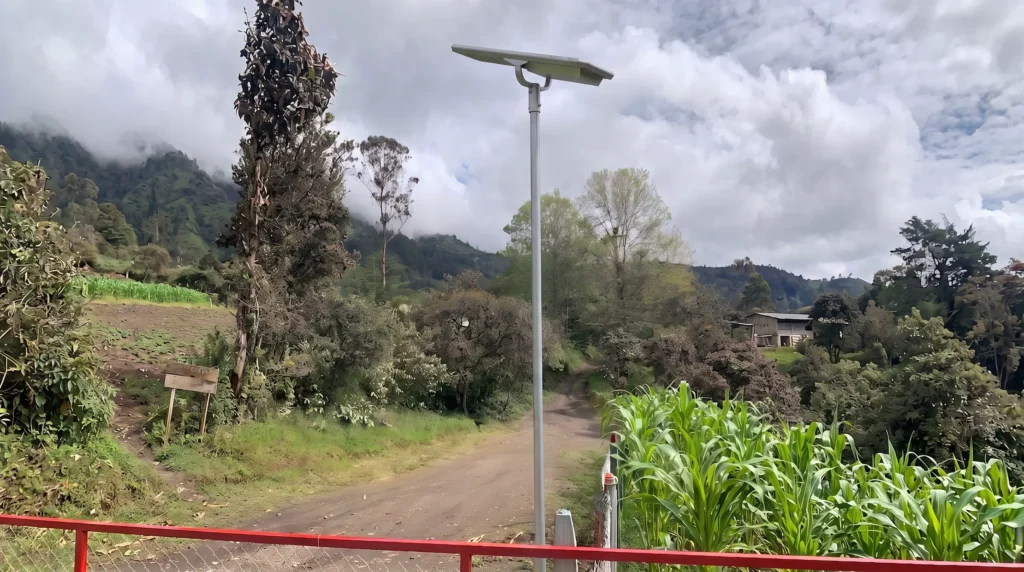
Project Overview
Project Details
| Field | Details |
|---|---|
| Project Name | Solar Lighting Project for Rural Roads in the Colombian Andes |
| Project Location | Mid-to-high-altitude agricultural-residential transition zone in the Andes Mountains |
| Client | Developer of an Ecological Agritourism Estate (Finca Agroturística) |
| Deployment Quantity | 50 sets of ATLAS Series all-in-one solar street lights |
Project Challenges
Challenge 1: Balancing Road Lighting Requirements with Agricultural Ecology
Many solar streetlight projects focus primarily on illuminance and coverage area. However, in agricultural areas, light itself becomes an environmental factor.
The roads in this project are adjacent to corn-growing areas. Corn is relatively sensitive to photoperiod changes, and prolonged exposure to high-intensity artificial light at night may interfere with its natural growth cycles.
Meanwhile, insect activity is particularly high at night in mountainous agricultural environments. Traditional high-brightness road lights operating continuously at full power can act as strong light sources, attracting phototactic insects.
Common issues with standard fixed-output solar street lights include:
- Continuous high-brightness operation throughout the night;
- Light spreading into surrounding farmland;
- Cool white light with a high proportion of blue wavelengths attracting more insects;
- Long-term accumulation of insect remains on luminaire surfaces, increasing maintenance requirements.
For eco-agricultural estates, brighter lighting is not necessarily better. The goal is to provide sufficient illumination only when needed.
SRESKY ATLAS Technical Solution 1
To address this scenario, the ATLAS Series adopts intelligent lighting control logic and uses PIR (Passive Infrared) motion sensors to reduce unnecessary lighting time.
The product supports multiple lighting modes, including M1, M2, and M3. In M1 mode, the base brightness is set at 30%, and brightness automatically increases when people or vehicles pass by, triggered by PIR detection. The PIR sensor provides a 120° detection angle with a maximum detection range of 8 meters.
The actual application logic is as follows:
Late at night when no one is passing by:
- Streetlights remain in a low-power standby state;
- The impact of continuous lighting on the farmland environment is reduced;
- Energy consumption is minimized.
When agricultural workers are conducting patrols or vehicles pass by:
- Brightness automatically increases;
- More comprehensive road lighting is provided.
Compared with traditional solar streetlights that “operate at full power all night,” this approach better matches the actual usage patterns of rural roads.
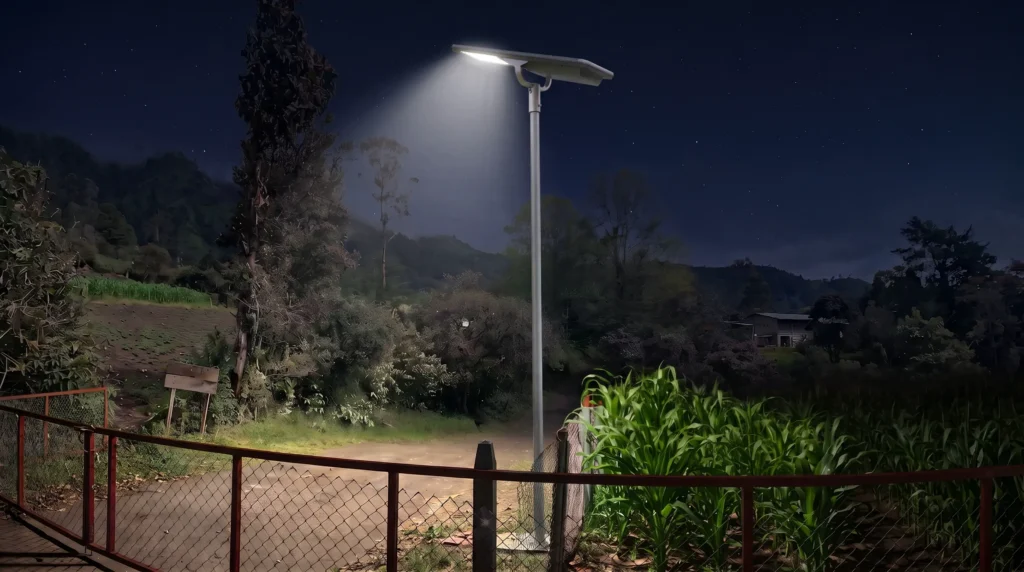
Additionally, the ATLAS Series uses a Type-II light distribution design, concentrating illumination more effectively on the road surface rather than allowing excessive light spill into surrounding farmland, making it suitable for rural road lighting applications.
Challenge 2: No Grid Access and Difficult Terrain Resulting in High Maintenance Challenges
There are no urban roads or infrastructure facilities near this project site, and the equipment installation locations are far from maintenance centers.
For standard solar street lights, the major long-term cost is often not the initial purchase price, but maintenance several years after installation, including:
- Declining battery capacity;
- Control system failures;
- Aging seals;
- The need for personnel to travel into mountainous areas for repairs.
Mountainous environments are typically characterized by:
- High humidity;
- Significant day-night temperature fluctuations;
- Long rainy seasons.
If equipment protection is insufficient, battery performance may deteriorate after several years of operation.
SRESKY ATLAS Technical Solution 2
The ATLAS Series uses A+ grade lithium iron phosphate (LiFePO₄) batteries and is equipped with an intelligent BMS protection system featuring multi-level hardware protection logic.
Lithium iron phosphate batteries have a cycle life of more than 4,000 charge-discharge cycles. Based on an average of one cycle per day, the theoretical service life can reach approximately 10 years.
For this project, the core value is not simply “brighter lighting,” but minimizing maintenance requirements by reducing the frequency of repeated visits by maintenance personnel to remote mountainous areas.
Combined with an IP66 protection rating and an IK08 impact-resistant structure, ATLAS is better suited for long-term outdoor applications and helps reduce maintenance burdens in remote environments.
Project Outcomes
- Light Pollution Control: By combining a Type-II light distribution design with a fully directional light control structure, the light beam is largely confined to the road surface, significantly reducing stray light entering the corn-growing areas at night.
- Reduced Insect Accumulation: In low-power cruise mode, project feedback indicates that insect accumulation has been significantly reduced. Fewer insect remains are found on lens surfaces, and light transmittance has remained generally stable.
- Significantly Reduced Maintenance Requirements: During approximately six months of operation for the 50 luminaires, no on-site repairs or battery replacements have been recorded.
- Prompt Lighting Response: In nighttime low-power cruise mode, the PIR sensor system quickly increases brightness to the preset level when people or vehicles pass by. According to project feedback, no noticeable lighting interruptions have occurred during the operational period.
Customer Testimonial
“Our primary concern was not simply nighttime brightness, but whether the equipment was suitable for an ecological agricultural environment. Roads need lighting, but the solution must not affect surrounding farmland or require frequent maintenance after several years. ATLAS’s smart control and battery solutions better meet the requirements of mountainous projects.”
Frequently Asked Questions (FAQ)
1. Are solar street lights suitable for installation on mountain roads?
Generally speaking, yes.
Mountain roads often face challenges such as high grid installation costs and long construction timelines. Solar street lights do not require underground cabling and can operate directly using solar energy.
However, when selecting products for mountainous projects, special attention should be paid to:
- Battery type;
- Protection rating;
- Smart control features;
- Battery performance during rainy seasons.
Compared with urban roads, mountainous projects place greater emphasis on long-term and stable operation.
2. Will installing solar street lights near farmland affect crops?
It depends on the luminaire design.
If standard high-brightness, fixed-output luminaires are used, prolonged nighttime illumination may increase the risk of light pollution.
For agricultural areas, the following features are recommended:
- Smart sensor modes;
- Appropriate light distribution;
- Effective control of stray light.
By reducing brightness during periods without activity, unnecessary artificial light interference can be minimized.
3. What is the service life of LiFePO₄ battery-powered solar street lights?
LiFePO₄ batteries provide better cycle performance than traditional battery types.
According to ATLAS Series documentation, the battery cycle life exceeds 4,000 cycles, and the system is equipped with a BMS protection system to improve long-term operational safety.
Actual service life may also be affected by local temperature, solar radiation conditions, and maintenance practices.
Summary
For ecological agricultural road projects such as those in the Colombian Andes, the core value of solar street lights lies not simply in replacing grid-based lighting, but in providing a balanced solution for areas without infrastructure.
A successful solution must ensure safe nighttime travel while minimizing impact on the natural environment and reducing long-term operation and maintenance costs.