
Table of Contents
- Project Background
- Project Overview
- Key Challenges and Solutions
- Project Outcomes
- Client Testimonials
- Frequently Asked Questions (FAQ)
Project Background
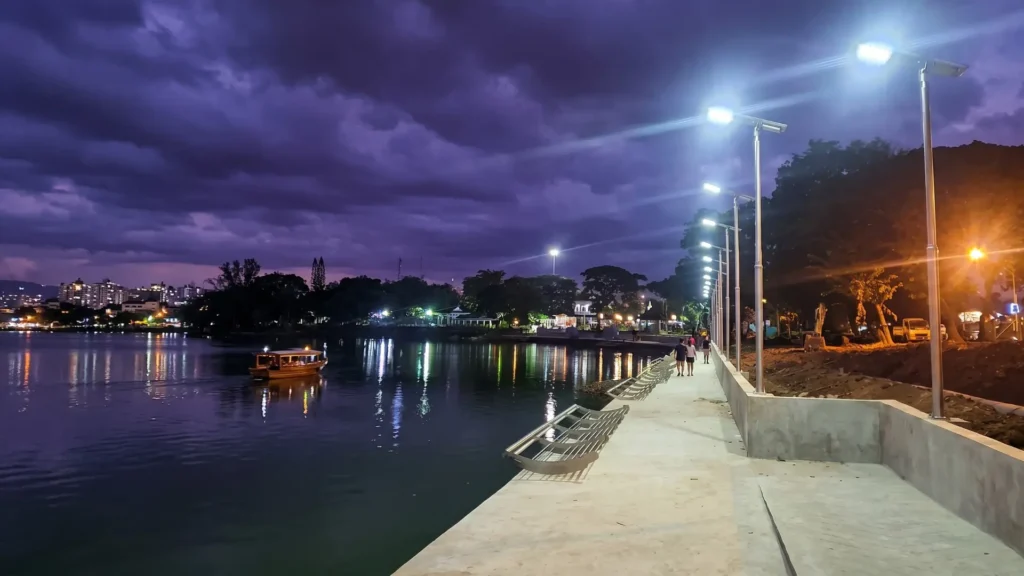
The lighting upgrade for a 1.2-kilometer waterfront walkway in Bangkok may not seem like a major project, but it had been a persistent challenge for the Municipal Public Works Bureau for nearly a year. The main issue was not funding, but construction. The walkway is squeezed between an old residential district and the river, with the narrowest section located less than 5 meters from residents’ balconies. In previous years, any proposal involving excavation immediately triggered a wave of complaints from local residents.
Under traditional construction methods, whether connecting to the city grid or installing standard streetlights, heavy machinery would have been required. Road excavation, pipe laying, formwork and rebar installation, and large-volume concrete pouring meant the civil engineering work alone could consume the entire dry season. More critically, flood-control pipelines and multiple underground utility networks were densely packed beneath the promenade, making coordination and approval procedures extremely time-consuming—often taking two to three months.
The project team understood that this approach would not only disrupt residents’ daily lives but also make it impossible to complete the project before the rainy season arrived.
The directive from municipal authorities was straightforward:
“Can you make it fast, quiet, and ensure residents don’t come complaining to us?”
After a technical assessment, the team ultimately selected 80 units from the SRESKY ATLAS Series. Installation was completed just before the rainy season began.
Today, the promenade is fully illuminated every night and has become one of the most popular evening destinations for local residents.
Project Overview
| Project Details | Information |
|---|---|
| Location | Bangkok Metropolitan Area — Waterfront Promenade |
| Client | Local Municipal Public Works Bureau / Department of Urban Public Spaces |
| Product | SRESKY ATLAS Series (Main Model: SSL-36A) |
| Number Installed | 80 units |
| Layout | Single-sided installation, spaced 25–30 meters apart |
Key Challenges and Solutions
Challenge 1: The Dual Pressure of a Corrosive Environment and Public Space Requirements
Bangkok’s waterfront areas experience year-round humidity levels above 80%, and standing water is common during the rainy season. Traditional metal lighting fixtures frequently suffer from internal corrosion, water ingress in junction boxes, and deterioration at the pole base within just two to three years. By the time these issues become visible, the entire fixture often requires replacement. Municipal authorities are highly aware of these hidden long-term maintenance costs.
At the same time, the promenade functions as an important public space where residents gather to socialize, relax, jog, and cycle in the evenings. If the lighting is excessively harsh or uneven, people will naturally avoid the area, defeating the original purpose of the project.
SRESKY Solution
Hardware Protection
The SSL-36A features a fully sealed aluminum-alloy housing with an IP65 protection rating and IK08 impact resistance. All mounting brackets undergo dual anti-corrosion treatment. In a permanently humid waterfront environment, these features directly determine whether the luminaires can survive multiple rainy seasons or require premature replacement.
Light Distribution Design
A Type II asymmetric light distribution design was selected. With 5–6-meter pole heights and 25–30-meter spacing in a single-sided layout, the lighting evenly covers the walking surface while carefully controlling spill light toward the river and nearby residential windows. The result is effective illumination without disturbing local residents.
After project completion, the increased nighttime foot traffic along the promenade became the clearest indicator of success.
Challenge 2: Extremely Limited Construction Space in Residential Areas
This was the most difficult aspect of the entire project and the primary reason construction had been delayed for so long.
The promenade is just over 3 meters wide, with a river retaining wall on one side and residential fencing on the other. Traditional streetlight foundations typically require excavation pits exceeding 1 cubic meter. Combined with ready-mix concrete trucks, formwork installation, and curing time, each foundation would take at least two days to complete.
For 80 lighting units, this would have meant months of noise, dust, blocked access, and partial road closures. In such a densely populated residential environment, public complaints would have been unavoidable. Even if the municipal power supply issue had been resolved, the conventional foundation construction process itself remained impractical.
SRESKY’s Quick-Install Foundation Solution
To minimize disruption to residents’ daily lives, the project team adopted custom-designed compact high-strength foundation cages. This optimized structural design reduced the lateral excavation area required for each foundation and eliminated the need for large construction machinery. Foundation preparation could therefore be completed using only micro-equipment or manual labor.
Combined with the ATLAS Series’ cable-free and grid-independent design, the construction workflow was dramatically simplified:
Micro-excavation → pre-installation of compact foundation cages → rapid concrete pouring → pole installation and tightening.
Using a segmented assembly-line installation approach, construction time per lighting point was reduced by approximately 70%, enabling rapid project delivery without interrupting residents’ evening use of the walkway.
This “micro-foundation + rapid construction” solution successfully solved the project’s two biggest challenges simultaneously: resident complaints and prolonged construction delays.
Civil engineering work no longer required large-scale mobilization, and the project subsequently became a valuable reference case for the Municipal Engineering Bureau when promoting community solar lighting projects across other districts.
Project Outcomes
After enduring the entire monsoon season, the pathway maintained stable lighting performance with no recorded outages or unexpected blackouts.
Residents have fully embraced the upgraded promenade. Evening walks, jogging, and social gatherings have transformed the area from a space that was once “deserted after dark” into a vibrant nighttime community destination.
Most notably, the project generated zero construction complaints, and pedestrian access remained largely uninterrupted throughout the installation period. For the first time, the Public Works Department received overwhelmingly positive community feedback for a lighting infrastructure project.
Client Testimonials
“For us, the primary goal of this project was to avoid disturbing residents. SRESKY allowed us to install the lights almost ‘silently’; the installation process was so fast that even we were surprised. Now the walkway is full of people every night, yet most residents hardly noticed construction had taken place. That is probably the best compliment we could receive.”
— Head of Municipal Engineering, Greater Bangkok Metropolitan Area
Frequently Asked Questions (FAQ)
Q: How long can solar street lights operate during consecutive rainy or overcast days?
A: The duration primarily depends on the battery management system. Conventional solar lights may experience significant dimming after 3–5 consecutive overcast days. The ATLAS Series, equipped with the ALS 2.2 intelligent energy management system, dynamically adjusts brightness based on remaining battery capacity and has been tested to continue operating through up to 10 consecutive days of low-sunlight conditions.
Q: Is the corrosion resistance of solar street lights sufficient for waterfront environments?
A: The key factor is not only the IP rating but also the overall sealing structure. The ATLAS Series uses an integrated sealed housing with waterproof connectors and no exposed ventilation openings. After enduring an entire rainy season in Bangkok’s high-humidity and tidal salt-fog environment, on-site inspections confirmed no visible internal corrosion or oxidation on terminal components.
Q: Are solar street lights suitable for waterfront walkways?
A: Yes. Solar street lights are particularly suitable for waterfront walkways and other areas with limited excavation space, complex underground utility networks, or strict requirements to minimize disruption to surrounding residents and landscapes. Because they eliminate the need for underground power cables, they significantly reduce both the construction footprint and civil engineering time required for installation.