
Designed to withstand Canada’s extreme cold of -20°C and low-light conditions in winter, the Sresky Basalt SSL-912A solar street light delivers a stable, high-brightness output of 12,000 lm thanks to its patented TCS thermal control system and ALS 2.2 intelligent control technology. This article details its preheating and charging protection features, wide-angle tilt bracket design to prevent snow accumulation, and the significant savings in excavation costs compared to grid-connected systems, providing a zero-maintenance, highly reliable B2B technical solution for municipal park lighting in high-latitude regions.
Table of Contents
Providing lighting for public parks in Canada presents significant engineering challenges. While the primary goal is to ensure pedestrian safety, the lighting system must also withstand extreme cold, temperatures below -20°C, winter daylight periods reduced to less than 2.5 hours, and years of demanding municipal performance testing.
The Sresky Basalt SSL-912A is a solar street light specifically engineered to meet these strict municipal requirements. With a high-brightness output of 12,000 lumens and an ultra-high-capacity 692.64 Wh battery, it is ideal for applications requiring wide coverage per pole, such as major park thoroughfares and large public plazas.
Project Snapshot
| Specifications | Details |
|---|---|
| Product | Sresky Basalt SSL-912A |
| Application Scenarios | Main thoroughfares in Canadian municipal parks, large plazas, shared pathways |
| Light Output | 12,000 lm |
| Recommended Installation Height | 10–12 m |
| Key Technologies | TCS Temperature Control System, Low-Temperature Insulation Process, ALS 2.2 Adaptive Lighting System |
| Protection Rating | IP65 / IK08 |
| Certifications / Warranty | CE, RoHS; 3-year product warranty |
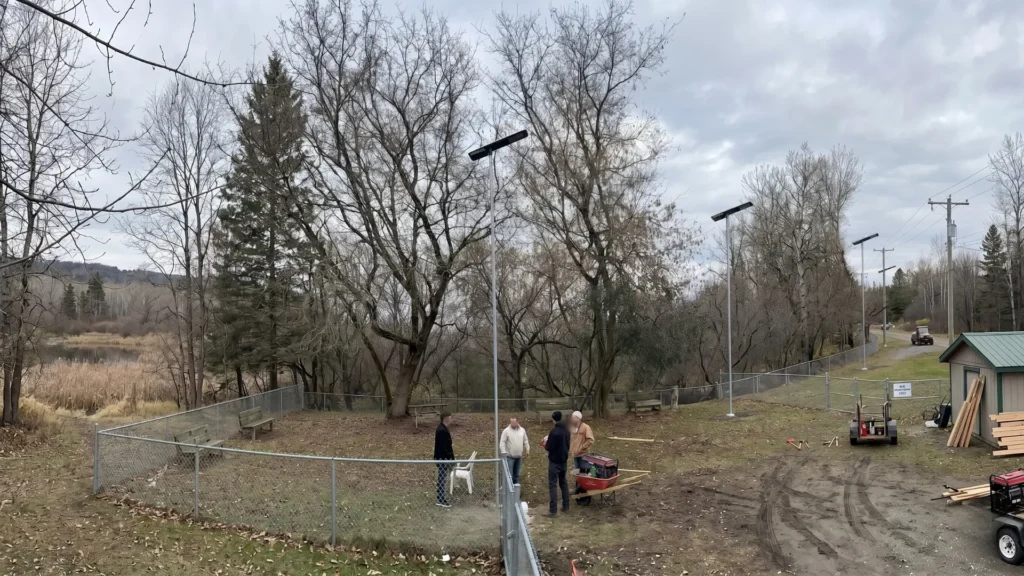
Why Do Standard Solar Street Lights Struggle in Canadian Winters?
1. Physical Limitations in Extreme Cold: Systemic Challenges with Batteries and Charging
In cities such as Calgary and Edmonton, conventional solar street lights often fail during winter. The core issue is that charging lithium batteries in low-temperature environments can cause lithium dendrites to form inside the cells, leading to irreversible capacity degradation and even short circuits. In addition, the usable discharge capacity of standard lithium batteries can drop by more than 50% at -25°C.
Sresky Solution: TCS Temperature Control + Low-Temperature Insulation Process
Low-Temperature Charging Protection
The SSL-912A features a TCS (Thermal Control System). This system incorporates a high-performance thermal insulation layer around the battery pack, combined with active heating technology. When sensors detect temperatures below the charging threshold, the system prioritizes using solar panel current to preheat the battery cells, ensuring they remain within the optimal charging temperature range and effectively preventing low-temperature charging degradation.
High Redundancy Capacity
With its massive 692.64 Wh battery capacity—the highest specification in the Basalt series—the SSL-912A maintains sufficient energy reserves to sustain a high-output 12,000 lm illumination level during extremely cold nights, even when physical power loss occurs.
2. Engineering Optimizations for High-Latitude Regions
Sun Altitude Compensation
In regions north of 50°N latitude, such as Saskatoon, the sun remains extremely low during the winter solstice. For these environments, an installation tilt angle of 50–60° is recommended. Compared to standard installation angles, this steeper tilt can improve winter photovoltaic conversion efficiency by 25–35% while also allowing snow to slide off naturally, reducing charging interruptions caused by snow accumulation.
Energy Management Strategy
The SSL-912A is equipped with patented ALS 2.2 technology, designed around the principle of intelligent energy allocation. The system automatically adjusts output power based on the previous day’s charging performance. During prolonged blizzard conditions, the luminaire maintains basic illumination levels instead of attempting to sustain maximum brightness, thereby avoiding complete system shutdown.
Light Distribution and Layout: Improving Park Pathway Coverage Efficiency
The SSL-912A adopts a TYPE-III asymmetric light distribution system. This professional lens-controlled distribution pattern extends light horizontally and directs it precisely onto pathways and road surfaces, minimizing unnecessary illumination of surrounding green spaces.
12-Meter Installation Height
Thanks to its exceptionally large coverage radius per pole, the recommended pole spacing can reach 50–55 meters while still complying with IES RP-33 safety standards.
Reduced Capital Expenditure (CAPEX)
With its ultra-high 12,000 lm output, municipal projects can reduce the number of required poles by 20–30% compared to lower-wattage alternatives while maintaining equivalent illuminance levels. This not only lowers fixture procurement costs but also significantly reduces labor and installation expenses.
Cost Analysis: Solar vs. Grid Connection
| Cost Category | Grid Connection (50 Units) | SSL-912A Solar (50 Units) |
|---|---|---|
| Excavation, Piping, and Backfilling | CAD 80,000–130,000 | $0 |
| Grid Connection Fee / Transformer | CAD 15,000–30,000 | $0 |
| Annual Electricity and Maintenance Costs | CAD 4,000–8,000/year | Approx. $0 |
| Break-even Point | — | Payback within 12–24 months |
Figures are illustrative and may vary depending on site conditions and local labor rates. The primary savings result from eliminating excavation and grid connection requirements, especially in park installations.
Procurement and Compliance Checklist
For Canadian municipal tenders, procurement officers should verify that the stated operating temperature range is supported by documented technical evidence rather than relying solely on specification sheets.
Proof of Operation in Extreme Cold
Suppliers should provide battery life forecast reports for specific operating modes at -20°C to verify the TCS system’s ability to maintain stable battery temperatures without relying on external heating sources.
Dual Protection Rating Certification
For high-intensity outdoor use in Canadian parks, IP65 (water and dust resistance) and IK08 (impact and hail resistance) certifications are essential to ensure the luminaire housing remains durable under extreme cold conditions.
Hybrid Option for Polar Environments
In regions such as Alberta, where temperatures frequently drop below -35°C, the AC-powered backup version of the SSL-912A is recommended for critical safety pathways. This version automatically switches to mains power when solar energy becomes insufficient, ensuring uninterrupted operation.
Quick Reference: Frequently Asked Questions
How many consecutive overcast days can the SSL-912A handle during a Canadian winter?
Under standard test conditions, the SSL-912A is rated for more than 10 consecutive overcast days. In regions between 50–55°N latitude, where winter daylight may be limited to 1.5–2.5 peak sunlight hours, the actual runtime in M1 mode is typically 7–10 days under moderate overcast conditions. The ALS system gradually reduces brightness instead of shutting the light off completely, ensuring continuous low-level illumination during severe weather.
What happens at temperatures below -30°C?
The rated lower operating limit is -20°C. Below this threshold, the TCS system limits battery discharge to protect the cells. While runtime and brightness will decrease, the battery will not fail or rupture. Municipalities that regularly experience nighttime temperatures below -35°C should either specify AC hybrid models for critical areas or accept reduced brightness for several nights each year.
Summary: Recommendations for Municipal Procurement Officers
The Sresky Basalt SSL-912A is an excellent solution for main park pathways, public plazas, and shared bicycle lanes across Canada. It combines high-lumen output with a TCS thermal management system specifically designed for northern climates. Although the physical operating limit remains -20°C, the ALS 2.2 intelligent control algorithm and substantial battery reserve help ensure reliable lighting performance when public safety depends on it most.
Contact Sresky or your local distributor for customized technical solutions tailored to your latitude and for IES light distribution simulation files.