
Table of Contents
Project Story: A Parking Lot Lighting Upgrade Where “No Excavation” Was Required
During a parking lot upgrade project in the town center of Picton, New South Wales, Australia, the Wollondilly Shire Council faced a practical engineering challenge: improving nighttime lighting conditions while minimizing disruption to existing road pavement and underground utilities.
Due to the complex underground infrastructure at the site, traditional grid-connected lighting solutions typically require cable installation, foundation construction, and pavement restoration. These processes not only increase construction complexity but may also disrupt the normal use of public spaces.
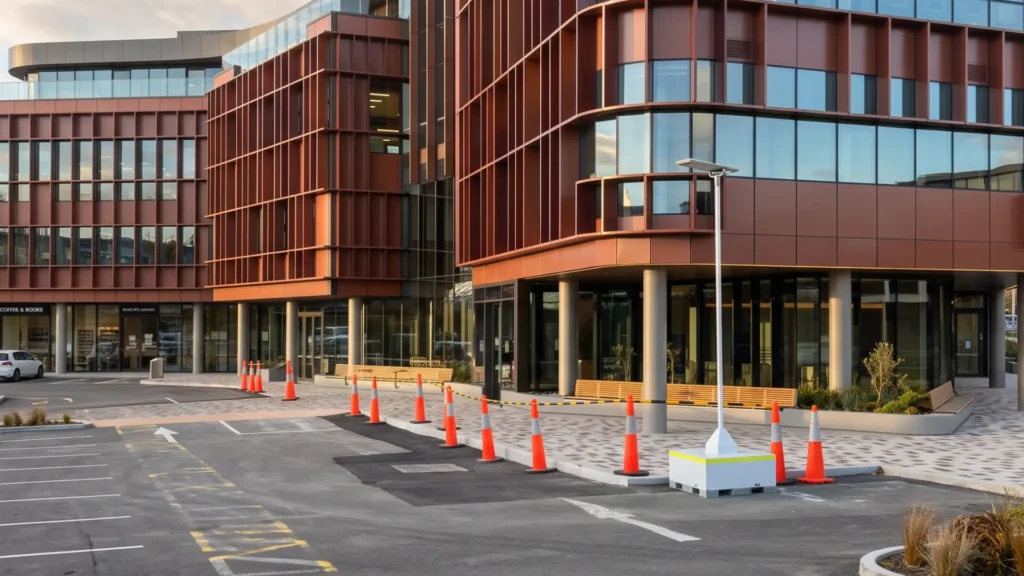
To meet the requirements for minimal construction disruption, long-term operation, and ease of maintenance, the Wollondilly Shire Council ultimately installed 35 sets of Sresky Atlas SSL-34A all-in-one solar street lights to provide nighttime illumination for the municipal center parking area.
Project Information
| Item | Details |
|---|---|
| Project Name | Wollondilly Shire Council Municipal Center Parking Lot Solar Lighting Project |
| Project Location | Picton Town Center, Wollondilly Shire, New South Wales, Australia |
| Client | Wollondilly Shire Council |
| General Contractor | Kane Constructions (or its project subcontracting team) |
| Application Scenario | Municipal parking lot and perimeter lighting for public service facilities |
| Product Model | Sresky Atlas SSL-34A All-in-One Solar Street Light |
| Number Installed | 35 units |
Project Challenge 1: Limitations on Lighting Infrastructure Deployment Due to Complex Ground Conditions
Challenges in the Actual Project
The municipal parking lot had already been paved with asphalt. If a traditional electric street lighting solution had been adopted, it would have required underground cable installation and related civil engineering work, potentially resulting in the following impacts:
- Cutting and excavating the existing pavement would increase coordination requirements;
- Foundation construction, curing, and pavement restoration would extend the project timeline;
- Normal use of the parking area could be disrupted during construction;
- The distribution of underground stormwater, power, and telecommunications infrastructure would complicate construction management.
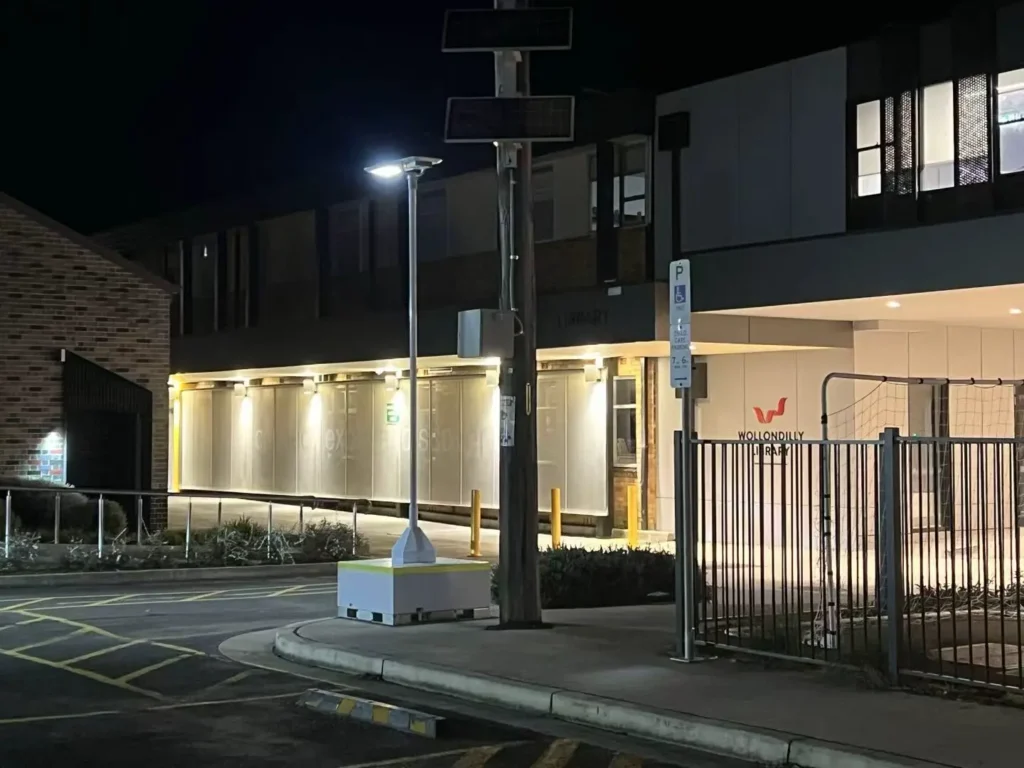
For public areas near libraries and children’s service facilities, the project needed to consider not only installation costs but also the impact of the construction process on community operations and the public environment.
Sresky Technical Solution
The SSL-34A all-in-one solar street light features an integrated design that combines solar panels, batteries, LED lighting modules, and a control system within the lamp body. This reduces on-site installation steps and helps lower construction complexity.
For parking lots with existing asphalt pavement, the project adopted installation methods suited to local conditions, such as steel or composite equipment cabinet bases, precast concrete foundation piers, or screw piles. These methods reduce the need for large-scale underground construction and improve flexibility in foundation deployment.
Additionally, the SSL-34A features a modular maintenance design, allowing the LED modules, battery pack, and control system to be inspected, maintained, or replaced independently. This minimizes disruption to the road surface during future maintenance activities.
Key Advantage: Reduced construction impact and improved convenience for future maintenance.
Engineering Challenge 2: Safety Lighting and Facility Protection Requirements in Children’s Activity Areas
Challenges in Actual Projects
Since the project is located near children’s service facilities, municipal authorities prioritized not only lighting performance but also equipment safety and long-term management convenience:
- In public areas, equipment may be exposed to collisions, impact from thrown objects, or vandalism;
- The structural design of luminaires must be suitable for long-term use in public environments;
- Failure to detect equipment malfunctions promptly may increase future maintenance workloads.
Sresky Technical Solution
The SSL-34A features an aluminum alloy housing and PC protective materials, which enhance the durability of the equipment in outdoor environments.
For public area applications, anti-climbing designs, impact protection features, and optimized pole structures can be incorporated according to project requirements to improve environmental adaptability.
Additionally, the SSL-34A supports remote monitoring of battery and solar panel operating status through an app or PC platform. It also allows users to configure lighting modes, scheduled on/off times, color temperature, and other parameters, enabling managers to monitor equipment operation in real time.
When abnormalities occur, monitoring data can help quickly identify issues and arrange targeted maintenance, improving the efficiency of municipal facility management.
Key Advantage: Enhanced equipment management convenience through remote status monitoring and parameter adjustment.
Project Outcomes
The project ultimately deployed 35 sets of integrated solar street lights, providing a new lighting solution for municipal parking areas:
- Reduced the need for extensive asphalt removal, lowering the complexity of foundation construction;
- Reduced coordination pressures associated with underground utility installation;
- Adopted an integrated design to improve installation and maintenance efficiency;
- Enhanced equipment weather resistance and structural adaptability for Australian outdoor environments;
- Supported long-term lighting operation and safety management requirements in public areas.
Client Testimonial
“For public areas where paving has already been completed, the biggest challenge is not installing the lights, but ensuring that existing infrastructure operations are not disrupted. The integrated solar solution reduces the need for complex underground construction while meeting the long-term usage requirements of municipal areas.”
— Feedback from project stakeholders

FAQ: Common Questions Regarding the Procurement of Municipal Solar Street Lights
1. Are solar street lights suitable for municipal parking lots?
In municipal parking lots with favorable solar conditions, sufficient installation space, and clearly defined lighting requirements, solar street lights are a viable lighting solution.
Municipal parking lots typically have specific lighting standards, high construction coordination requirements, and complex underground infrastructure.
Solar street lights do not require underground cable connections, reducing the need for certain civil engineering works. They are suitable for applications such as parking lots, community roads, parks, and areas surrounding public facilities.
2. How is post-installation maintenance handled for municipal solar lighting projects?
Some high-quality solar street lights feature a modular design.
When issues occur with the LED modules, battery, or control system, the corresponding component can be inspected and maintained without dismantling the entire unit.
For long-term operational projects managed by government agencies, parks, and roadway authorities, modular designs improve maintenance efficiency and convenience.
3. What parameters should be considered when selecting solar street lights for Australia?
Australian projects typically require attention to:
- Solar panel weather resistance;
- Structural design of the light fixture;
- Water and dust resistance ratings;
- Impact resistance;
- Battery cycle life;
- Adaptability to changing weather conditions.
Compared with focusing solely on LED power output, long-term operational stability and overall system compatibility are generally more important considerations.
Future-Oriented Municipal Lighting Choices
As low-carbon urban infrastructure continues to develop, solar street lights are becoming a preferred option for upgrading lighting systems in municipal parking lots, roads, parks, and public areas.
For projects with limited construction conditions, complex underground utilities, or a need to reduce long-term maintenance burdens, integrated solar lighting provides more flexible deployment options.
Municipal authorities should prioritize equipment reliability, life-cycle costs, and maintenance convenience. Engineering contractors should comprehensively evaluate installation conditions, climate adaptability, and construction efficiency. Planners can leverage solar lighting solutions to reduce energy dependence and improve infrastructure flexibility.
The Wollondilly Shire Council project demonstrates that an excellent solar lighting solution must not only meet basic lighting requirements but also adapt to the local environment and create long-term value for operation and management.