
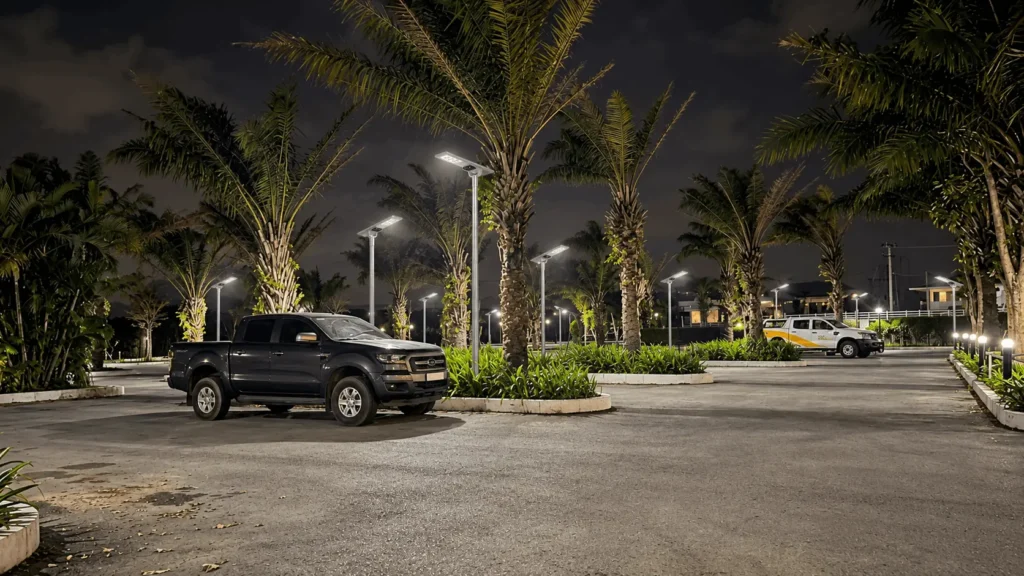
In Vietnam’s coastal regions, solar streetlights must withstand not only typhoons and strong winds but also high salt-fog exposure, shading from palm trees, and prolonged rainfall during the rainy season. For resort developers and EPC contractors, the key challenge is balancing the structural safety of lighting installations with reliable nighttime illumination while minimizing disruption to the resort’s landscape and overall lighting layout.
Project Snapshot
Project Details
- Project Type: Lighting for parking areas and internal roads at a coastal resort/hotel.
- Location: Coastal tropical region of Vietnam.
- Client: Resort developer, with procurement managed by the EPC general contractor.
- Quantity: 60 ATLAS SSL-315 solar streetlights.
Engineering Challenge 1: How Can Solar Streetlights Maintain Structural Safety During Typhoons and Strong Winds?
Vietnam’s coastal regions are frequently exposed to typhoons and strong winds. Photovoltaic (PV) panels mounted on top of solar streetlights increase their wind-exposed surface area, placing additional loads on the light poles, flanges, and mounting brackets.
The 60 streetlights in this project are installed alongside open-air parking areas, vehicle access roads, and pedestrian walkways. If a pole were to topple or any components were to detach, the consequences could extend beyond equipment damage to pose potential safety risks to pedestrians and vehicles.
Key Risks Include:
- Pole Structural Failure: Bending moments generated by strong winds may exceed the load-bearing capacity of the poles and foundations.
- Loosening of Fasteners: Prolonged wind-induced vibration may cause bolts to loosen and mounting brackets to experience fatigue.
- Salt-Fog Corrosion: High salinity and humidity in coastal environments accelerate the corrosion of exposed metal components.
- Project Acceptance Risks: A lack of structural calculations and wind-resistance documentation may complicate the EPC contractor’s design verification and project acceptance processes.
SRESKY Solution: Wind-Resistant Structural Assessment, Reinforced Connections, and Corrosion Protection
To address the wind conditions at the project site, SRESKY focused on optimizing the solar streetlight design in four key areas: structural calculations, component layout, fastening systems, and corrosion protection.
- Wind-Resistant Structural Calculations: With reference to applicable wind load requirements in Vietnamese building codes, such as TCVN 2737, the bending strength of the light poles, flange connections, and structural joints is assessed. Corresponding structural calculation documents can be provided to support engineering review.
- Optimized PV Panel Layout: Adjustable-angle mounting brackets allow the installation angle of the PV panels to be optimized, balancing solar energy collection efficiency with wind resistance requirements.
- Anti-Loosening and Anti-Vibration Design: Double-nut fastening systems and anti-vibration spring washers are used to reduce the risk of fastener loosening caused by prolonged wind-induced vibration.
- Enhanced Coastal Corrosion Protection: Exposed metal components undergo enhanced hot-dip galvanizing treatment. Relevant salt spray test data can also be provided according to project requirements to demonstrate corrosion resistance in coastal environments.
Core Value: Reduces structural risks associated with typhoons and coastal exposure through engineering calculations, vibration-resistant connections, and enhanced corrosion protection.
Engineering Challenge 2: How Can Continuous Nighttime Lighting Be Maintained Despite Palm Tree Shading and Prolonged Rainfall?
Numerous tall palm trees line both sides of the resort’s roads. Their canopies sway in the sea breeze, potentially casting moving shadows over the solar panels. Seasonal changes in the sun’s elevation angle can further affect the available solar energy. Meanwhile, prolonged rainfall during Vietnam’s rainy season reduces solar power generation, placing additional pressure on nighttime energy supply.
Key Risks Include:
- Solar Panel Shading: Tree canopy coverage reduces the actual power generation of PV modules.
- Limited Flexibility in Pole Relocation: Moving light poles may compromise lighting coverage in parking areas and along access roads.
- Prolonged Overcast Conditions: Several consecutive days of low solar irradiance may result in insufficient battery charging.
- Premature Nighttime Shutdown: Without effective energy management, insufficient stored energy may compromise lighting during the latter part of the night.
SRESKY Solution: Solar System Configuration Optimization and ALS Intelligent Dimming
To address tree shading and battery performance challenges during the rainy season, SRESKY optimized the system across three key areas: solar power generation, energy storage configuration, and nighttime energy consumption.
- Solar Power Generation Assessment: Historical solar irradiance and meteorological data from the project location are analyzed to evaluate the impact of shading and prolonged rainfall on power generation. Based on these assessments, the appropriate PV panel capacity and battery configuration can be determined.
- ALS Adaptive Lighting System: The intelligent dimming technology of the ATLAS series adjusts output power according to lighting requirements at different times of the night. Higher brightness is maintained during the early evening hours, while power consumption is appropriately reduced later at night. This helps extend system runtime while maintaining adequate illumination in critical areas.
- LiFePO₄ Battery Technology: Lithium iron phosphate energy storage technology provides a balance between battery cycle life and charging and discharging performance.
- Smart BMS Battery Management: The battery management system monitors charging and discharging conditions to improve the operational safety and reliability of the energy storage system.
Core Value: Reduces the impact of solar panel shading and prolonged rainy weather on nighttime lighting through solar power generation assessments, optimized energy storage configurations, and ALS intelligent dimming.
Project Outcomes: 60 Solar Streetlights Deployed for Coastal Resort Lighting
- Assessable Structural Risks: Wind load assessments were conducted in advance to provide an engineering basis for the design of light poles, mounting brackets, and foundations.
- More Optimized Solar Configuration: PV panel capacity and battery specifications were selected based on local solar irradiance conditions and the effects of tree shading.
- More Efficient Nighttime Energy Management: ALS intelligent dimming adjusts power consumption according to different periods of the night, improving the utilization efficiency of stored energy.
- Reduced Dependence on Traditional Power Infrastructure: Where site conditions and local regulations permit, the solar lighting system can reduce the need for underground cabling, trench excavation, and electrical connections between light poles.
Client Feedback
“Our two biggest concerns at the outset were whether the lights would remain stable during strong winds and whether the parking areas would be left in darkness on rainy nights during the wet season. SRESKY helped us address these concerns through verifiable engineering documentation during the design phase, rather than leaving us to deal with potential problems after installation.”
— EPC Contractor, Site Engineering Manager
FAQ: Common Questions About Solar Streetlights in Coastal Vietnam
1. Can solar streetlights be installed in coastal areas of Vietnam?
Yes. However, their design and configuration must be adapted to local environmental conditions:
- Evaluate structural wind loads under typhoon and strong-wind conditions.
- Select corrosion-resistant materials and surface treatments suitable for high-salinity, high-humidity environments.
- Configure PV panels and batteries according to local solar irradiance and rainy-season conditions.
- Select luminaire power ratings and installation locations based on actual road lighting requirements.
2. How should wind-resistant solar streetlights be selected for typhoon-prone areas?
We recommend evaluating the following aspects:
- Light pole height, wall thickness, and overall structural strength.
- Wind-exposed surface area and installation angle of the solar panels.
- Connection strength of flanges, bolts, and mounting brackets.
- Load-bearing capacity of the light pole foundations and anchor bolts.
- Availability of structural wind load calculation reports that comply with local engineering requirements.
3. Does palm tree shading affect the operating time of solar streetlights?
Yes. Shading on photovoltaic panels can reduce solar power generation and, consequently, the amount of energy stored in the battery. The following measures are recommended:
- Conduct a shading assessment at each proposed light pole location before installation.
- Adjust the orientation and installation position of the PV panels wherever site conditions allow.
- Verify PV panel capacity and battery specifications based on actual power generation losses.
- Use ALS intelligent dimming to reduce energy consumption during periods of lower lighting demand.
Conclusion: Coastal Solar Streetlight Projects Require More Than Higher Power Output
As the development of coastal resorts, hotels, commercial parks, and municipal infrastructure continues across Southeast Asia, solar streetlight applications are evolving beyond basic off-grid lighting. Increasingly, these projects demand higher standards of structural safety, environmental adaptability, and long-term energy management.
For developers and EPC general contractors, conducting structural and energy assessments before finalizing equipment configurations is an essential step in ensuring project reliability.
Solar streetlights designed for coastal applications must do more than function properly on the first night after installation. They must also demonstrate reliable, sustainable long-term performance under real-world environmental conditions, including strong winds, salt fog, and prolonged rainfall.