
Table of Contents
Project Background
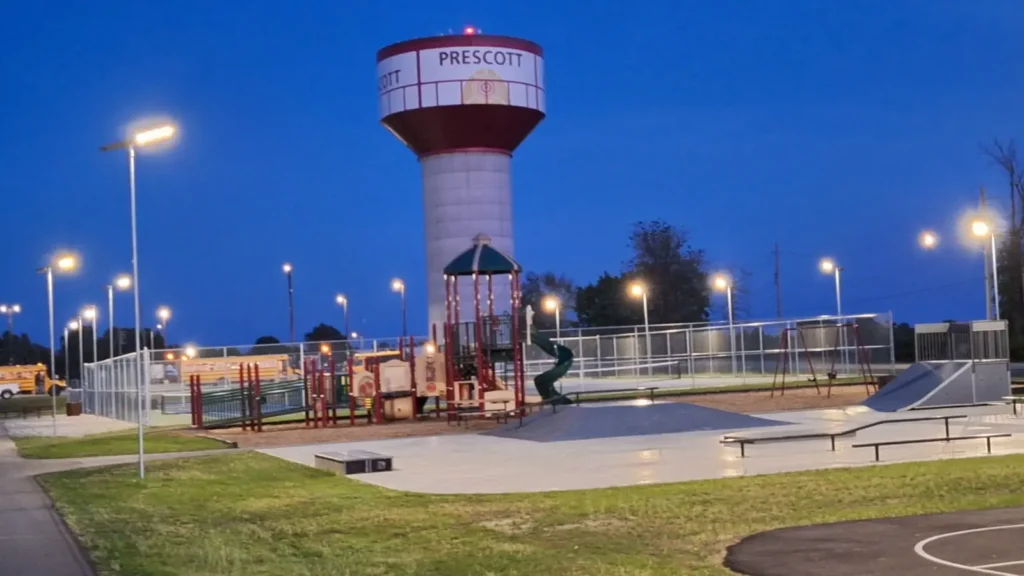
A community park in a town in eastern Ontario, Canada, continues to serve public functions such as resident recreation, children’s activities, and community sports even during winter nights. With snowfall, low temperatures, and shorter daylight hours in winter, municipal authorities sought to improve nighttime lighting conditions in public areas while optimizing maintenance and management practices.
For solar lighting projects in cold regions of North America, winter conditions are a critical consideration in system design. Low temperatures, snow coverage, changes in solar elevation angles, and seasonal variations in daylight hours can all affect the energy management and operational performance of solar lighting systems.
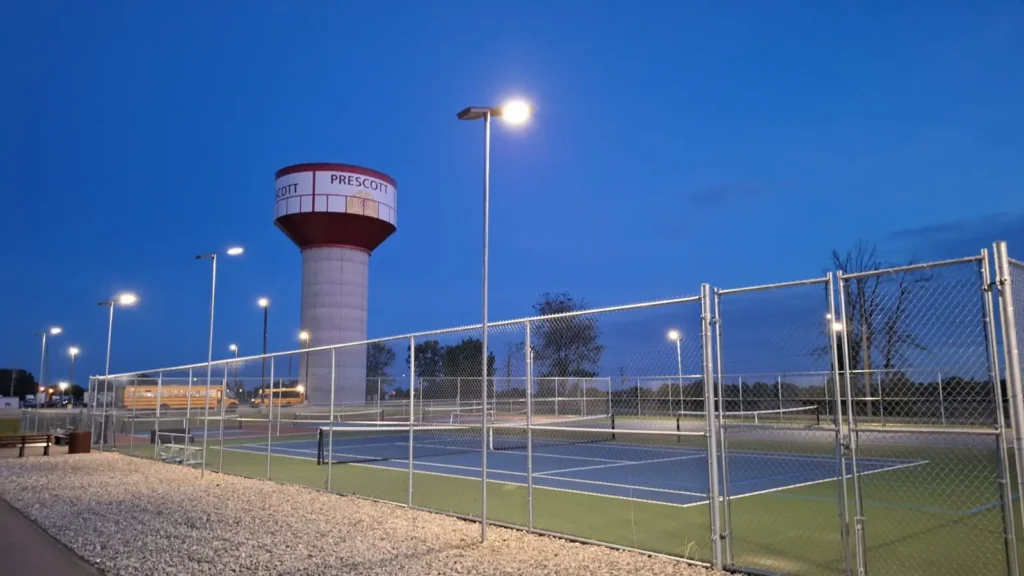
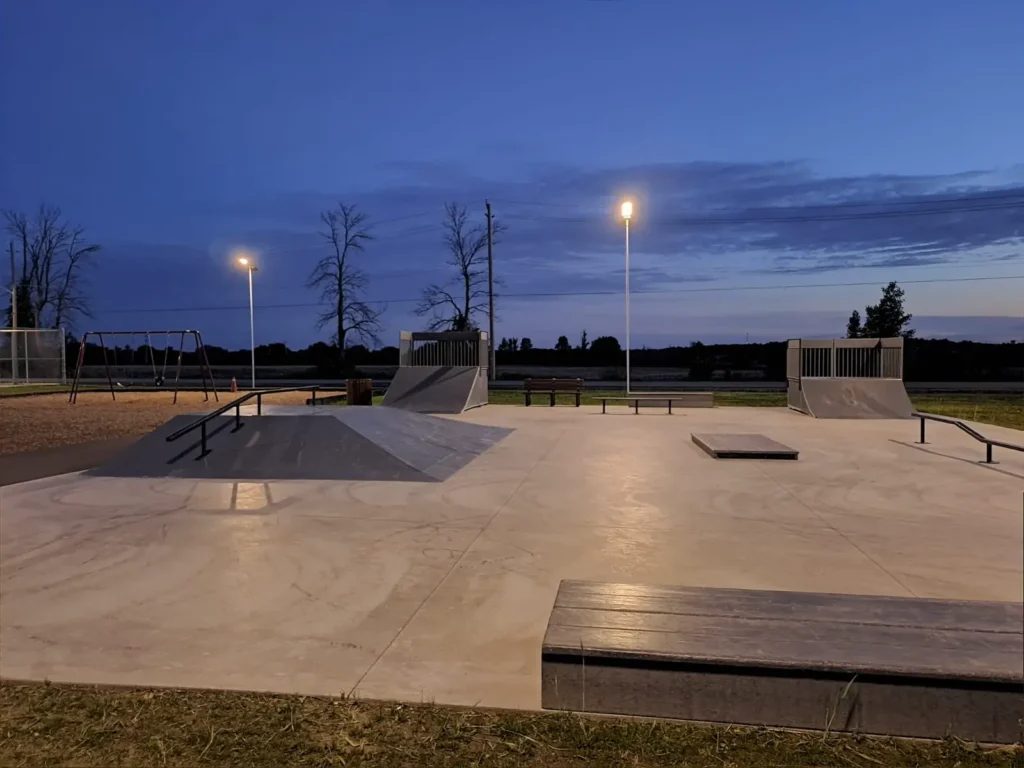
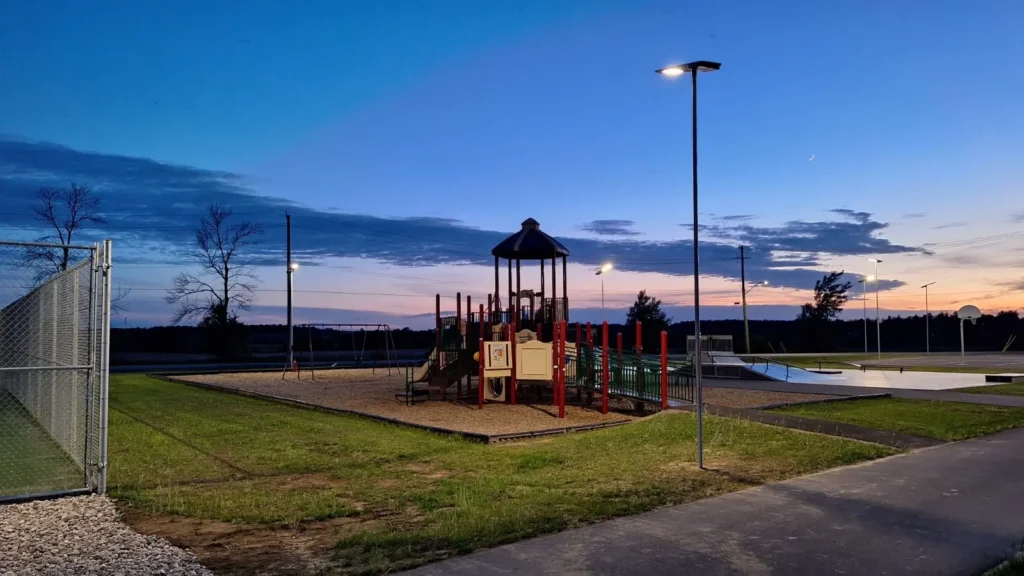
In response to these needs, the municipality launched a community park lighting upgrade project. During the first phase, 30 sets of Sresky BASALT SSL-96 all-in-one solar street lights—customized for extreme cold and vibration resistance—were installed in areas such as children’s play areas, skate parks, tennis courts, and public walkways. The project provides residents with a more reliable nighttime lighting environment.
Project Information
| Item | Details |
|---|---|
| Project Type | Solar Lighting Project for Municipal Community Parks and Multi-Purpose Sports Fields |
| Project Location | A municipality in eastern Ontario, Canada (high-latitude cold region) |
| Project Owner | Local municipal parks and recreation department |
| Application Areas | Children’s play areas, skate parks, tennis courts, public walkways, and open lawns |
| Product Model | Sresky BASALT SSL-96 Customized Extreme Cold and Vibration-Resistant Model |
| Project Scale | 30 solar street lights in Phase 1 |
Engineering Challenge 1: Energy Challenges Caused by Winter Snow Accumulation and Limited Sunlight in High-Latitude Regions
Parts of eastern Canada experience long winters, requiring solar lighting systems to adapt to environmental changes caused by low temperatures, shorter daylight hours, and snowy conditions.
Key influencing factors include:
- Snow accumulation may cover photovoltaic modules, reducing solar energy input;
- Lower solar elevation angles in winter reduce available sunlight hours;
- Prolonged cloudy and snowy weather increases pressure on the energy storage system;
- Low-temperature environments place higher demands on battery performance.
Therefore, the project design focuses not only on increasing summer energy generation but also on comprehensively optimizing energy storage, system control, and winter operational adaptability based on local climate conditions.
Sresky Solution: Intelligent Energy Management and Low-Temperature Adaptive Design
The project uses the Sresky BASALT SSL-96 extreme cold and vibration-resistant solar street light solution, which incorporates an intelligent energy management system that adjusts operating strategies according to battery status, environmental conditions, and lighting requirements.
The system configuration includes:
- Low-temperature battery protection design;
- Insulated battery compartment structure;
- BMS (Battery Management System);
- Photovoltaic module installation angles optimized for the local environment.
Through intelligent energy management, temperature control, and optimized photovoltaic layouts, the solution improves the environmental adaptability of solar street lights and supports long-term operation in cold regions.
Engineering Challenge 2: The Burden of Manual Inspections in Winter Park Maintenance Environments
Municipal public areas typically cover large spaces, with equipment distributed across diverse landscapes. Winter snow accumulation, frozen ground, and severe weather conditions increase the difficulty of equipment maintenance and on-site management.
Key impacts include:
- Reduced convenience for winter equipment inspections;
- The need for more efficient management methods to verify equipment status;
- Traditional lighting system maintenance may require additional coordination with construction teams;
- Repairs in remote areas may require significant labor resources.
Therefore, the project solution needed to balance equipment reliability with the convenience of future operation and maintenance.
Sresky Solution: Modular Design and Intelligent Monitoring Management
The project adopts a modular structural design, with LED lighting modules, battery assemblies, and control systems arranged independently to simplify future inspection and maintenance.
At the same time, through intelligent monitoring functions, managers can monitor:
- Battery operating status;
- System charging status;
- Equipment fault alerts.
This management approach helps transform traditional reactive maintenance into a more proactive equipment management strategy, improving the operational efficiency of municipal lighting projects.
Project Implementation Results
Following the completion of Phase I installation, the lighting system has achieved stable operation:
- 30 solar street light systems are now in operation, meeting the area’s nighttime lighting requirements;
- The system has been adapted to Canadian winter conditions, maintaining stable illumination during cloudy and snowy weather;
- Reduced the need for frequent municipal on-site inspections, lowering long-term maintenance burdens;
- No underground excavation or cable installation was required, minimizing construction impact;
- Improved the nighttime user experience in sports areas and surrounding roads.
Customer Testimonials
“In public infrastructure projects, installation is only the first step; long-term operation and maintenance are equally important. We place greater emphasis on whether a solution can adapt to the local climate and meet long-term usage requirements.”
— Project Manager, a Canadian Municipality
FAQ
1. Is winter in Canada suitable for installing solar street lights?
Some regions in Canada are suitable for solar street lights, but project design must fully consider winter environmental conditions.
Key considerations include:
- Seasonal variations in winter daylight hours;
- The impact of snow accumulation on photovoltaic modules;
- Battery performance at low temperatures;
- System energy management strategies.
For projects in high-latitude regions, proper system configuration is more important than simply selecting a specific equipment model.
2. Are solar street lights suitable for municipal park lighting?
Solar street lights can be used in a variety of public spaces, including:
- Park walkways;
- Community sports fields;
- Public recreational areas;
- Certain off-grid locations or areas with limited access to the power grid.
Compared with traditional lighting methods, solar solutions can reduce the need for underground wiring and improve project deployment flexibility.
3. What Is the Difference Between Integrated Solar Street Lights and Split-Type Solar Street Lights?
Integrated solar street lights combine photovoltaic modules, batteries, and LED luminaires into a single unit. Their installation process is relatively simple, making them suitable for rapid deployment in open areas.
Split-type solar street lights, on the other hand, allow solar panels to be installed separately and adjusted according to site conditions, making them more suitable for environments with obstructions or special installation requirements.
The selection of a suitable solution typically requires comprehensive consideration of:
- Site conditions;
- Solar availability;
- Installation requirements;
- Long-term maintenance plans.
For open community parks, the integrated solution adopted in this project reduces construction steps while meeting public lighting requirements.
Conclusion
As global public infrastructure continues to move toward low-carbon and smart solutions, solar lighting is being deployed in an increasing number of parks, walkways, and off-grid public areas.
For projects in high-latitude and cold regions, the key consideration is not only the equipment itself but also whether the overall system can adapt to the local environment and meet long-term operational and maintenance requirements.
During the project planning stage, municipal departments, engineering contractors, and urban planning teams need to comprehensively evaluate environmental conditions, construction methods, and lifecycle management requirements.
This case study demonstrates the practical application of a solar lighting solution in a cold-region public space in Canada, providing a reference for similar municipal parks, sports fields, and off-grid infrastructure projects.