
Medellín, Colombia, is a typical mountainous city.
As the city continues to expand eastward toward the foothills, new residential areas, neighborhood roads, and bike lanes are being brought into service one after another. However, as roads begin to traverse slopes and curves, a key challenge emerges—lighting.
During the day, the mountainous terrain creates significant variations in sunlight exposure across different road sections. At night, some lights along the same road may remain bright while others dim prematurely. For residents, the greatest risk is not complete darkness, but the visual blind spots caused by inconsistent and intermittent illumination.
To address this issue, the Medellín Urban Renewal and Infrastructure Development Agency partnered with a local EPC contractor and a renewable energy lighting integrator to deploy 130 units of SRESKY Basalt SSL-912A solar streetlights along approximately 6–8 kilometers of roadway. The system provides illumination for residential access roads, hillside side roads, and mixed-use pedestrian and bicycle paths.
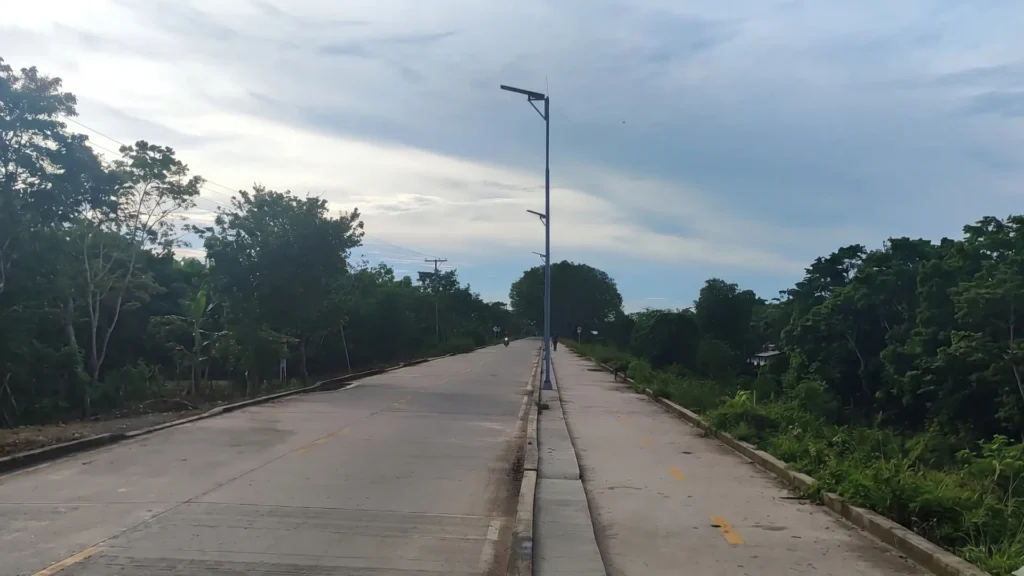
Project Overview
| Project Element | Details |
|---|---|
| Project Location | Eastern Foothills Urban Expansion Area, Medellín |
| Client | Medellín Urban Renewal and Infrastructure Development Agency |
| EPC Contractor | Local road contractor + renewable energy lighting integrator |
| Product Used | SRESKY Basalt SSL-912A |
| Number Installed | Approximately 130 units |
| Application Scenarios | Residential access roads / hillside side roads / mixed-use pedestrian and bicycle paths |
Project Challenges and Solutions
Challenge 1: Uneven Solar Charging Due to Hillside Shading Causes Nighttime Lighting Gaps
The road winds along steep terrain with significant elevation changes and sharp curves. Low-lying sections receive minimal direct sunlight in the morning, while leeward slopes remain shaded for more than half the day. This results in large differences in charging efficiency among luminaires along the same route.
In traditional solar lighting systems, this would lead to:
- Some luminaires maintaining normal brightness
- Some luminaires dimming prematurely
- In extreme cases, individual lights shutting down early
Ultimately, this creates an intermittent lighting effect. On mountain roads with frequent curves and slopes, such inconsistency can directly impact visual judgment for both drivers and pedestrians.
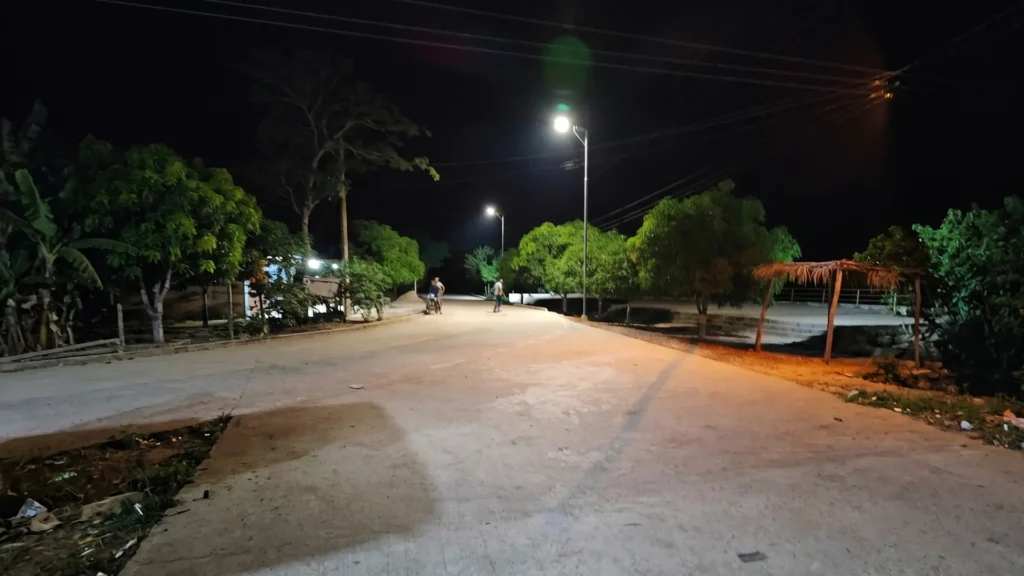
Solution 1: Terrain-Based Energy Zoning + ALS Dynamic Dimming
The SRESKY Basalt SSL-912A does not rely on a uniform configuration. Instead, it optimizes performance through terrain-based zoning:
- Steep and heavily shaded sections: higher-capacity battery and output configuration
- Moderately sunlit areas: standard operating mode
- Stable illumination sections: energy-saving priority mode
Combined with the built-in ALS (Adaptive Lighting System) intelligent dimming, the system dynamically adjusts nighttime output based on real-time battery conditions. This balances energy discharge across different luminaires.
The goal is not to maximize brightness at individual points, but to ensure consistent system-level illumination continuity across complex terrain.
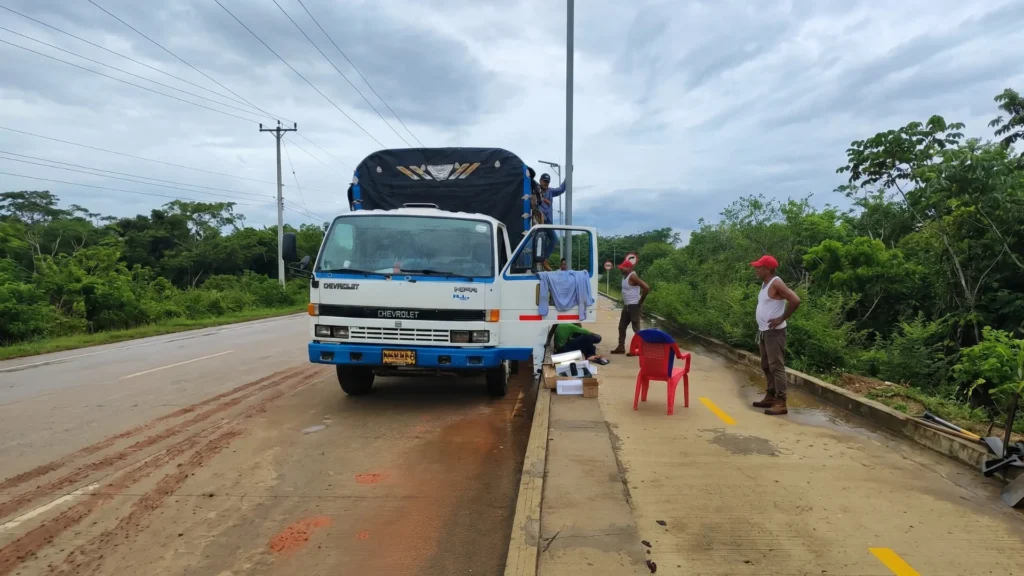
Challenge 2: Slopes and Curves Increase Nighttime Traffic Risk
Mountain roads in this project area feature:
- Frequent curves
- Large gradient variations
- Mixed pedestrian and bicycle traffic
- Reduced visibility during rainy and foggy conditions
If lighting distribution is not properly designed, visual blind spots can easily occur at curve entrances and slope transitions—even when overall brightness appears sufficient.
Solution 2: Type III Optical Distribution + PIR-Triggered Adaptive Lighting
The system uses a Type III road lighting distribution design combined with smart control logic:
- Maintains low-energy uniform baseline lighting
- When the PIR sensor (120° detection range) detects pedestrians or vehicles, local illumination is increased
- Curve zones enter enhanced lighting mode in advance
Rather than simply increasing brightness, this approach enhances visual contrast in critical areas, improving perception and safety under wet and foggy conditions in low-speed mixed traffic environments.
Project Outcomes
As a project implemented during the urban expansion phase, acceptance criteria focused primarily on operational stability. Based on EPC on-site feedback and early operational data:
- Continuous nighttime road illumination coverage improved significantly
- Visibility on curves and slopes was notably enhanced
- Routine maintenance frequency decreased compared to the previous lighting system
- Lighting consistency across varied terrain improved markedly
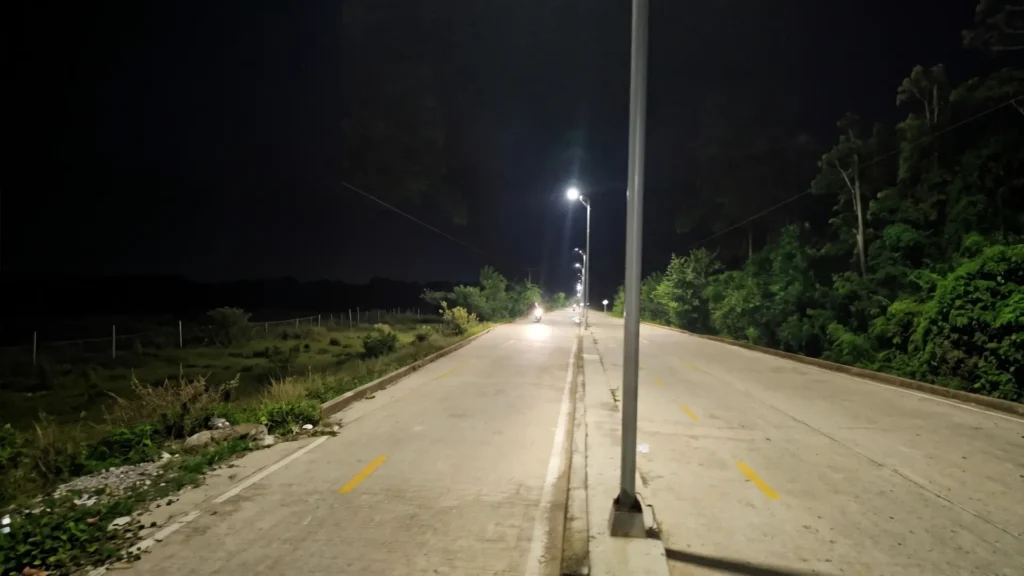
Customer Feedback
“Our primary concern is visual continuity on sloped roads, not the brightness of individual points. The greatest risk on mountain roads comes from inconsistent lighting, and the Basalt solution has effectively addressed this issue.”
— Technical Lead, Medellín Urban Renewal and Infrastructure Development Agency Project
FAQ
Q1: How do solar street lights improve driving safety on curves?
A: Optical distribution tailored to road geometry directs light precisely where drivers and pedestrians need it most. Maintaining uniform illumination at curves, intersections, and slopes helps reduce blind spots and improves visibility.
Q2: How do humidity, rainy seasons, and mountain fog affect solar street lights?
A: The main impact is reduced visibility combined with environmental attenuation.
In Medellín’s rainy season, common issues include:
- Increased light scattering due to wet fog, reducing visual contrast
- Unstable road surface reflectivity, affecting recognition distance
- Long-term humidity exposure increasing wear risks
Therefore, system design must prioritize:
- High protection ratings (e.g., IP65 or above)
- Corrosion-resistant and sealed structural design
- Stable baseline illumination under low-visibility conditions
Under these conditions, lighting design should focus not on “brighter” output, but on more consistent visibility.
Q3: Can solar street lights operate in partially shaded road sections?
A: Yes. In partially shaded environments, systems must adapt to varying solar charging conditions. Features such as adaptive lighting control and sufficient battery reserve capacity help maintain stable nighttime operation even in unevenly shaded terrain.
Conclusion
The Medellín project demonstrates that successful solar lighting in mountainous terrain is not simply about increasing brightness. The real challenge lies in maintaining consistent illumination under conditions affected by slope, shading, and weather variability.
By integrating adaptive energy management, road-specific optical design, and system-level reliability, the SRESKY Basalt SSL-912A delivers a more stable and predictable nighttime environment for both drivers and pedestrians.
For municipalities, contractors, and urban planners working on hillside roads, bike paths, or expanding residential districts, this project offers a practical reference for designing solar lighting systems in complex terrain conditions.