
In the West Midlands region of the UK, many residential back alleys and public parking lots face a common lighting challenge: outdated wiring and difficulties in retrofit construction. The region’s unique climatic conditions—high latitude, low winter temperatures, and limited annual sunlight—make solar street lighting more challenging than in many other areas.
On the one hand, effective charging time is significantly reduced. On the other hand, charging in low-temperature environments can damage battery cells, leading to capacity degradation and shortened lifespan, which results in unstable nighttime power supply.
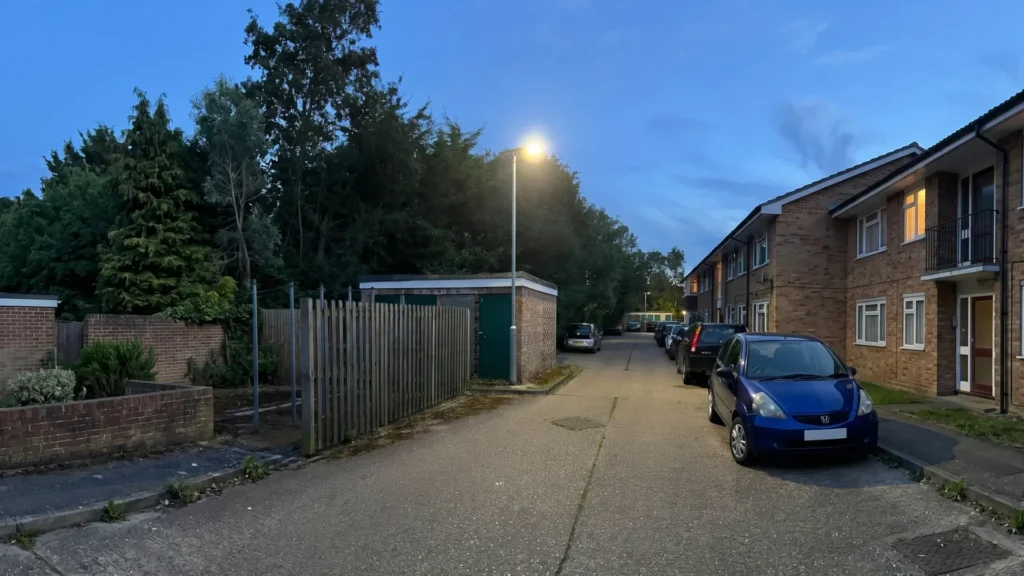
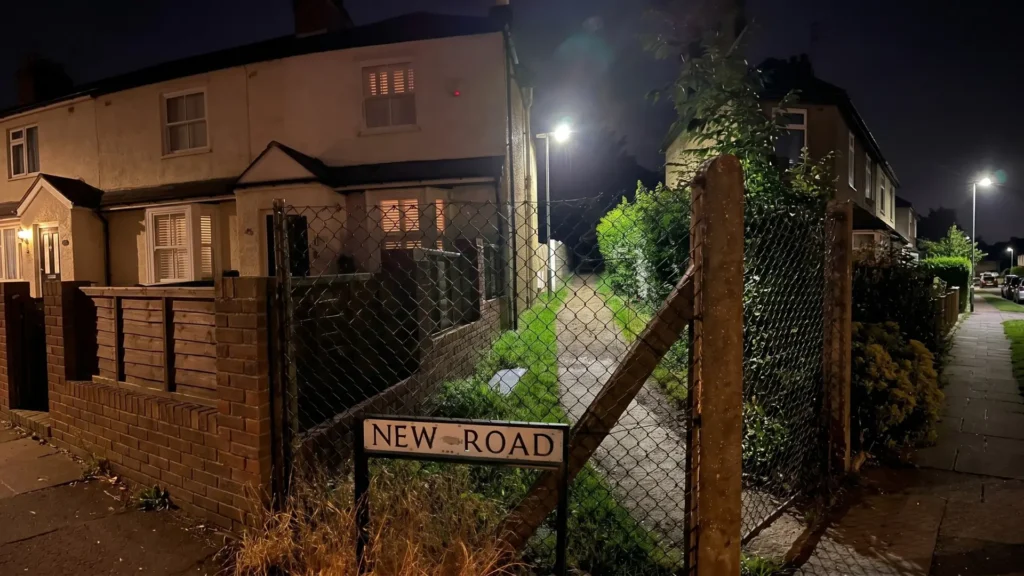
The residential community on New Road faces precisely this challenge. The back alleys connect residential areas, public parking lots, and pedestrian walkways, serving as key routes for residents’ nighttime travel. The local Borough Council, in collaboration with the property management company and parking lot operator, sought a lighting solution that requires no extensive excavation, adapts to the UK’s high-latitude environment with low temperatures and limited sunlight, and ensures reliable visibility during foggy weather.
Ultimately, the project deployed 66 SRESKY Atlas Series SSL-36A / SRESKY Atlas Series SSL-38A solar street lights, covering residential back alleys, connecting walkways, and public parking areas.
Project Overview
| Project Element | Details |
|---|---|
| Project Name | New Road Residential Back Alleys and Parking Lot Solar Smart Lighting Project |
| Project Location | New Road Residential Area, West Midlands, UK |
| Client / Responsible Organizations | Local Borough Council + Joint Residential Property Management Company + Parking Lot Operator |
| Number Installed | 66 SRESKY Atlas Series SSL-36A / SRESKY Atlas Series SSL-38A solar street lights (UK climate-customized version) |
Key Engineering Challenges and Solutions
Challenge 1: Low Temperatures and Limited Sunlight in Winter Reduce Charging Efficiency and Increase Battery Degradation Risk
During UK winters, the sun’s elevation angle is low, and back alleys are heavily shaded by buildings and tree canopies. It is common for the same road section to receive sunlight in the morning but none in the afternoon, significantly reducing effective charging time.
At the same time, nighttime temperatures frequently drop below 5°C or even approach 0°C. Charging lithium-ion batteries under such conditions can lead to lithium plating, resulting in irreversible capacity degradation, reduced lifespan, and potential long-term safety risks.
Specific consequences include:
- Reduced charging duration, leading to insufficient nighttime power supply
- Accelerated battery degradation under low-temperature charging conditions
- Battery undervoltage and performance instability, causing flickering or shutdowns
- Increased security blind spots, reducing residents’ sense of safety at night
- Higher municipal O&M costs due to frequent maintenance and battery replacement
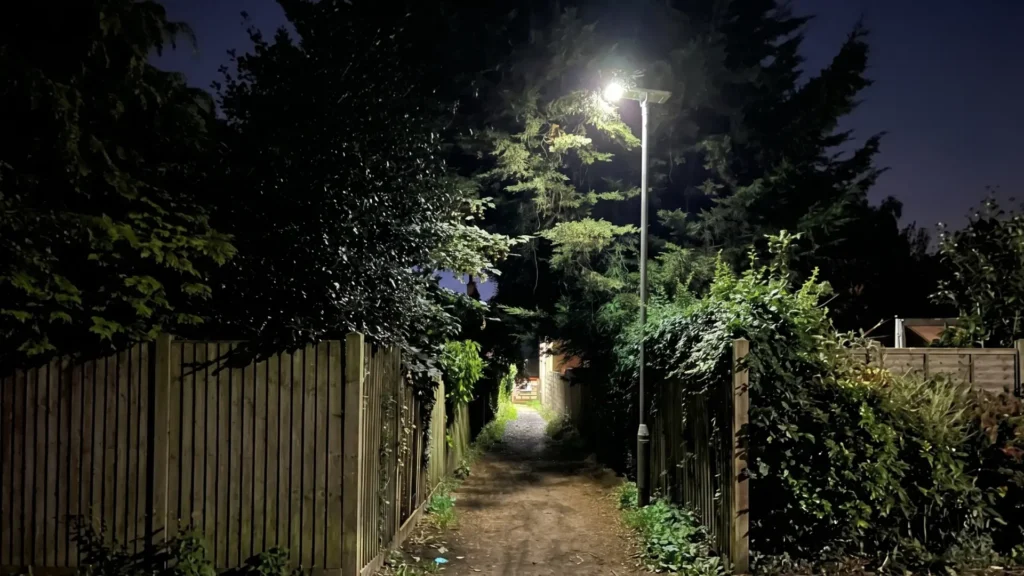
Solution: Atlas SSL-36A / SSL-38A Low-Temperature Adaptive System Design
The SRESKY Atlas SSL-36A / SSL-38A solar street lights feature integrated optimizations targeting both battery performance and charging strategy.
Key highlights:
- High-efficiency monocrystalline PV modules (conversion efficiency > 23%), optimized for low-light and diffuse light conditions
- BMS (Battery Management System) improves fragmented charging efficiency by approximately 30%
- TCS (Temperature-Compensated Charging System): dynamically adjusts charging current and voltage based on real-time battery temperature to prevent low-temperature lithium plating
- Low-temperature battery cells with insulated battery compartments to reduce nighttime heat loss
- Upgraded ALS algorithm: dynamically adjusts brightness based on available daily charge to ensure all-night operation
Through coordinated optimization of battery selection, charging strategy, and lighting control, the SRESKY Atlas series ensures stable operation in low-temperature and low-light environments.
Challenge 2: Ensuring Nighttime Visibility in Foggy UK Weather
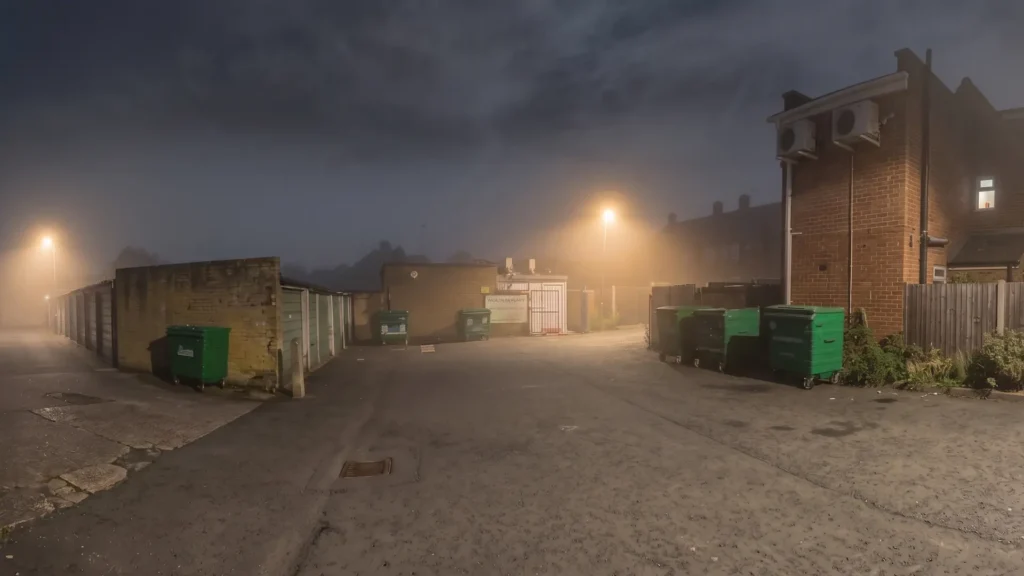
Fog and low visibility are common in the UK during winter, particularly in central and northern regions. In such conditions, traditional high color temperature (cool white) streetlights tend to scatter more blue light, reducing visibility and shortening the effective visual range for drivers and pedestrians.
Solution: Dual-CCT Adaptive Lighting System
The project uses SRESKY Atlas Series SSL-36A / SRESKY Atlas Series SSL-38A luminaires equipped with a dual-color temperature (Dual-CCT) system optimized for foggy conditions.
Key features:
- Dual-CCT LED system: warm light (~3000K) and cool white light (~5000–6000K)
- Fog Mode: prioritizes warm light, which provides better penetration and improved visibility in fog and rain
- Clear Weather Mode: switches to cool white light for higher contrast and sharper road detail
- Reduced glare toward residential windows, improving nighttime comfort
The system dynamically adjusts lighting modes based on weather conditions, balancing safety and visual comfort.
Project Outcomes
After a full winter of operation, the project achieved strong performance results:
- No significant battery degradation or premature replacements during winter operation
- Stable minimum daily lighting duration even under cloudy and low-light conditions
- Improved visibility in foggy weather, enhancing nighttime safety perception
- Reduced blind spots through a continuous lighting network of 66 units
- Lower O&M costs due to zero electricity consumption and reduced maintenance cycles
Customer Feedback
“In older residential areas, retrofitting traditional lighting is costly and disruptive. The New Road project demonstrates that, with proper attention to battery selection, charging strategy, and lighting algorithms, solar street lights can operate reliably even in the UK’s rainy, foggy, and low-temperature environment.”
— Mark R. Donnell, Project Manager, Borough Council
Frequently Asked Questions
Q1: Can solar street lights operate reliably during cold UK winters?
Yes. Reliability depends not only on solar panel efficiency but also on low-temperature battery adaptability, charging strategy design, and lighting control algorithms. Systems with TCS, insulated battery compartments, and adaptive lighting can operate reliably in winter conditions.
Q2: What risks are associated with low-temperature battery charging, and how are they mitigated?
Charging lithium-ion batteries at low temperatures can cause lithium plating, leading to irreversible capacity loss and safety risks.
Mitigation methods include:
- Real-time temperature monitoring via sensors
- Dynamic adjustment of current and voltage through TCS
- Battery compartment insulation to reduce nighttime temperature drops
- Avoidance of high-current charging in extreme cold conditions
Q3: Are solar street lights suitable for residential alleys and roads?
Yes. They are widely used in residential streets, alleys, sidewalks, and housing developments because they eliminate trenching and cable installation, reducing both cost and construction disruption.
Summary and Recommendations
In the UK’s broader transition toward low-carbon municipal infrastructure, solar street lights are becoming a practical solution for retrofitting older residential communities due to zero electricity costs, no trenching requirements, and simplified maintenance.
However, successful deployment in high-latitude environments requires more than improved solar panel efficiency. It also demands:
- Robust low-temperature battery design
- Intelligent charging protection systems
- Adaptive lighting control algorithms
- Optical design optimized for fog and haze conditions
Whether for municipal upgrades, contractor-led infrastructure projects, or climate-resilient urban planning, this case demonstrates how system-level design is essential for reliable solar lighting in challenging environments.