
In recent years, a “hotel–residential” mixed-use model has emerged in coastal tourism development zones in northeastern Brazil, where walkways connect hotel lobbies, residential complexes, and seaside leisure areas. These areas are bustling during the day, but at night they require a lighting system that is both reliable and unobtrusive, so as not to disrupt the resort atmosphere.
For these coastal complexes in northeastern Brazil—which integrate hotel lobbies, residential clusters, and seaside recreational areas—walkway lighting is far more than simply “installing lights.” The system must operate reliably under the combined effects of 35°C heat, 90% humidity, and heavy salt fog exposure, while preserving the resort’s ambiance and minimizing long-term maintenance. This is especially important because every excavation for repairs risks damaging carefully maintained landscape vegetation.
This was the real challenge faced by a regional development group. Ultimately, they delivered a scalable solution by installing 35 sets of SRESKY ATLAS SSL-32A integrated solar street lights.
Table of Contents
Project Overview
| Project Parameter | Details |
|---|---|
| Location | Coastal resort city in northeastern Brazil (hotel + residential complex) |
| Product Used | SRESKY ATLAS SSL-32A solar street lights |
| Number Installed | 35 sets |
| Pole Height | 5–7 meters (single-sided/double-sided lighting) |
| Pole Spacing | 15–30 meters |
| Covered Areas | Walking paths, hotel entrances and exits, children’s play areas, residential connecting walkways |
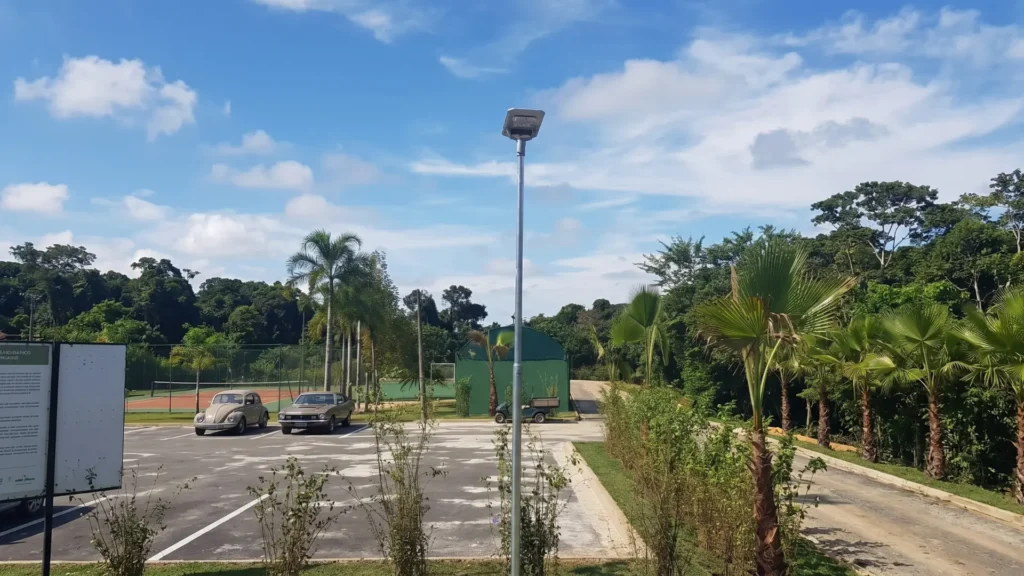
Why Does Lighting in Seaside Resort Areas Pose Technical Challenges?
Complex Environment of High Humidity, Salt Fog, and Prolonged High Temperatures
The coastal region of northeastern Brazil presents multiple environmental stresses—it is not a single-factor challenge of water resistance. During the rainy season (November through March), lighting systems are continuously exposed to:
- Persistently high humidity
- High temperatures (28–36°C)
- Coastal air with high salt content (salt fog corrosion)
- Prolonged sealing stress on enclosure structures
In this environment, traditional split-type lighting systems often fail prematurely due to exposed components such as:
- External wiring points
- Power supplies
- Connection terminals
When subjected to prolonged moisture and corrosion, these components quickly become the system’s primary failure points.
Solution: Integrated Solar Lighting System Design
This project adopted an integrated solar streetlight architecture based on the SRESKY ATLAS SSL-32A platform. Rather than relying solely on improving waterproof ratings, this design focuses on:
- Minimizing external exposure: Integrating the battery, controller, and lighting module into a fully sealed enclosure
- Reducing external wiring interfaces: Lowering the risk of moisture ingress
- Improving maintenance efficiency: In landscaped resort areas, frequent maintenance can damage roads, green belts, and landscape features. By reducing the need for internal component servicing, the system minimizes disruption to daily resort operations
Lighting Challenge: Pathway Uniformity vs. Brightness
Why is lighting uniformity more important than brightness?
Unlike highways or urban roads, resort walkways are multifunctional spaces for human interaction and must support:
- Entrance guidance lighting
- Comfortable pedestrian pathways
- Low-glare children’s play areas
- Soft transition lighting between residential zones
Traditional high-intensity pole lighting often results in:
- Overexposed “hot spots”
- Dark blind spots between poles
- Visual discomfort in leisure environments
Lighting Design Strategy Adopted for This Project
To address these challenges, the installation plan incorporated:
- Pole height: 5–7 meters
- Spacing: approximately 15–30 meters
- A distributed lighting layout strategy
Combined with multi-mode control (M1 / M2 / M3 operating logic), the system achieved:
- Low-power continuous mode: Ensures uninterrupted illumination along walkways
- Enhanced brightness mode at key nodes: Improves lighting at entrances and intersections
- Late-night energy-saving mode: Automatically reduces power consumption during low-traffic hours
This approach creates a continuous band of light, significantly improving visual comfort in pedestrian areas.
Project Operational Results
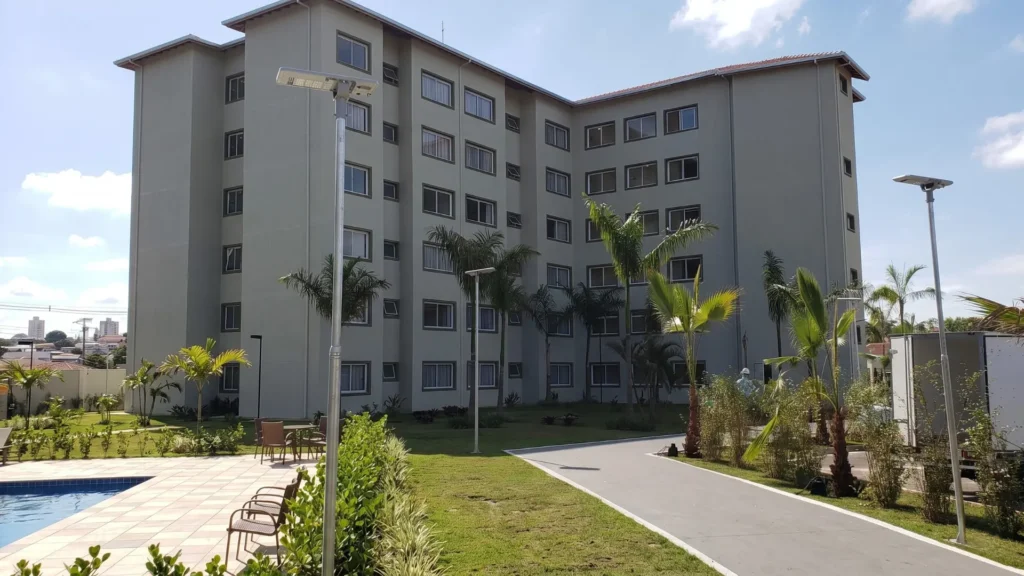
Following deployment, the lighting system has demonstrated stable performance:
- Consistent pathway lighting with no noticeable dark spots
- Improved visual guidance at entrances and children’s play areas
- No need for trench digging or underground cable installation
- No damage to landscaping or paved surfaces
- Stable operation during the rainy season, with no lighting interruptions during overcast or rainy weather
Customer Testimonial
“Our biggest concern beforehand was how the system would perform during prolonged rainy periods. So far, the walkway lighting has remained stable under various weather conditions. Maintenance requirements have been significantly lower than expected, especially since there was no need for underground wiring—which has greatly reduced our operational workload.”
— Regional Development Group · Head of Infrastructure Operations
Frequently Asked Questions (FAQ)
Q: Are solar streetlights suitable for beachfront resorts?
A: Yes. Solar streetlights are widely used in beachfront resorts because they provide reliable lighting without the need for underground wiring, while also helping preserve existing landscapes and public spaces.
Q: How can resorts reduce maintenance costs for solar lighting?
A: Reducing maintenance costs starts with selecting a system designed for long-term reliability. Integrated solar lighting systems eliminate underground cables, reducing potential failure points. Features such as corrosion-resistant materials, sealed enclosures, modular components, and smart energy management help reduce repair frequency, lower labor costs, and minimize total lifecycle cost.
Q: What is the best solar lighting solution for resort walkways?
A: The optimal solution focuses on uniformity rather than maximum brightness. Guests should be able to move comfortably between hotels, residential areas, restaurants, and recreational zones without glare or dark spots. This project uses a distributed lighting layout combined with multiple operating modes to create a continuous and comfortable lighting environment.
Conclusion
The Brazilian seaside resort project demonstrates that successful walkway lighting is not about installing brighter lights, but about ensuring safe and comfortable nighttime movement while preserving the landscape and minimizing long-term maintenance disruptions.
For seaside hotels, resorts, and high-end residential developments, integrated solar streetlights such as the SRESKY ATLAS SSL-32A, combined with thoughtful walkway lighting design, can enhance guest experience while reducing O&M costs—offering a more sustainable lighting solution for coastal public spaces.