
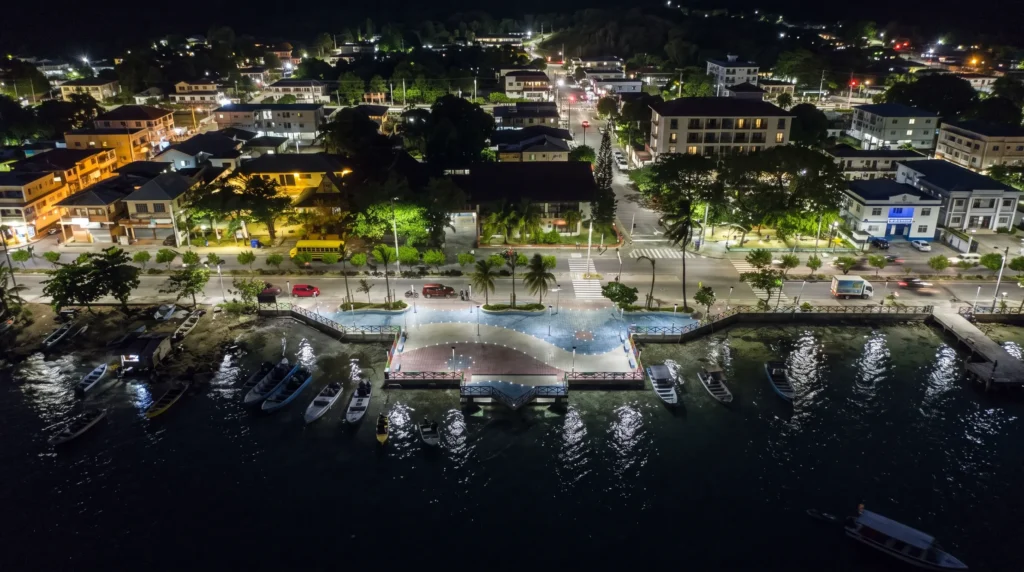
Located near the port, the area is constantly exposed to sea breezes, high humidity, and salt spray. The lighting system must not only ensure nighttime safety but also avoid damaging the existing landscape paving.
For the project owner, the challenge was not simply adding lights, but achieving long-term, stable lighting while preserving the plaza’s overall design.
Consequently, the port authority adopted a solution featuring 105 Sresky UFO solar landscape lights, which minimized underground construction and allowed the waterfront public space to balance lighting needs with landscape integrity.
Project Snapshot
| Project Information | Details |
|---|---|
| Project Name | Colombia Waterfront Plaza Solar Lighting Project |
| Project Location | Waterfront public plaza in a major port city on the Caribbean coast of Colombia |
| Project Owner | Port Authority / Waterfront Management Committee |
| Application Scenarios | Waterfront plaza, pedestrian areas, along railings, and landscaped areas |
| Product Model | Sresky SLL-12N All-in-One UFO Solar Landscape Light |
| Number Installed | 105 sets |
Engineering Challenges and Solutions
Engineering Challenge 1: Protecting the Paving and Ensuring Wind Resistance in a Hard-Paving Environment
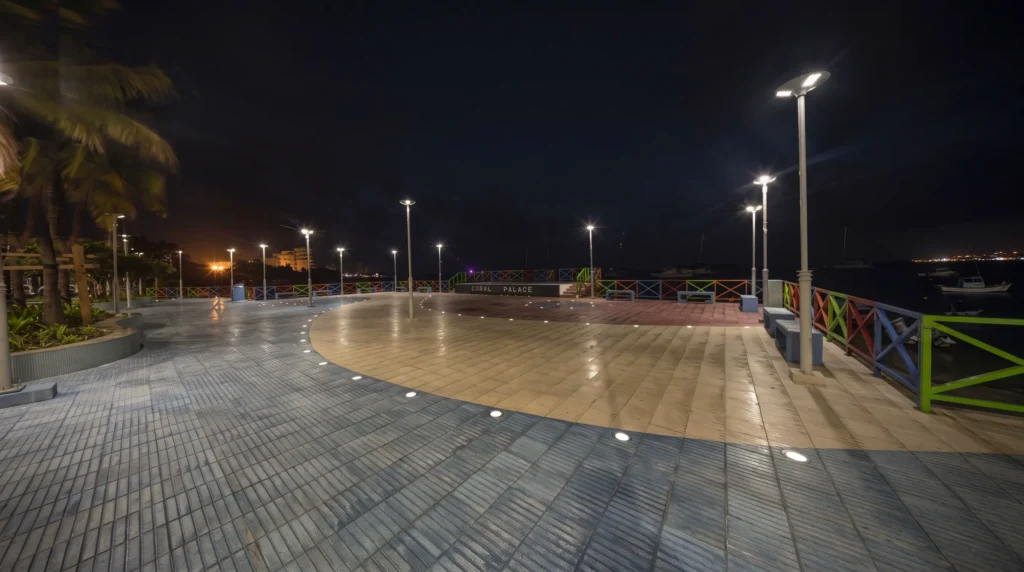
The waterfront plaza features high-precision patterned paving. Traditional lighting installation requires excavating foundations, laying underground cables, and restoring the surface, which can easily damage the landscape and increase construction disruption.
Key Project Challenges:
- Demolishing the paving could affect the overall landscape aesthetics;
- Underground cabling is complex and increases costs;
- Post-installation restoration is difficult;
- Strong coastal winds can easily cause light poles to loosen or tilt.
Therefore, the project required a reliable installation method and long-term wind-resistant operation while preserving the existing landscape.
Sresky Technical Solution: Integrated Design + Low-Disruption Installation
The project utilized the Sresky SLL-12N integrated solar landscape light, which incorporates solar panels, batteries, and a control system within the lamp body. This eliminates the need for underground cables and significantly reduces construction disruption.
Installation methods were adapted to wind conditions:
- In low-wind areas, a 120–150 kg steel counterweight base is used, paired with EPDM protective pads to safeguard the pavement;
- In high-wind areas, small-diameter chemical anchors are used for fixation, minimizing ground disturbance.
Additionally, the SLL-12N’s UFO-shaped disc design reduces wind resistance. Combined with a high-strength connection structure, it can withstand gusts of up to 35 m/s.
Through “integrated design + low-impact installation + wind-resistant structure,” the project achieves both landscape preservation and long-term stable operation.
Engineering Challenge 2: High Salt Fog Corrosion—Avoiding Premature Equipment Failure and Uncontrolled Maintenance Costs
The Caribbean coast is a typical high-corrosion coastal environment.
The challenge is not a single instance of corrosion, but rather the long-term cyclical effects of the environment:
Daytime:
- High temperatures;
- Intense UV radiation;
- Salt deposition.
At Night:
- Increased humidity;
- Salt fog condensation;
- Moisture penetrating the equipment structure.
Conventional outdoor lighting equipment is prone to:
- Corrosion of metal fasteners;
- Moisture ingress into battery compartments;
- Oxidation of PCB electronic components;
- Salt crystal deposition on solar panel surfaces.
For public plaza projects, frequent maintenance not only increases costs but also affects the visitor experience.
Therefore, equipment reliability is more important than the initial purchase price alone.
Sresky Technical Solution: High-Grade Corrosion Protection + Smart Energy Management
The SLL-12N features a reinforced design based on an IP65 protection rating:
- PCB components are protected by a triple-proof coating;
- To address high-salt-fog coastal environments, the light poles feature a combination of hot-dip galvanizing and outdoor anti-corrosion coatings;
- SUS316L stainless steel components are used at critical connection points to enhance long-term resistance to salt fog corrosion.
Project Results
- Successful Installation and Delivery: 105 luminaires were installed without disrupting the plaza’s paving during construction.
- Operational Adaptability to Coastal Environments: The luminaires maintain stable operation in environments exposed to salt fog and sea breezes.
- Ensuring Continuous Lighting During the Rainy Season: The ALS system optimizes output based on weather conditions, reducing the risk of nighttime outages.
- Enhancing the Nighttime Experience: Plaza lighting is more uniform, and glare in the waterfront area is effectively controlled.
Client Testimonial
“The most important aspect of this project was completing the lighting upgrade while minimizing disruption to the existing plaza paving. The solar solution eliminated the need for extensive underground cable installation, and the corrosion protection and installation structure optimizations tailored for the coastal environment have given us greater confidence in the system’s long-term operation. Since its commissioning, the plaza’s nighttime lighting has become more comprehensive, and ongoing maintenance has become simpler.”
FAQ: Frequently Asked Questions About the Coastal Solar Street Light Project Procurement
1. Is the seaside a suitable location for installing solar street lights?
Yes, but products with adequate protection must be selected based on the environment.
Key considerations for coastal areas:
- Salt fog corrosion;
- Water resistance rating;
- Battery temperature management;
- Ease of long-term maintenance.
Standard solar street lights may not meet the requirements for long-term operation in coastal environments.
Key considerations during procurement:
- Structural sealing;
- Corrosion-resistant design;
- Intelligent energy management system.
2. Can solar street lights still function during prolonged periods of overcast or rainy weather?
Yes.
However, appropriate configurations must be selected based on local climate conditions.
The SLL-12N utilizes ALS intelligent lighting technology to adjust its output strategy, thereby:
- Reducing energy consumption during overcast or rainy weather;
- Enhancing continuous lighting capability;
- Reducing the risk of lights turning off at night.
3. Are solar landscape lights suitable for ports, parks, and waterfront walkways?
Yes, they are.
Integrated solar landscape lights are particularly suitable for:
- Waterfront walkways;
- Urban plazas;
- Parks and scenic areas;
- Public areas around ports;
- Areas without grid coverage.
Summary
For coastal urban infrastructure projects, solar lighting is not merely a replacement for traditional power supplies.
More importantly, it addresses:
- Construction constraints;
- Environmental adaptability;
- Long-term operation and maintenance.
The Colombia Waterfront Plaza Solar Lighting Project demonstrates that in environments with high salt fog, high humidity, and high aesthetic requirements, integrated solar lighting can serve as a reliable solution for upgrading public spaces through appropriate product selection and engineering design.