
I. Project Background and Needs Analysis
1.1 Project Background
Croatia’s rural areas cover a vast expanse, with agriculture serving as the backbone of its economy. The region is renowned for cultivating crops such as corn and wheat. Roads in these areas connect villages, farms, and fields, serving not only as vital routes for farmers’ daily commutes but also as essential corridors for transporting agricultural machinery.
However, traditional grid-based lighting systems face numerous challenges. Laying cables requires digging up farmland, which can damage soil structure and crop growth. Maintenance costs are high, and power supply in remote locations is often unstable.
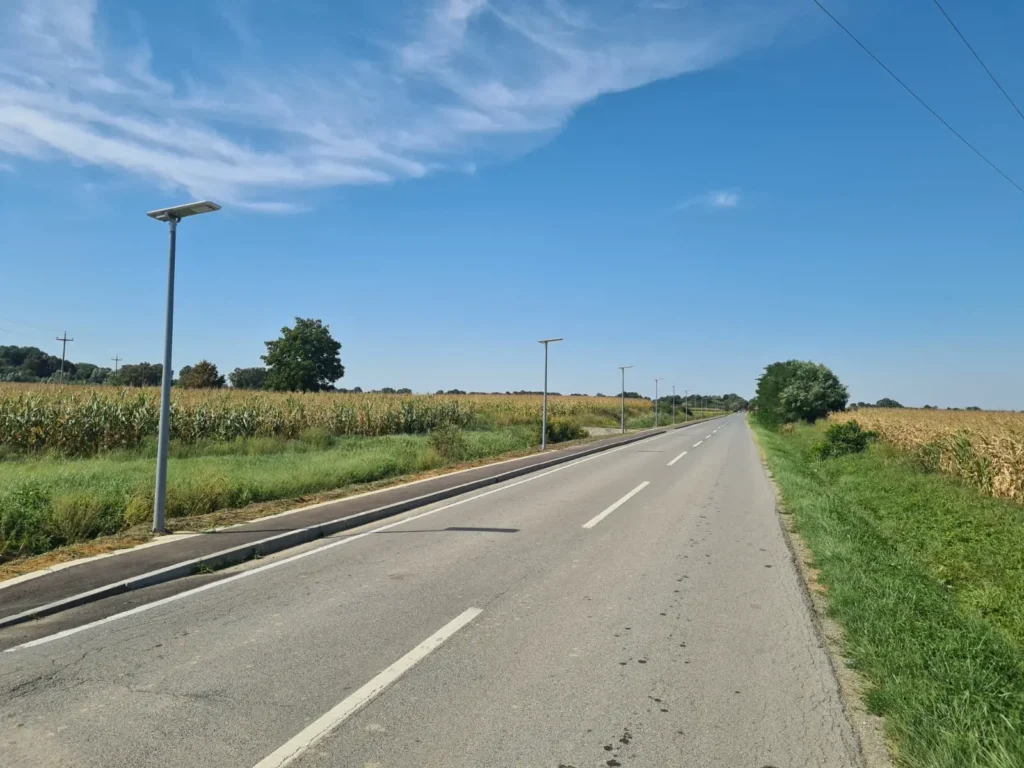
With the advancement of the EU’s Common Agricultural Policy (CAP) and Croatia’s national rural revitalization strategy, the project team initiated a green infrastructure upgrade. Located in a typical agricultural region in central Croatia, where roads are flanked by golden cornfields, this project aims to achieve low-impact, sustainable lighting by replacing outdated fixtures with solar streetlights. The Sresky Atlas series was selected for this project; with a brightness range of 2,000 LM to 10,000 LM, it accommodates different road widths and has proven reliable in rural projects worldwide.
1.2 Core Requirements
The unique rural road environment imposes several critical requirements on the lighting system:
- Minimal environmental impact: The golden cornfields are sensitive. Traditional installation methods that require digging cable trenches can cause soil erosion and reduced crop yields. Luminaires must enable “zero-impact” deployment.
- Extreme weather resistance: Croatian rural areas experience summer temperatures as high as 40°C with intense sunlight, and winter temperatures dropping to -20°C, sometimes with continuous rain exceeding 10 days. The system must provide stable year-round lighting to prevent weather-related hazards.
- Intelligent lighting modes: During peak farming seasons, nighttime traffic is heavy, while late-night traffic is sparse. The system must dynamically adjust brightness to balance energy efficiency and safety.
- Low maintenance costs: Rural areas are dispersed, and labor is scarce. Luminaires must feature self-healing capabilities, long-life batteries, and modular designs.
Based on these requirements, the Sresky Atlas series, with its aluminum alloy and PC construction and a 3-year warranty, emerged as the ideal solution.
II. Technical Solution Design: Sresky Atlas Series
Given the open geography of the Croatian countryside, the project selected the Sresky Atlas series of smart solar streetlights, whose modern square design blends seamlessly with the pristine fields.
2.1 Core Technology Adaptation
The Atlas series integrates multiple patented technologies:
- ALS 2.2 Adaptive Lighting System (ALS): Monitors light levels and battery status in real time, maintaining illumination even during 10 consecutive days of rain or overcast conditions. During winter, the system automatically switches to energy-saving modes (e.g., M1: 30% constant illumination + PIR trigger), ensuring a runtime of over 10 days, far exceeding traditional lighting fixtures.
- TCS (Temperature Control System): Designed for high-temperature environments, operating stably between 0°C–45°C for charging and -20°C–60°C for discharging. Intelligent algorithms extend battery life by over 30%, making it suitable for intense rural sunlight.
- BMS (Battery Management System): Improves charging efficiency by 30% using monocrystalline silicon solar panels and lithium-ion batteries. Charging time ranges from 6.7–10 hours, with a cycle life exceeding 1,500 cycles.
- PIR motion sensor: Covers 120° with an 8m range, enabling intelligent dimming: 100% brightness when machinery or pedestrians approach, and 25% dimmed when the area is empty, optimizing for fluctuating rural traffic.
2.2 Hardware Advantages
The system uses OSRAM 3030 LED chips with a color temperature of 5700K and efficiency of 230 lm/W. Type 2 light distribution ensures clear visibility of road markings. With an IP65/IK08 protection rating, it withstands debris and heavy rain. Advanced remote control supports DIY mode adjustments during peak farming seasons. LED indicators provide status feedback: red flashing indicates <30% charge, while a steady green light indicates >95% charge.
III. Project Implementation and Deployment
3.1 Non-Invasive Installation
The integrated design of the Atlas series eliminates the need for cable trenches. Foundation cages are secured directly along the roadside using C20 concrete, and brackets and luminaires are mounted with screws. Deployment takes only a few hours, causing no disturbance to the cornfields and preserving the agricultural ecosystem.
3.2 Scenario Presentation (Based on Actual Conditions)
In daytime landscapes, under clear blue skies, the golden fields and square lamp heads create a sense of geometric beauty. Streetlights are arranged in a single row along the gray roadway, forming an orderly artery outlined by white dashed lines.
IV. Project Outcomes and Impact
4.1 Social Value
Post-implementation, nighttime safety improved significantly: accident rates decreased by over 20%, enhancing farmers’ quality of life. The urban-rural lighting gap narrowed, bringing rural areas closer to city-level lighting standards and strengthening community cohesion.
4.2 Environmental and Economic Benefits
A model of sustainability: Zero-carbon solar power saves electricity costs annually and reduces carbon emissions by hundreds of kilograms. The efficient BMS and 1,500 charge cycles ensure high ROI over 5–8 years.
V. Risks and Mitigation Strategies
| Potential Risk | Atlas Mitigation Strategy |
|---|---|
| Dust accumulation from harvesting | Sloped lamp head design uses rainwater for self-cleaning, preventing dust buildup from affecting photovoltaic efficiency. |
| Low winter temperatures impacting battery | TCS regulates charging/discharging currents in extremely cold environments, protecting battery performance. |
| Maintenance challenges in remote areas | Modular design allows direct installation, removal, or replacement of each component on the pole, eliminating the need for professional teams on-site. |
| Energy waste from unnecessary late-night lighting | PIR motion sensors automatically reduce brightness during late-night hours, saving energy and reducing light pollution. |
These strategies ensure zero-failure operation, highlighting Sresky’s professionalism.
Conclusion
The successful implementation of the Sresky Atlas series in rural Croatia has not only resolved lighting challenges but also set a benchmark for sustainable, green agricultural infrastructure.