
Anyone who has worked on street lighting projects knows that the biggest challenges are unstable foundations and severe weather conditions. When construction began on the AP-2 Highway service road project in Spain, the general contractor immediately faced three major challenges:
- Cables could not be buried: The subgrade for the 21-kilometer service road had not yet been compacted.
- Extremely strong winds: Gusts in open areas of the region routinely reach 100–120 kilometers per hour throughout the year.
- High security risks: Due to low public safety in surrounding areas, outdoor equipment was highly vulnerable to theft.
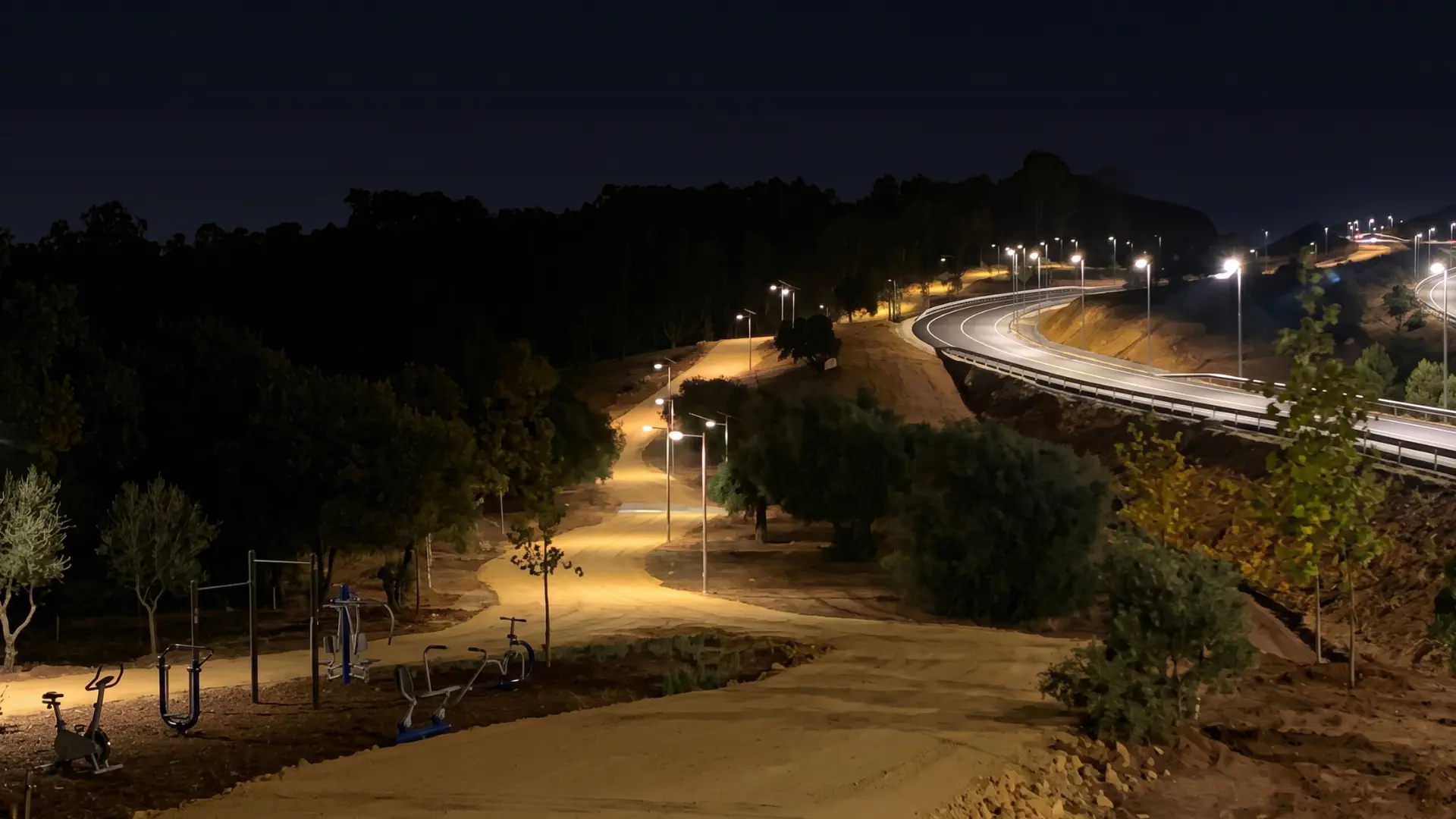
Faced with the practical pressures of a tight schedule and harsh environmental conditions, the construction team abandoned traditional, time-consuming procedures. Instead, they adopted a single-sided staggered layout with 35–38-meter spacing to efficiently install 580 sets of Sresky Titan 2 Series Split-Type Solar Street Light.
The lighting infrastructure for the entire service road was completed without relying on the municipal power grid and successfully passed acceptance inspection by the General Directorate of Highways under Spain’s Ministry of Transport.
Project Information
| Item | Details |
|---|---|
| Project Name | Solar Lighting Project for the AP-2 Highway Service Road, Monegros Section |
| Project Location | Monegros Region, Zaragoza Province, Spain |
| Client / Owner | AP-2 Highway Concession Management Company |
| Technical Supervision | General Directorate of Highways, Spanish Ministry of Transport |
| Road Length | Approximately 21 kilometers |
| Number of Luminaires | Approximately 580 Sresky Titan 2 Series Split-Type Solar Street Light units |
Project Challenges and Solutions
Challenge 1: How to Complete Lighting Installation Simultaneously with Road Construction
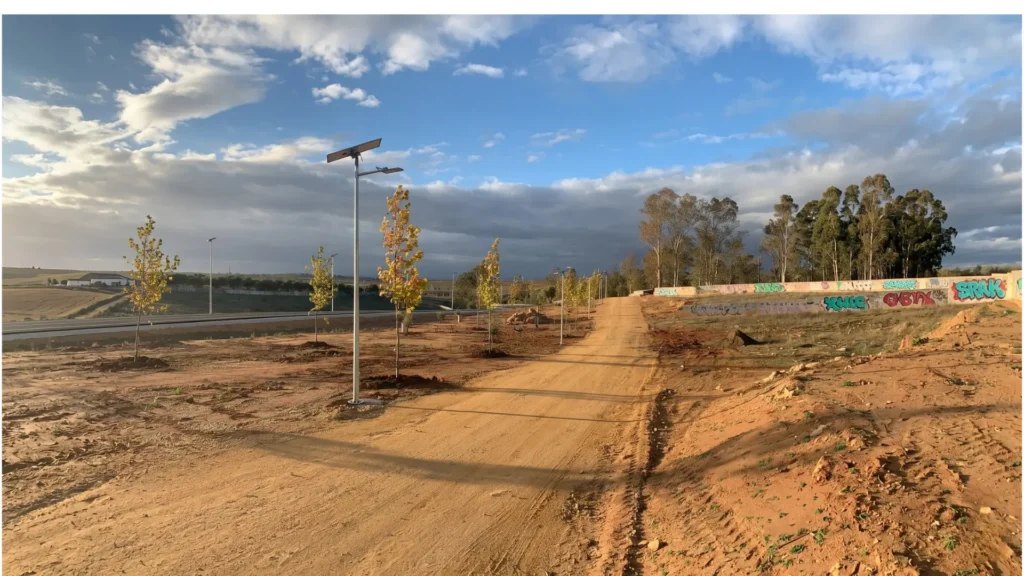
The roadbed consists mainly of undisturbed soil and crushed stone. Due to repeated compaction by heavy construction vehicles, ground bearing capacity is uneven.
If traditional grid-connected lighting were used, the following steps would be required:
- Excavation of cable trenches
- Laying underground cables
- Construction of power distribution infrastructure
- Waiting for completion of roadworks before installing lighting fixtures
This would make lighting installation the final phase of the entire project.
Solution 1: Off-Grid Solar Lighting Without Cabling
The Sresky Titan 2 Series Split-Type Solar Street Light features a fully off-grid design, with each unit operating independently and eliminating the need for underground cabling or distribution systems.
On-site construction only requires:
- Pouring the foundation
- Installing the light pole
- Mounting the solar panel
- Installing the luminaire
This allows lighting installation to proceed in parallel with road construction, avoiding repeated excavation. As a result, the overall construction period was reduced by approximately 45 days compared with the original schedule.
Challenge 2: Ensuring Long-Term Stability Under Persistent Strong Winds
The Monegros Region lies in the Ebro River Valley, where strong Cierzo winds occur frequently throughout the year. Recorded extreme gusts can reach 100–120 kilometers per hour. The terrain is open, and newly planted roadside vegetation has not yet matured, leaving the area with minimal natural wind barriers.
If solar panels, batteries, and luminaires are all installed at the top of the pole:
- Top-load weight increases
- Wind-exposed surface area increases
- Long-term fatigue risk becomes higher
Solution 2: Structural Optimization for High-Wind Environments
The Sresky Titan 2 Series Split-Type Solar Street Light is structurally optimized with a “top-load reduction” concept:
- The solar panel is separated from the luminaire head, reducing pole-top weight
- The solar panel supports 360° adjustable installation, allowing wind-direction alignment and reduced wind resistance
- High-strength aluminum alloy structure is used with IP65/IK08 protection ratings
Field performance shows that even under sustained Cierzo wind conditions, the system remained structurally stable, with no deformation observed in poles or mounting brackets. This provides strong validation for deployment in high-wind highway environments.
Challenge 3: Reducing Theft Risk in Remote Road Sections
This highway section is located far from urban areas, with limited pedestrian traffic and minimal on-site monitoring.
Solar lighting systems with exposed batteries and controllers are highly vulnerable to theft or vandalism, resulting in both operational failures and high replacement costs.
Solution 3: Concealed Anti-Theft Design
The Sresky Titan 2 Series Split-Type Solar Street Light integrates key components including the:
- Battery
- Controller
These are housed inside a locked compartment within the pole.
Compared with traditional exposed designs, this approach provides:
- Lower visual exposure
- Higher removal difficulty
- Reduced vandalism risk
During six months of operation, no theft incidents were recorded.
Project Outcomes
- Installation schedule: 580 luminaires installed concurrently with roadbed construction, avoiding delays in pavement works
- Cost optimization: Eliminated excavation and reinstatement of approximately 21 km of cable trenches, reducing civil works and material costs
- Wind resistance: System withstood multiple Cierzo wind events (peak gusts exceeding 80 km/h during monitoring), with no structural deformation observed
- Operational safety: No theft or vandalism incidents recorded in the first six months
Customer Testimonials
“Even after several Cierzo storms, the light poles remained stable. From construction start to commissioning, we experienced virtually no delays. Most importantly, the batteries are concealed inside the poles, which significantly reduces theft risk on remote road sections.”
— J. M. Martínez, Site Manager, AP-2 Highway Service Road Project Contractor
FAQ
Q1: When should split-type solar street lights be used?
Split-type systems are more suitable for highways, high-wind regions, projects requiring flexible solar panel orientation, or locations with high anti-theft requirements. Integrated systems are better suited for municipal roads and community environments with stable installation conditions.
Q2: What type of solar street light is suitable for high-wind areas in Spain?
In high-wind environments, split-type systems are the safer choice. The Sresky Titan 2 Series Split-Type Solar Street Light reduces wind load through its separated panel design and adjustable mounting structure. In real-world applications in the Monegros Region, it has demonstrated strong operational stability.
Q3: How can battery theft be prevented on remote road sections?
The most effective method is to conceal and lock the battery within the pole structure. The AP-2 highway project demonstrates that integrating batteries inside locked compartments can effectively eliminate theft incidents without additional security systems.
Q4: Can solar street lights be installed before roadbed stabilization is complete?
Yes. Unlike grid-connected lighting, solar street lights do not require trenching or cable installation. They can be installed immediately after foundation preparation, allowing lighting and civil works to proceed in parallel. In this project, all 580 units were installed while the roadbed was still in its initial soil and gravel stage, shortening the schedule by approximately 45 days.
Conclusion
As European highway infrastructure increasingly adopts off-grid and low-carbon solutions, solar street lighting is becoming a mainstream choice—especially in challenging environments such as unpaved roadbeds, high-wind corridors, and remote areas with security risks.
For municipalities, contractors, and highway planners, the AP-2 Monegros section project demonstrates a practical model: solar lighting not only reduces construction time and cost but also enhances resilience and security through modular, off-grid design.