
In September 2025, along the coastal highway between Paphos and Limassol in Cyprus, lighting engineer Antonis stood silently as he looked at the solar streetlights that had only recently been installed.
In less than three months, sea winds and salt fog had already caused rust to appear at the bases of the light poles. After two consecutive days of rain, lighting across the entire area had once again failed.
This was not the first time the coastal road had experienced such issues. High levels of salt spray, strong sea winds, and rugged cliffside terrain made it difficult for many conventional solar streetlights to operate reliably over the long term. Each repair required significant labor and equipment costs.
Faced with this challenge, Sresky redesigned the solution based on local topography and climate data, ultimately deploying 233 Atlas Series integrated solar streetlights along the coastline to achieve long-term, stable lighting performance.
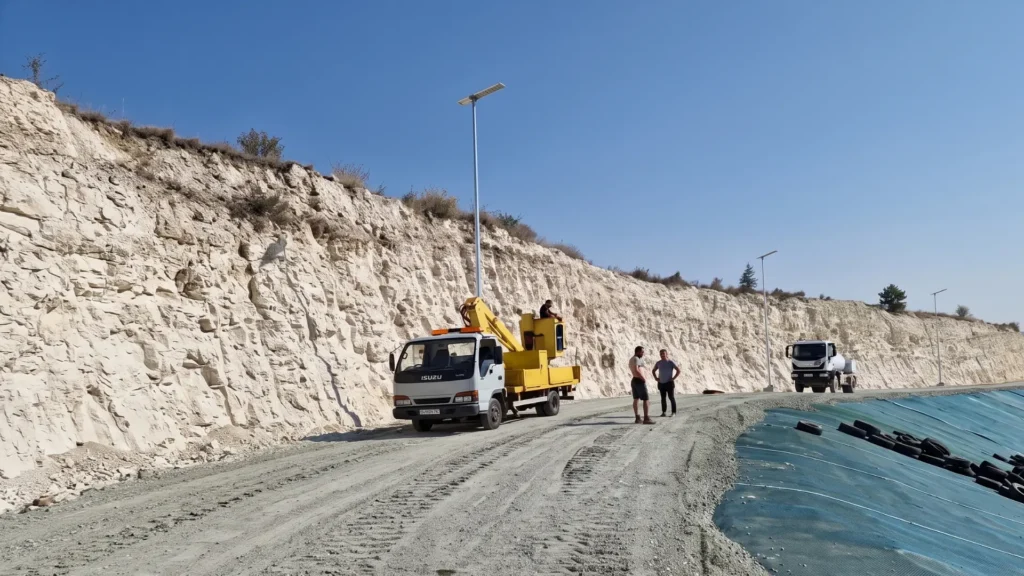
Project Snapshot
| Project Elements | Details |
|---|---|
| Project Location | Southwest coast of Cyprus, along the coastal strip between Paphos and Limassol and around the Akamas Peninsula |
| Client/Responsible Agency | Cyprus Public Works Department / Regional Development Planning Directorate of the Ministry of the Interior / Committee for the Management of Scenic Areas and Nature Reserves |
| Project Scale | 233 solar street lights |
| Model Selected | Sresky Atlas Series all-in-one solar street lights |
Engineering Challenges and Solutions
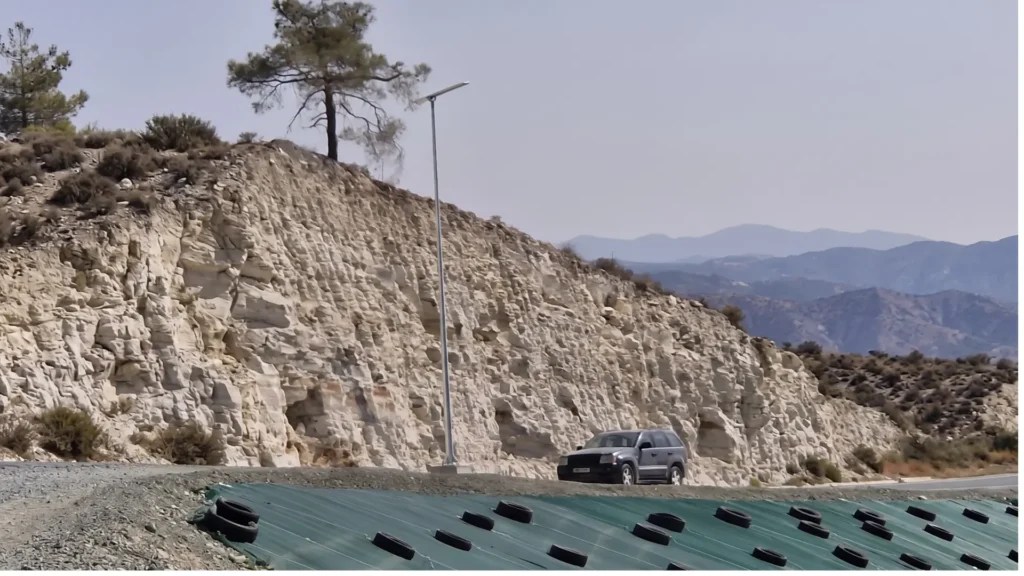
Challenge 1: High Salt Fog Corrosion and Strong Winds in a Coastal Limestone Cliff Environment
Located in a coastal cliff area, the solar street lights are continuously exposed to high salt fog, high humidity, and strong winds. Salt fog generated by ocean waves accelerates metal corrosion, while canyon-like terrain amplifies local wind speeds, placing continuous stress on the lamp post structures.
Key risks include:
- Reduced equipment lifespan: Standard luminaires are prone to rusting and fastener aging.
- Increased maintenance difficulty: Construction and repairs in coastal areas are challenging, and frequent maintenance would significantly increase operating costs.
- Reduced lighting stability: Salt fog may affect electrical connections, leading to system failures.
- Increased structural safety risks: Long-term wind-induced vibrations may compromise the stability of light poles.
Therefore, the project required more than just lighting products; it required a solar streetlight solution capable of withstanding harsh coastal environments and ensuring long-term, stable operation.
Sresky Customized Solution
Designed for environments with high salt fog and strong winds, the Sresky Atlas Series features highly corrosion-resistant materials and a reliable structural design to ensure the long-term, stable operation of solar street lights.
Core Solutions:
- C5-Grade Corrosion Protection: Utilizes the ISO 12944 C5-grade corrosion protection system to enhance resistance to salt fog and reduce maintenance caused by corrosion.
- Optimized Wind-Resistant Structure: Structural reinforcement tailored to the project’s wind conditions improves long-term operational safety.
- Sealed Electrical Design: Minimizes the impact of moisture and salt fog to ensure stable operation of LEDs, batteries, and control systems.
Through C5-grade corrosion protection, wind-resistant structural design, and reliable electrical protection, Sresky solar street lights help projects reduce maintenance costs and achieve long-term, reliable lighting.
Challenge 2: EU CYS Compliance Requirements and Import Delivery Risks
As a public infrastructure project within the EU, the Cypriot market imposes strict compliance and performance requirements on solar street lights. The equipment must not only meet lighting performance standards but also comply with relevant safety, environmental, and optical requirements.
Key risks include:
- Increased acceptance risks: A lack of complete certification documentation may affect project approval.
- Reduced bidding efficiency: The inability to quickly provide lighting simulation data may impact the bidding process.
- Unpredictable costs: Import procedures, tariffs, and customs clearance issues may increase budget pressure.
- Lighting performance risks: Inadequate light distribution may cause glare and light pollution.
Therefore, European projects require solar streetlight solutions that comply with standards, ensure rapid delivery, and minimize implementation risks.
Sresky Customized Solutions
Sresky provides an integrated solution combining EU compliance support and project delivery capabilities to help clients mitigate risks and accelerate project implementation.
Core Advantages:
- Complete EU Compliance Documentation: Provides CE, RoHS, and EN 60598 test reports, as well as IEC/TR 62778 photobiological safety assessments, to support government audits.
- Professional Optical Design Support: Provides IES files that can be directly imported into DIALux for rapid lighting simulations.
- DDP Duty-Paid Delivery Solution: Completes HS code and tax assessments in advance to reduce customs clearance risks and cost uncertainty.
- Rapid European Prototype Support: Prototypes from the Atlas Series are dispatched from local warehouses to quickly complete testing and project validation.
With EU certification, professional optical design, and stable delivery capabilities, Sresky solar street lights meet the core requirements of European public projects for safety, compliance, and long-term reliable operation.
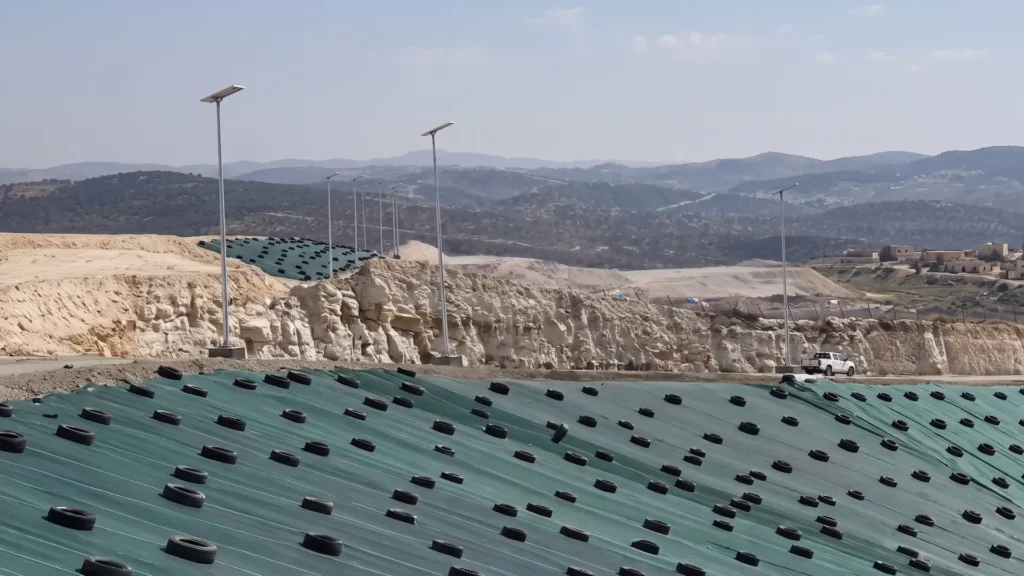
Project Results and Customer Feedback
The installation and grid connection of 233 Atlas Series all-in-one solar street lights were completed in November 2025.
As of July 2026, the system has been operating stably, performing well in coastal environments characterized by salt fog, strong winds, and overcast, rainy winter conditions.
Corrosion Resistance: After nine months of exposure to a high-salt-fog environment, no significant rusting was observed on the light poles or fasteners.
Wind Resistance: The luminaires showed no structural damage or loosening and maintained stable operation.
Battery Performance: The project experienced two consecutive periods of four days of overcast and rainy weather. The luminaires consistently maintained basic lighting levels, with no instances of lights shutting down.
O&M Cost Performance: No major malfunctions affecting normal lighting operations occurred during the project’s operation.
Customer Testimonial
“In previous coastal projects, we found that standard solar lighting equipment was highly susceptible to salt fog corrosion and challenging maintenance conditions. Therefore, this project placed greater emphasis on long-term stability rather than only the initial procurement cost.”
— Antonis Papadopoulos, Lighting Engineer, Cyprus Municipal Engineering Authority
Frequently Asked Questions (FAQ)
Q1: Does a coastal salt fog environment affect the lifespan of solar street lights?
A: Yes.
Long-term exposure to salt fog, high humidity, and UV radiation accelerates metal corrosion, aging of electrical connections, and degradation of sealing performance. Therefore, coastal solar streetlight projects must prioritize corrosion protection ratings, sealing structures, and material reliability.
This project uses a C5-grade corrosion protection design, effectively improving equipment stability in Cyprus’s Mediterranean coastal environment.
Q2: Can solar street lights still function normally during prolonged periods of overcast and rainy weather?
A: Yes, but performance depends on battery capacity and energy management strategies.
Low sunlight reduces solar panel power generation efficiency, so the system must be equipped with intelligent dimming and energy storage management capabilities.
The Atlas Series used in this project is equipped with the ALS Intelligent Energy Management System, which automatically optimizes energy usage based on environmental conditions and maintains basic lighting operations even during four consecutive days of overcast and rainy weather.
Q3: What certifications are required for solar street lights in European municipal projects?
A: European public projects typically require certifications related to product safety, environmental protection, and lighting performance, including:
- CE;
- RoHS;
- EN 60598-related testing;
- Optical data files.
Comprehensive certification documentation and lighting simulation support help reduce project acceptance risks and improve implementation efficiency.
Case Summary
The core challenge of the project along the southwestern coast of Cyprus was not merely the installation of 233 solar street lights, but achieving long-term, stable lighting while addressing high salt fog, strong sea winds, complex terrain, and European public project compliance requirements.
Through C5-grade corrosion protection design, optimized wind-resistant structures, the ALS Intelligent Energy Management System, and comprehensive European compliance support, the Sresky Atlas Series helped the project overcome reliability and O&M challenges in coastal environments, providing a sustainable lighting solution for public infrastructure projects along the Mediterranean coast.