
Last winter, at a rural sports field in Zala County, Hungary, dusk had just fallen, but practice was not yet over.
Standing on the sidelines, the engineer looked at the two solitary light poles in the distance, knowing full well that there were significant challenges ahead:
There was no access to the municipal power grid, and winter snow and low temperatures made it difficult for conventional solar lights to operate reliably. Meanwhile, frequent on-site maintenance was simply not feasible.
This small project, which at first glance appeared to involve only a few light fixtures, was in fact a comprehensive challenge involving:
- Adaptability to low-temperature environments;
- Unattended operation;
- Compliance with sports lighting safety standards.
Ultimately, Sresky custom-deployed 12 Thermos solar lighting systems for this rural sports field, achieving stable lighting without cable installation or frequent maintenance, and helping the local community complete this upgrade to rural public infrastructure.
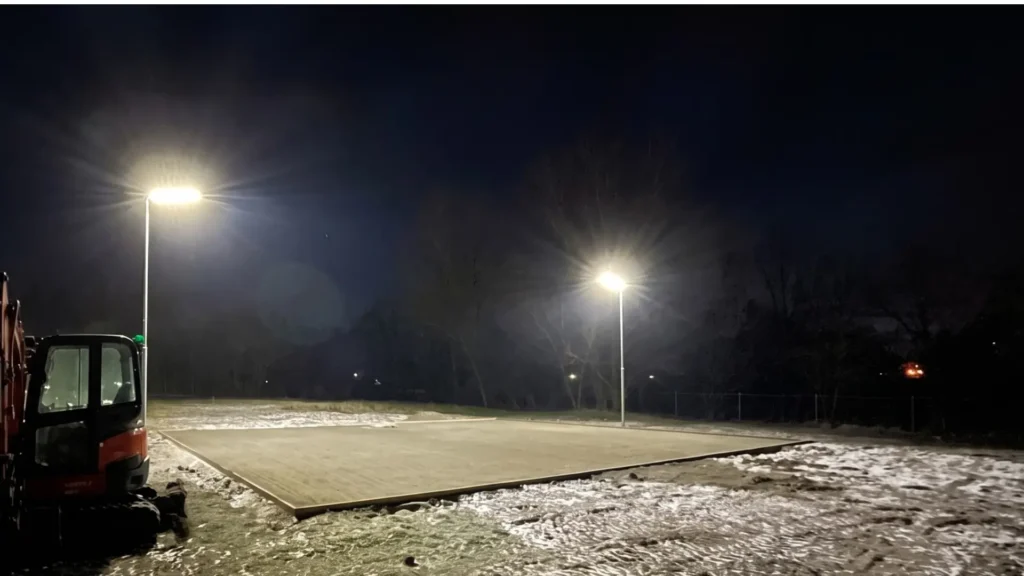
Project Snapshot
| Project Elements | Details |
|---|---|
| Location | Rural/suburban area of Hungary, approximately 47°N |
| Client / User | Public Facilities Management Department of the Township Autonomous Government, jointly operated with a local agricultural cooperative |
| System Scale | 12 off-grid solar LED luminaires (arranged in a dual-pole, cross-illumination configuration to cover the sports field) |
| Light Fixture Model | Sresky Thermos Series customized sports floodlights (10,000 lm, symmetrical light distribution) |
Challenge 1: Risk of “Battery Low-Temperature Hibernation” and Solar Panel Malfunction Due to Snow Accumulation in Cold, High-Latitude Environments
Project Challenges
Winter temperatures in Hungary can drop below -15°C, with limited effective sunlight hours and prolonged periods of overcast and snowy weather.
Conventional solar street lights are prone to reduced battery performance in low temperatures, while snow accumulation on solar panels can significantly reduce charging efficiency.
Given the lack of professional O&M personnel in the project area, traditional solutions face the following challenges:
- Insufficient battery capacity in winter, resulting in frequent nighttime power outages;
- High costs and operational difficulties associated with manual snow removal;
- Simply adding more batteries and solar panels would cause the project cost to exceed the budget.
The project required a solar lighting system capable of operating reliably in extremely cold environments while maintaining long-term unattended operation.
Sresky Thermos Tailored Solution
TCS Intelligent Temperature Control + Automatic Cleaning Modules + High-Latitude Snow-Shedding Structure
Sresky Thermos addresses battery stability issues in low-temperature environments through TCS intelligent temperature control technology, ensuring reliable operation even at -20°C.
Core Design:
- Automatic Cleaning Module and 45°–50° High-Tilt Housing
The light fixture automatically cleans itself six times daily. Combined with a high-tilt snow-shedding housing optimized for deep winter conditions at 47°N, the system uses minimal heat conduction generated during operation to accelerate snow melting and sliding, enabling autonomous snow removal without human intervention. - ALS Intelligent Energy-Saving System + MPPT Low-Light Tracking Technology
Combined with the ALS Intelligent Energy-Saving System and MPPT low-light tracking technology, the system automatically adjusts output according to weather conditions and battery status, maintaining basic lighting performance even during extended periods of overcast and snowy weather.
Challenge 2: How to Achieve Uniform Sports Field Lighting and Reduce Glare Under Limited Installation Conditions?
Project Challenges
Initially, the project was planned with only two sets of poles for opposing-beam lighting rather than the standard four-corner lighting layout commonly used for sports fields.
Conventional solar street lights are primarily designed for road lighting, with light beams oriented along the direction of the road. Applying them directly to a rectangular sports field can easily result in uneven illumination.
Key issues include:
- Excessive brightness in the center of the field, with insufficient illuminance in corner areas;
- Dark zones in the playing area, compromising safety during nighttime activities;
- Increased glare caused by snow reflection, reducing visual comfort;
- Difficulty meeting the requirements of the EN 12193 sports lighting standard.
Therefore, the project required a solution that could provide more uniform and comfortable sports field lighting with a limited number of installation points.
Sresky Thermos Solution
Professional Sports Field Light Distribution + Anti-Glare Structure for Uniform Lighting Under Dual-Pole Conditions
Sresky Thermos adopts a symmetrical wide-angle light distribution design specifically developed for sports fields, optimizing light distribution, reducing central hotspots, and improving illumination coverage at the edges.
To address the limitations of dual-pole installation, the system features:
- A dual-lamp-head configuration with an anti-glare structure;
- Extended projection range;
- Reduced direct glare.
At the same time, through:
- High-efficiency configurations of 8,000–10,000 lm;
- Optimized color temperature design;
the system meets nighttime lighting requirements for sports fields.
Core Advantages
Thermos not only provides high-brightness lighting but also achieves uniform and comfortable sports field illumination under limited installation conditions through professional light distribution and anti-glare design.
Project Results
Extreme Cold Resistance
After enduring temperatures as low as -18°C and two consecutive seven-day snowfall periods, all 12 lighting fixtures operated without failure, maintaining an average nighttime illumination duration of more than 6 hours.
Designed in accordance with EN 12193 sports lighting standards, the system optimized the nighttime training environment through uniform illuminance distribution and effective glare control.
Field measurements showed significant improvements in illuminance uniformity, while the anti-glare shields maintained the Glare Rating (GR) at ≤50, meeting community-level sports training requirements.
Unattended Autonomous Snow Removal
The steeply angled structure (45°–50°), combined with automatic snow brushing six times daily, prevented snow accumulation on the solar panel surfaces and ensured efficient solar energy collection during winter.
Budget and Compliance
The following documentation was provided in full:
- CE certification;
- RoHS certification;
- DIALux report;
- Supply chain certification.
Total project expenditures remained within the special subsidy limit, and the project successfully passed the rural audit.
Customer Testimonial
“At first, we didn’t believe solar lights could last even a week through a Hungarian winter, let alone meet official glare testing standards. But Sresky not only achieved this, it also eliminated the costs of cable installation and hiring an additional design firm. Now, the children can train under the lights throughout the winter.”
— László N., Project Coordinator, Zala County Municipal Public Facilities Management Department
Frequently Asked Questions (FAQ)
Q1: Can solar lights meet glare standards for sports field lighting?
A: Yes, but standard solar streetlight solutions cannot be applied directly.
Road lighting typically uses asymmetric light distribution, whereas sports fields prioritize illuminance uniformity and glare control.
It is necessary to select an appropriate wide-angle or specialized sports lighting distribution scheme based on the field type and validate performance through simulation software such as DIALux to ensure compliance with relevant lighting requirements, including EN 12193.
Q2: How do solar street lights address snow accumulation issues?
A: For solar street lights installed in high-latitude and cold regions, the following factors must be considered:
- Solar panel tilt angle;
- Snow-shedding capability;
- Ease of maintenance.
A reasonable tilt angle design can reduce snow accumulation and improve winter power generation efficiency. Combined with structural optimization and appropriate maintenance measures, the impact of snow on system operation can be minimized.
Q3: How are solar street lights repaired when they malfunction in remote areas?
A: The biggest challenges in remote areas are maintenance costs and transportation distances.
Solar street lights equipped with modular designs and intelligent fault detection systems can quickly identify problems and reduce the need to dismantle entire fixtures. By replacing individual components, maintenance time and long-term operating costs can be significantly reduced.