
In Thailand’s central agricultural regions, farming activities do not stop when night falls.
Every morning, farmers must sort and load their produce before sunrise and transport it to nearby markets for sale. However, because some rural roads are located far from the power grid, reliable lighting has historically been unavailable. As a result, farmers often had to wait until daylight to begin transportation, which not only affected market schedules but also increased the risks associated with nighttime travel.
To improve the efficiency and safety of agricultural roads, a local infrastructure contractor introduced SRESKY Titan SSL-64 split-type solar street lights in a farm road project. A total of 80 units were installed to provide reliable lighting for agricultural transport roads, village access roads, and produce transportation routes.
This project not only addresses nighttime lighting challenges but also enables local farmers to begin preparing for agricultural product transportation and sales approximately two hours earlier. By providing illumination during the early morning hours, the system improves the efficiency of the agricultural supply chain.
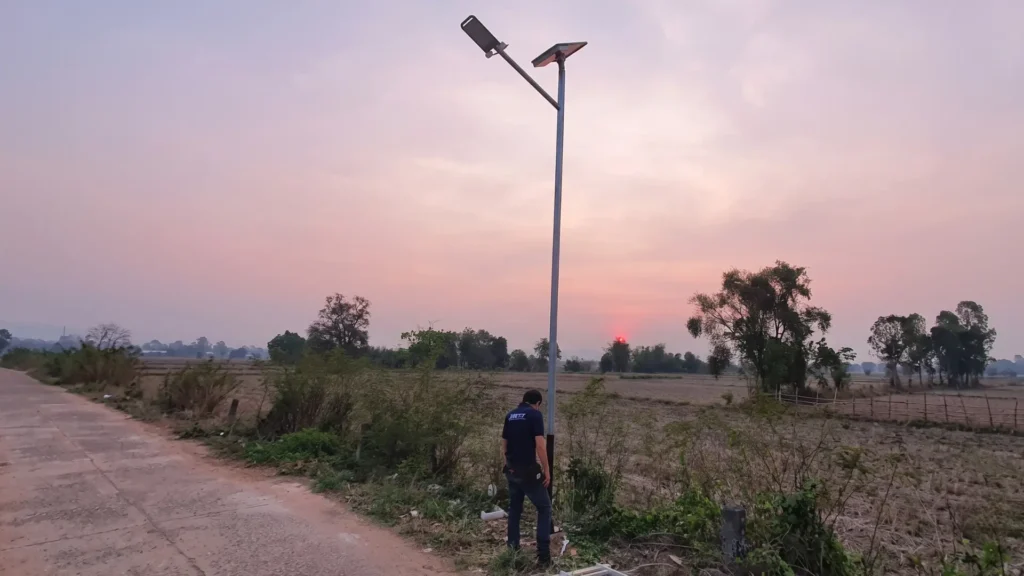
Project Overview
| Project Parameters | Details |
|---|---|
| Project Type | Lighting for Agricultural Roads and Rural Transportation Routes |
| Project Location | Agricultural Region in Central Thailand |
| Product Model | SRESKY Titan SSL-64 |
| Product Type | Split-Type Solar Street Lights |
| Number Installed | 80 units |
Engineering Challenges and SRESKY Technical Solutions
Challenge 1: How Can Continuous Lighting Be Ensured During the Rainy Season?
Central Thailand experiences its annual rainy season from May to October. During this period, prolonged cloudy and rainy weather can significantly reduce solar power generation efficiency.
For agricultural roads, the transportation of agricultural products and villagers’ daily travel must continue regardless of weather conditions. Therefore, the lighting system must have strong energy management capabilities to maintain stable operation.
SRESKY Solution: Split-Type Structure + ALS Intelligent Energy Management
The SRESKY Titan SSL-64 features a split-type design, with the solar panel, battery, and LED luminaire modules installed separately.
Key advantages include:
- The solar panel can be flexibly adjusted according to on-site lighting conditions, improving solar energy collection in low-light environments.
- The battery is positioned away from the heat source of the luminaire, improving stability in high-temperature conditions.
- The ALS intelligent energy management system automatically adjusts brightness according to battery levels, extending operating time during prolonged cloudy or rainy periods.
Through intelligent adjustment, the system achieves a balance between agricultural transportation requirements and energy efficiency.
Challenge 2: How Can Maintenance Costs Be Reduced in Remote Areas?
Agricultural roads are typically distributed across large areas. When traditional lighting equipment fails, maintenance teams must manually inspect each unit, resulting in high labor costs and extended troubleshooting times.
SRESKY Solution: FAS Fault Detection + Modular Maintenance
The SRESKY Titan series is equipped with the FAS fault detection system, allowing maintenance personnel to quickly evaluate equipment status and identify potential issues.
At the same time, its modular design supports:
- Independent battery replacement;
- Rapid controller maintenance;
- Separate repair or replacement of LED modules.
Compared with traditional lighting solutions, this design reduces on-site troubleshooting time and improves maintenance efficiency for remote infrastructure projects.
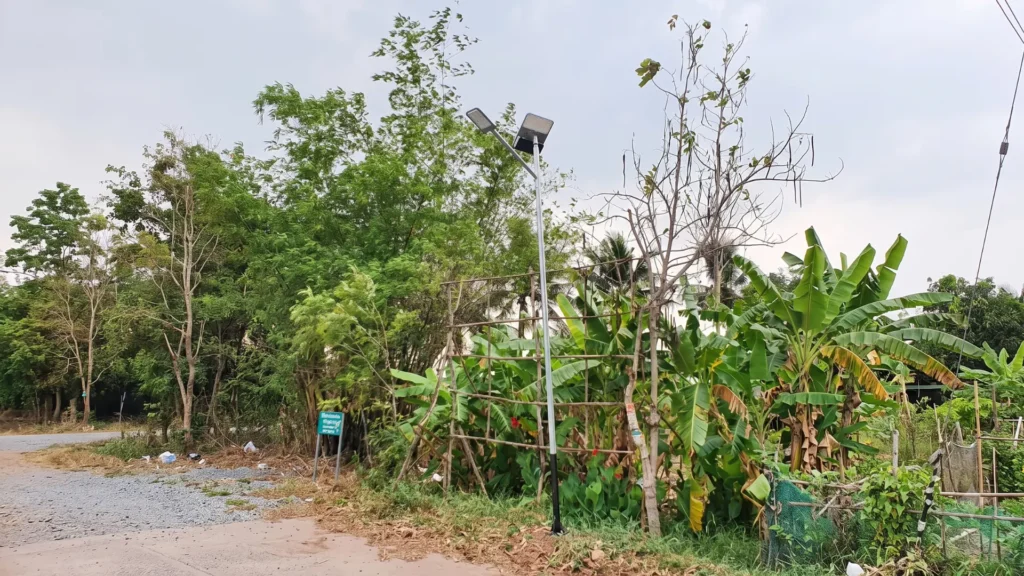
Why Choose Titan Split-Type Solar Street Lights?
Better Adaptation to Complex Agricultural Environments
The split-type design allows solar panels, batteries, and luminaires to be configured independently, providing greater flexibility and making the system better suited to Thailand’s hot and rainy climate.
Supporting Agricultural Production Needs
The intelligent segmented lighting mode enables:
- Higher brightness during the first half of the night to ensure transportation safety;
- Reduced power output during the second half of the night to extend battery life.
This approach meets transportation requirements during peak farming seasons while improving overall energy efficiency.
Reduced Long-Term Operating Costs
No cable installation is required. Combined with intelligent monitoring and modular maintenance, the system helps reduce long-term operating and maintenance costs in remote areas.
Project Results
- Earlier Lighting, Improved Agricultural Transportation Efficiency: The SRESKY Titan SSL-64 enables farmers to begin sorting and transporting agricultural products approximately two hours earlier.
- Stable Operation During the Rainy Season: The system performs reliably under Thailand’s prolonged cloudy and rainy conditions.
- Zero Grid Construction Required: No underground cables or complex power distribution systems are needed, reducing the complexity of rural infrastructure development.
- Efficient Maintenance Management: The FAS fault detection system helps maintenance personnel quickly identify and resolve equipment issues.
Project Feedback
“Previously, the biggest challenges in rural road projects were lighting instability during the rainy season and the difficulty of repairs when failures occurred. The split-type design of Titan adapts well to local weather conditions, while the fault detection feature allows maintenance personnel to quickly diagnose problems. Now, farmers can begin transporting agricultural products earlier, and road utilization efficiency has improved significantly.”
— Somchai, General Contractor at the Project Site
Frequently Asked Questions (FAQ)
Q1: Are split-type solar street lights suitable for agricultural roads in Thailand?
Yes.
Thailand’s agricultural areas are characterized by high temperatures, high humidity, and a long rainy season. Split-type solar street lights provide better heat dissipation and greater installation flexibility, making them more suitable for rural road applications.
Q2: Why are solar streetlight projects for agricultural roads attracting attention from procurement teams?
Because they not only provide lighting but also:
- Improve road safety;
- Extend agricultural working hours;
- Reduce grid construction costs;
- Minimize long-term maintenance expenses.
Q3: What parameters should be considered for agricultural solar lighting projects?
In addition to lighting brightness, the following factors should be evaluated:
- Solar panel power;
- Battery capacity;
- Ability to operate during consecutive rainy or cloudy days;
- Control system;
- Installation environment;
- Post-installation maintenance requirements.
Conclusion
The Thai agricultural road project demonstrates that the value of solar lighting extends beyond nighttime illumination. It also helps rural communities improve production efficiency and transportation reliability.
For agricultural road and remote-area projects, stable operation, climate adaptability, and reduced maintenance requirements are key factors in determining long-term project value.
Through its modular design, ALS intelligent energy management system, and FAS fault detection technology, the SRESKY Titan series provides a reliable, low-maintenance, and sustainable off-grid lighting solution for Thailand’s agricultural roads.
For contractors planning rural roads, agricultural parks, or government infrastructure projects, selecting solar street lights that meet local environmental requirements is not only about developing lighting infrastructure—it is also an investment in the long-term value of agricultural development.