
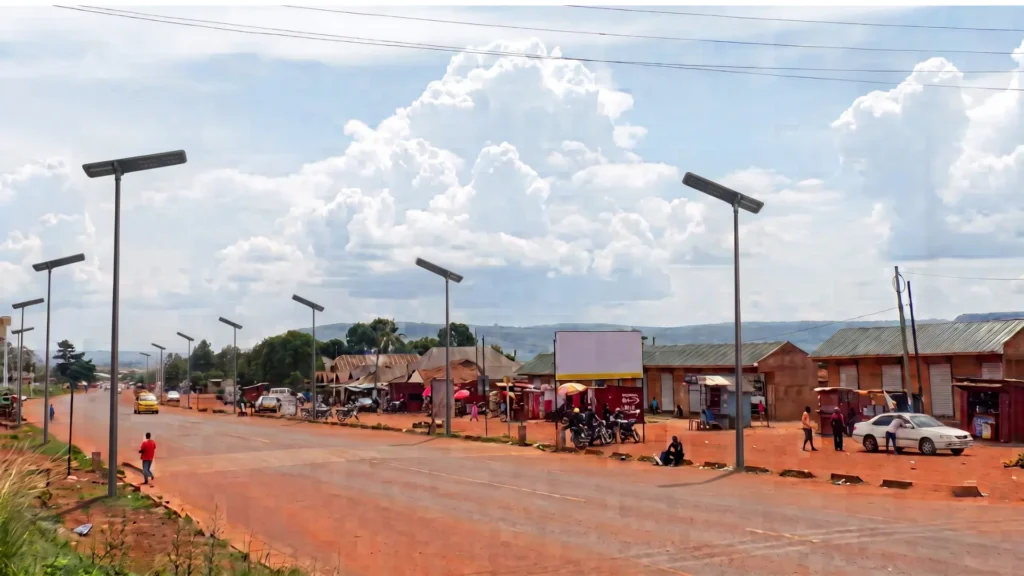
Project Snapshot
| Project Elements | Specific Information |
|---|---|
| Project Area | Roads in Tanzania’s northwestern border region and surrounding communities |
| Project Type | Off-grid public road lighting project |
| Project Scale | Approximately 260 integrated solar street lights |
| Product Models | Sresky ATLAS Series SSL-315 to SSL-320 |
| Pole Height | 8–12 meters |
Engineering Challenges
Challenge 1: How to Ensure Long-Term, Stable Lighting on Remote Roads Without Grid Support?
Some roads in the project area are located far from urban centers and have limited access to traditional power infrastructure. If conventional grid-connected streetlights were installed, extensive cable networks and supporting power facilities would be required. This would not only increase initial investment costs but also create additional challenges for future maintenance.
Additionally, some regions of Tanzania experience significant seasonal weather variations:
- Continuous cloudy conditions during the rainy season may reduce solar power generation efficiency;
- Road lighting demand remains constant during nighttime hours;
- Maintenance costs are higher in remote areas due to transportation and labor requirements.
Therefore, the project’s primary objective was not simply to install lighting fixtures, but to ensure that the solar streetlight system could maintain stable operation under changing weather conditions.
Solution:
Designed specifically for off-grid road applications, the Sresky ATLAS Series integrated solar streetlights improve overall system reliability through high-efficiency energy conversion and intelligent lighting management.
Key design features include:
- High-efficiency solar panels to maximize daytime energy capture;
- Smart lighting control technology that automatically adjusts lighting modes according to battery levels and environmental conditions;
- Optimized energy storage management to improve lighting stability during extended periods of cloudy or rainy weather;
- An all-in-one design that simplifies installation and reduces construction time.
Through a system design combining “high-efficiency power generation + smart energy conservation + independent power supply,” the solar streetlights can meet the long-term lighting requirements of remote roads while eliminating dependence on complex grid infrastructure.
Challenge 2: How to Reduce Maintenance Requirements in Hot and Humid Lake Regions and Across Long-Distance Deployments?
Some project areas are located near lakes and experience prolonged high temperatures and high humidity. Meanwhile, the roads cover extensive areas, and some installation sites are far from urban maintenance centers.
For outdoor lighting equipment operating over long periods, environmental conditions may result in:
- Material aging caused by prolonged outdoor exposure;
- Reduced equipment reliability due to rain and dust;
- Increased inspection difficulties due to remote locations;
- Higher repair costs after equipment failures.
Therefore, during the equipment selection process, the project prioritized weather resistance and ease of maintenance.
Solution:
The Sresky ATLAS Series solar street lights feature structural optimizations designed for long-term outdoor applications:
- Weather-resistant design suitable for harsh outdoor environments, extending equipment service life;
- Enhanced protection against moisture and dust to reduce impacts on internal components;
- Modular design that simplifies installation and future inspections;
- Intelligent operational status monitoring to help maintenance personnel quickly evaluate equipment conditions.
Compared with traditional lighting systems that require regular inspections of wiring and power supply infrastructure, self-contained solar street lights reduce maintenance demands and improve operational efficiency for remote road projects.
Project Outcomes
- Improved nighttime traffic safety along border roads;
- Reduced dependence on traditional power infrastructure;
- Lowered long-term costs associated with cable maintenance and energy management;
- Expanded public lighting coverage in remote areas.
Customer Testimonial
“For border road projects, the biggest challenge is not installation—it is ensuring stable operation years after deployment. Since these areas are far from cities, frequent equipment failures would result in high maintenance costs. The Sresky solution allows us to focus more on long-term reliability rather than only the initial construction investment.”
— Project Manager, Tanzania Road Project
Frequently Asked Questions (FAQ)
1. Are all-in-one solar street lights suitable for government road projects?
Yes.
Compared with traditional grid-connected streetlights, all-in-one solar street lights do not require underground cable installation or additional power distribution infrastructure. This makes them particularly suitable for rural roads, border areas, industrial parks, and regions with limited grid coverage.
For government infrastructure projects, key considerations include product reliability, warranty terms, maintenance convenience, and the supplier’s project experience.
2. Can solar street lights be used on border roads and in remote communities?
Yes.
Border roads are typically characterized by long distances, difficult maintenance conditions, and limited grid availability. Off-grid solar lighting systems can reduce dependence on traditional power infrastructure and provide independent energy supply.
However, project design must fully consider local climate conditions, traffic requirements, and future maintenance needs.
3. What Should Be Considered When Installing Solar Street Lights in Hot and Humid Regions?
Hot and humid environments place higher demands on the long-term performance of solar street lights.
When selecting equipment, it is recommended to consider:
- Solar panel efficiency;
- Battery cycle performance;
- Ingress protection rating;
- Thermal management design;
- Proven long-term outdoor application experience.
For the East African Great Lakes region, high-humidity areas, and tropical climates, a highly reliable system design is more important than focusing solely on initial purchase costs.
Conclusion
The solar streetlight project along Tanzania’s border corridor demonstrates that the core challenge of road lighting in remote areas is not equipment installation, but ensuring stable operation over many years.
With the continued development of rural road construction, border infrastructure upgrades, and green energy applications across Africa, solar streetlights are becoming an increasingly important choice for off-grid lighting projects.
For:
- Municipal infrastructure management departments;
- EPC contractors;
- Road planning and construction agencies;
selecting a solar streetlight solution requires careful consideration of local environmental conditions, system reliability, and long-term maintenance costs.
Through the ATLAS Series solar streetlight solutions, SRESKY provides off-grid lighting solutions for remote roads, lake regions, and public infrastructure projects in Africa that are better adapted to real-world application requirements. These projects also provide valuable practical experience that can serve as a reference for similar overseas infrastructure developments.