
In a large wildlife reserve in East Africa, nighttime lighting along visitor trails and at campsites had long been unreliable. Located far from the national power grid and lacking a permanent maintenance team, the reserve faced repair delays of up to several weeks whenever streetlights failed. Continuous rainfall during the local rainy season reduced charging efficiency, while high temperatures during the dry season placed additional stress on equipment. At the same time, compliance with ecological light pollution control requirements made achieving stable, low-maintenance, long-term lighting a key challenge.
To address these challenges, the East African National Parks Authority (NPA) partnered with the International Ecotourism Development Fund to launch a specialized lighting upgrade project. They deployed 350 sets of Sresky Basalt Series industrial-grade solar street lights across three core visitor areas, two field management camps, and 12 kilometers of roads. By leveraging TCS bidirectional temperature control, ALS adaptive dimming, and a full-cut-off optical design, the system effectively addresses three major challenges: extended runtime in high-temperature environments, reduced solar input during overcast conditions, and compliance with light pollution control requirements.
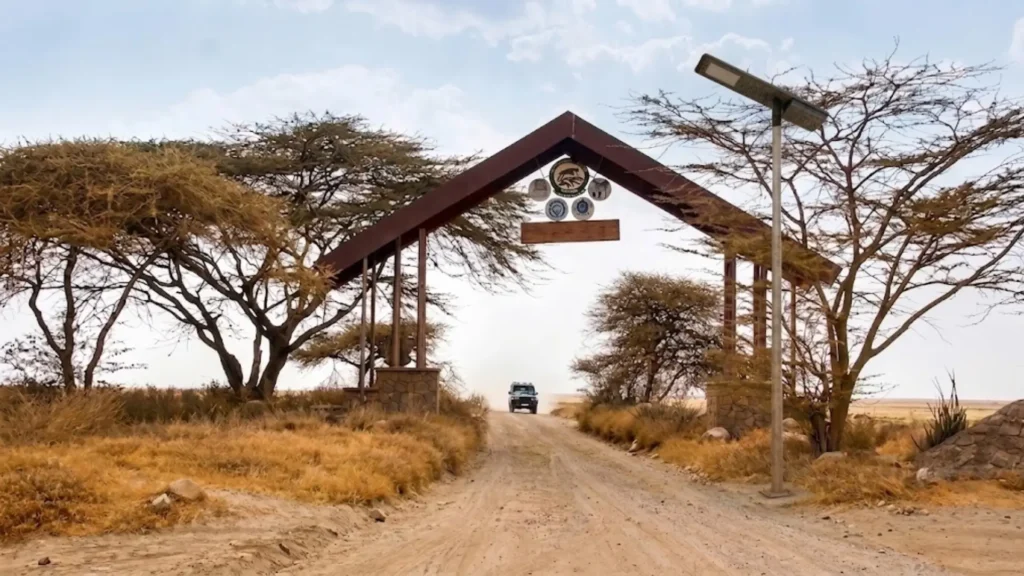
Project Snapshot
Project Information
- Project Location: A large wildlife reserve in East Africa (visitor service centers, management camps, and key road areas)
- Client/Managing Authority: National Parks Authority (NPA) + International Ecotourism Development Fund
- Project Scope: Three core visitor service areas, two field management camps, and approximately 12 kilometers of key off-grid roads
- Number of Street Lights: 350 industrial-grade solar street lights
- Pole Specifications: 8–10-meter hot-dip galvanized wind-resistant poles
- Product Model: Sresky Basalt Series
Engineering Challenges and Solutions
Challenge 1: Impact of Continuous Rainy Weather During the Wet Season and High Temperatures During the Dry Season on System Stability
The project site is located in the East African savanna region, where climate conditions vary significantly throughout the year.
During the rainy season, prolonged cloudy and rainy weather can reduce solar energy input. During the dry season, extended exposure to high temperatures places greater demands on battery performance and system management capabilities.
Previously, conventional solar streetlight systems operating in similar environments could face the following issues:
- Insufficient energy storage during cloudy and rainy periods, affecting nighttime lighting duration;
- High temperatures accelerating battery degradation;
- Difficult maintenance access in remote areas, resulting in longer fault resolution times;
- Potential impacts on visitor access and nighttime staff patrols.
Sresky Technical Solution 1:
Through temperature monitoring, thermal insulation design, and charge/discharge management, Sresky helps reduce the impact of high temperatures on battery performance and improves long-term system stability.
At the same time, the ALS Adaptive Power Regulation System adjusts LED output power according to remaining battery capacity and weather conditions.
During extended periods of cloudy or rainy weather, the system reduces non-essential energy consumption and prioritizes essential lighting needs, thereby extending operating endurance.
Ultimately, the project adopted Sresky Basalt Series solar street lights equipped with TCS and ALS technologies, including the SSL-918, SSL-920, and SSL-930 models.
Challenge 2: Ecological Conservation Areas Impose Stricter Requirements on Lighting Methods
This protected area is not only a tourist destination but also an important ecological zone. Management requirements focus not only on whether roads are illuminated but also on whether lighting equipment minimizes its impact on the natural environment.
The project’s technical requirements included:
- Reducing upward light spill;
- Minimizing nighttime glare;
- Reducing disturbance to nocturnal wildlife habitats;
- Adjusting illuminance and color temperature according to different zones.
Additionally, the reserve contains areas with different functional requirements:
- Visitor trails require safe but low-impact lighting;
- Viewing platforms require lighting solutions that preserve the natural nighttime environment as much as possible;
- Parking lots and entrance areas require lighting that meets higher safety standards.
If a fixed-brightness and fixed-color-temperature solution were adopted, future adjustments to meet changing ecological management requirements could become difficult.
Sresky Technical Solution 2:
First, the Sresky Basalt Series uses an optimized optical design that reduces unnecessary upward light spill by precisely controlling light distribution while minimizing glare in visitor areas.
Second, the luminaires support adjustable LED color temperature settings, enabling different configurations for specific application scenarios. If conservation requirements change in the future, lighting parameters can be adjusted accordingly.
Based on the functions of different areas, the project implemented a differentiated lighting strategy:
- Visitor trails: A low-glare lighting mode is used to meet nighttime access requirements;
- Viewing platforms: Warm-toned lighting is used to minimize impact on the natural nighttime environment;
- Parking lots and entrances: Lighting solutions designed for higher safety requirements are combined with nighttime energy-saving control modes.
In addition, the system adopts a low-disturbance lighting design, making it more suitable for long-term operation in ecologically sensitive areas.
Project Outcomes
- Covered approximately 12 kilometers of off-grid roads, enabling self-sufficient lighting;
- Improved equipment resilience in high-temperature environments;
- Enhanced lighting stability during prolonged periods of low solar radiation through intelligent energy management;
- Met ecological area lighting requirements for low glare and minimal light pollution.
Customer Testimonial
“In the past, we were particularly concerned about lighting system stability during the rainy season, as continuous rainfall increased maintenance pressure. Since these systems were put into operation, nighttime safety management has become more reliable. The modular color temperature design also provides greater flexibility to adapt to future changes in ecological management requirements.”
— Infrastructure Manager, National Park Administration
Frequently Asked Questions (FAQ)
1. Are solar street lights suitable for installation in high-temperature regions of East Africa?
Yes, but it is essential to select solar street light products designed for the local environment.
When choosing a system, attention should be paid to:
- Battery temperature control capabilities;
- Operating temperature range;
- Battery management system;
- Product protection rating.
Standard solar street lights and industrial-grade solar street lights designed for complex environments may differ significantly in long-term operational performance.
2. Will solar street lights continue to operate normally during prolonged periods of cloudy or rainy weather?
High-quality off-grid solar street lights typically rely on intelligent energy management systems to cope with low solar irradiation conditions.
Key design features include:
- Appropriate energy storage capacity;
- Intelligent power regulation;
- Automatic optimization of operating modes based on battery charge levels.
The ALS Adaptive Power Regulation System helps the equipment adjust lighting strategies when solar input is insufficient, improving overall energy efficiency.
3. Will installing solar street lights in wildlife reserves affect the ecosystem?
Properly designed solar street lights can minimize their impact on the ecological environment.
It is recommended to choose:
- Low-color-temperature light sources;
- Precise light distribution designs;
- Low-glare solutions;
- Adjustable lighting modes.
The purpose of lighting in ecological areas is not simply to increase brightness, but to achieve a balance between safety requirements and environmental protection.
Conclusion
As more national parks, rural areas, mining sites, islands, and remote roads advance infrastructure development, off-grid solar street lights are evolving from simple lighting devices into more reliable energy solutions.
For:
- Municipal road planners;
- EPC contractors;
- Government procurement departments;
- Ecotourism and nature reserve management agencies;
selecting a solar street light solution requires comprehensive consideration of local climate conditions, maintenance capabilities, ecological requirements, and long-term operating costs.
A solar street light system designed for the actual application environment does more than answer the question of “whether there is light at night.” More importantly, it provides safe, stable, and low-maintenance lighting support throughout years of operation.