
Table of Contents
During last year’s rainy season, a village chief in West Java sent a video via WhatsApp. On the access road connecting the village government office to the plantation workers’ dormitories, the lamp heads of three solar street lights had stopped working after four consecutive days of rain and overcast skies. In the video, he could be heard repeating the phrase, “keempat harinya mati” (“they went out on the fourth day”). This detail says more than any product specification sheet: in rural Indonesia, the reliability of solar street lights is not proven by brightness figures alone, but by whether they are still illuminated at dawn on the fourth day of the rainy season.
The project eventually resulted in the installation of 45 sets of Sresky Atlas Series solar street lights. The entire process, from on-site diagnosis to final delivery, took approximately six weeks. The following sections document several of the most noteworthy engineering decisions made during the project.
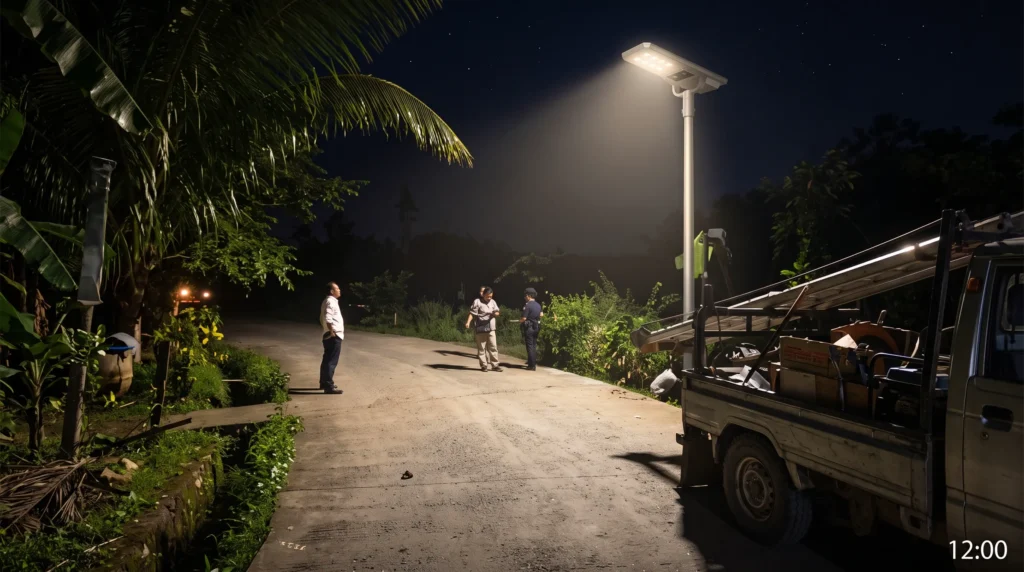
Project Snapshot
| Project Element | Specific Information |
|---|---|
| Project Location | Rural roads in Indonesia / Access roads to plantation residential areas |
| Client/Contracting Party | Village government (Desa), implemented through the Village Fund (Dana Desa) |
| Number Installed | 45 sets |
| Road Characteristics | Narrow, single-sided road, approximately 3.5 meters wide, with shrubs and tall trees on one side |
| Luminaire Selection | Sresky Atlas Series integrated solar street lights, installed at a height of 6 meters |
Challenge 1: How Can We Ensure Long-Term Corrosion Resistance for Solar Street Lights in Humid, Salt-Spray Environments?
Although the village is not directly adjacent to the sea, the project site is located approximately 14 kilometers from the southern coast. High humidity, salt spray, and intense UV radiation can continuously affect the luminaire housing, mounting brackets, and fasteners. For rural solar street lights, long-term maintenance is often affected not by the LED light source itself, but by corrosion of structural components and connection points.
Key Risks Include
- Corrosion and seizing of fasteners, increasing the difficulty of future maintenance;
- Corrosion at lamp-head connection points, potentially compromising structural safety;
- Aging and peeling of surface coatings, reducing long-term protective performance;
- Rainwater and moisture entering connection points, increasing the risk of equipment failure.
Solution: Use Highly Weather-Resistant Materials and Stainless Steel Fasteners
The 45 Sresky Atlas Series solar street lights installed in this project feature corrosion-resistant aluminum alloy housings paired with stainless steel brackets and fasteners. The protective structure at the top helps reduce water accumulation and potential leakage paths around the lamp-head connections, thereby minimizing the risk of corrosion associated with salt spray and humid environments through careful material selection.
Core Logic
Corrosion resistance is not achieved by simply replacing a single bolt. Instead, it requires a comprehensive protection system covering the lamp body, surface treatment, and fasteners.
Challenge 2: Narrow Rural Roads Make Standard Urban Light Distribution Unsuitable
A brighter luminaire does not necessarily provide better road lighting. This is an aspect that is often overlooked in rural solar street light projects.
Many local public lighting projects primarily serve urban roads, main thoroughfares, or standardized paved roads. As a result, product designs typically focus on taller poles, wider roads, and relatively regular lighting layouts.
However, the preliminary site assessment for this project indicated that the luminaires might be installed:
- Along the sides of narrow rural roads;
- On access roads within plantations;
- Near green belts or shrubs;
- In areas primarily used by pedestrians and motorcycles.
If luminaires with wide, symmetrical light distributions are used directly, two issues may arise. On the one hand, some light may be directed toward shrubs or non-traffic areas on the outer side of the road. On the other hand, the opposite side of the road or areas near the green-belt boundary may still have insufficient illumination.
This is not a problem that can be solved simply by increasing the luminaire’s wattage. Higher wattage may result in greater energy demand, larger solar panel and battery configurations, and higher overall procurement costs.
Solution: Select an Existing Atlas Series Light Distribution Option Better Suited to Narrow Roads
Based on a road width of approximately 3.5 meters, single-sided installation, and the green-belt boundary, the project team compared and adjusted the light distribution schemes of different Atlas Series models to concentrate more of the effective luminous flux on the actual traffic area.
This achieved a semi-customized light distribution effect tailored to the rural road scenario without requiring the development of new molds specifically for this 45-unit project.
Core Logic
Rather than simply increasing power, the goal was to ensure that more of the available light actually falls on the road surface.
Project Results
Installation and commissioning of the 45 street lights were completed approximately three weeks after delivery. Operational feedback over the following three months showed:
- Stable Illumination During Four Consecutive Days of Rain: During a four-day period of continuous rain, the lights were still able to maintain basic nighttime illumination. Intelligent power adjustment reduced the risk of premature shutdown during the rainy season;
- No Significant Rust on Lamp Bodies or Fasteners: The components maintained a good appearance in the salt-spray environment;
- More Concentrated Road Illumination: Asymmetric light distribution reduced wasted illumination directed toward trees and areas outside the road;
- 6-Meter Installation Height Well Suited to Rural Roads: The installation height balanced road lighting coverage with on-site installation conditions.
Customer Feedback
“The lights installed on that road before worked fine during the first year, but they started having problems in the second year. After replacing them this time, the most noticeable difference is that I no longer have to worry about the lights going out while walking at night during the rainy season.”
—Project Liaison, Sukamaju Village
FAQ on Solar Street Lights for Rural Indonesia
1. Can Solar Street Lights Maintain Stable Illumination During the Rainy Season?
This can be achieved through proper system configuration, provided that the energy storage system and controller are designed with sufficient capacity and redundancy to withstand consecutive days of low solar irradiance and rain.
Standard systems that operate in a fixed-brightness mode and have limited energy storage may be prone to running out of power and shutting down prematurely after several consecutive days of overcast and rainy weather.
In contrast, systems equipped with intelligent adaptive energy management and sufficient backup energy storage can flexibly adjust output power based on the remaining battery charge, thereby reducing the risk of power outages during the rainy season.
2. Are Rural Roads in Indonesia Suitable for Installing Solar Street Lights?
Yes, but on-site conditions should first be assessed, including:
- Whether a stable power grid is available;
- Whether roads are scattered and cable installation costs would be high;
- Whether local solar resources meet the system requirements;
- Whether there is significant tree-canopy shading;
- The extent to which consecutive overcast days during the rainy season may affect the energy storage system.
For remote rural areas, plantation roads, and off-grid roads, solar street lights can serve as a standalone lighting solution.
3. Does the Tropical Rainy Season Affect the Runtime of Solar Street Lights?
Yes. Prolonged overcast and rainy conditions may reduce the effective power generation of solar panels, resulting in insufficient battery recharging.
The actual impact depends on factors such as luminaire power, solar panel configuration, battery capacity, dimming strategy, local solar irradiance conditions, and tree shading.
When purchasing solar street lights, it is important to focus on the system’s designed autonomous lighting duration rather than simply considering the battery’s nominal capacity.
Conclusion: Moving from “Installability” to “Long-Term Stable Operation”
As the development of rural roads, plantations, off-grid communities, and public infrastructure in Indonesia continues to advance, the evaluation of solar street light projects is shifting from a simple comparison of power, price, and quantity toward a greater focus on long-term reliability.
For rural solar street light projects in Indonesia, at least three key areas should be thoroughly verified: operational endurance during the rainy season, corrosion resistance, and road-lighting distribution.
- For municipal departments: Focus on reliability and maintenance costs throughout the project’s entire lifecycle;
- For engineering contractors: Focus on site conditions, installation methods, system configuration, and product documentation;
- For lighting planners: Base light distribution design on road width, installation location, tree shading, and actual lighting requirements rather than simply increasing luminaire power.
Experience from this 45-unit project shows that the value of solar street lights lies not merely in installing them alongside roads, but in ensuring that they can operate continuously under local climate, road, and usage conditions.
Therefore, when selecting solar street lights for rural areas in Indonesia, it is recommended to first complete on-site data collection, solar resource assessment, and lighting simulations, and then determine the final configuration based on the supplier’s product test reports. This approach provides municipal authorities, contractors, and project planners with a more actionable basis for procurement than simply comparing the unit price of the luminaires.