
Table of Contents
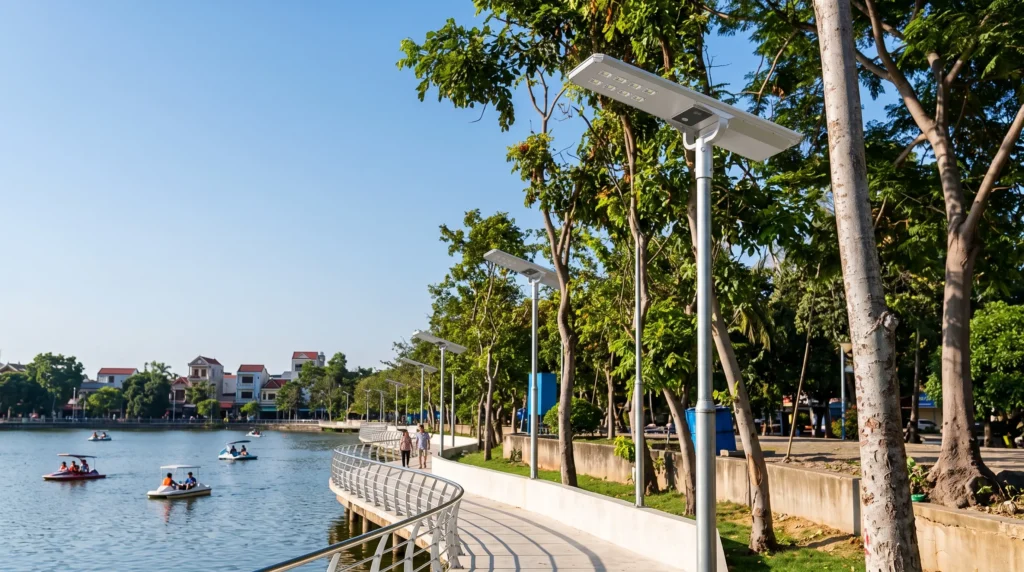
At 6:00 p.m., the walking paths in a Thai city park begin to buzz with activity. More and more people come out to run, walk, and ride bikes. However, when the rainy season arrives, the park management’s main concern isn’t simply whether there are enough lights—it’s whether the solar street lights will continue to function properly after prolonged periods of rain and whether public lighting will remain safe in flood-prone conditions.
For this type of coastal or inland urban park project, the project team ultimately selected 65 sets of Sresky Atlas Series solar street lights, arranged in a single-sided configuration. This approach minimizes the need for underground cabling while addressing key considerations such as rainy-season safety, tropical vegetation, and long-term operation and maintenance.
Project Snapshot
| Project Parameters | Details |
|---|---|
| Project Location | Urban parks and public green spaces in central and eastern Thailand |
| Client | Infrastructure Construction Division under the local Municipal Engineering Bureau or Park Administration Bureau |
| Number of Fixtures | 65 sets (single-sided layout) |
| Product Series | Sresky Atlas Series |
Challenge 1: Waterlogging During the Rainy Season—How Can We Ensure the Safety of Solar Street Lights and Public Areas?
Thailand’s rainy season is characterized by short, intense downpours, which often lead to water accumulation near walkways and green belts in urban parks. For traditional grid-connected lighting, underground cables are constantly exposed to damp conditions, increasing the risk of insulation degradation and adding to maintenance demands.
Potential Consequences
- Electrical safety management challenges in areas with standing water;
- Increased difficulty in troubleshooting and repairing underground cable faults;
- The need for more frequent inspections following heavy rainfall;
- Disruptions to lighting continuity in open park areas.
Solution: Implement a Solar Street Light System Without Buried Cables
The project utilizes Sresky Atlas Series solar street lights, which are powered by independent photovoltaic systems, reducing reliance on underground power lines. The product series features an IP65–IP66 protection rating, with slight variations by model, and an IK08 impact resistance rating. The housing is made of aluminum alloy and PC composite materials and is paired with a stainless steel bracket, making it suitable for outdoor environments exposed to rain and humidity.
The project team also conducted actual submersion tests on critical components, such as junction boxes, battery compartments, and PV panel interfaces, to verify their sealing performance under waterlogged conditions.
The core logic is straightforward: with no buried cables and no exposed live conductors, the risk of electric shock in waterlogged areas is significantly reduced from a physical standpoint.
Challenge 2: How Can We Reduce the Maintenance Burden for Solar Street Lights in Areas with Abundant Tropical Vegetation and Flying Insects?
Unlike ordinary roads, urban parks often have light poles located near trees, shrubs, and grassy areas. In Thailand’s hot and humid climate, nighttime insect activity increases during the rainy season and seasonal transitions. The long-term accumulation of insects, dust, pollen, and moisture can also increase the burden of cleaning and maintaining the fixtures.
Main Consequences
- Insects and debris are more likely to accumulate on the exterior of the fixtures;
- If the fixtures are not sufficiently sealed, their interiors may be affected by moisture and foreign objects;
- Lens contamination increases the need for routine cleaning;
- Maintenance becomes more challenging in areas of the park with dense vegetation.
Solution: Reduce the Impact of Flying Insects Through Structural Sealing and Spectral Design
The Sresky Atlas Series features a structural separation design between the optical lens chamber and the heat-dissipation channel, reducing the likelihood of foreign objects entering the luminaire. Some models also employ more precise sealing methods to further minimize gaps through which insects could enter.
From an optical perspective, the project team also considered the impact of LED spectral design on insect attraction. By optimizing the spectral output, they sought to reduce the luminaires’ phototactic attraction to flying insects. Specific spectral parameters should be based on the supplier’s actual test reports.
Project Outcomes
Following the deployment of 65 Sresky Atlas Series solar street lights, the project achieved the following key results:
- Reduced Reliance on Underground Wiring: The use of independent solar power reduces safety management pressures associated with cable maintenance in waterlogged environments.
- Improved Adaptability to Outdoor Environments During the Rainy Season: IP65–IP66 protection ratings and sealed designs for critical components support long-term outdoor use in park environments.
- Reduced Maintenance Impact from Flying Insects: Insect-resistant structural designs and spectral optimization minimize the likelihood of the lights being affected by insects and debris.
- Better Suitability for Park Settings: No large-scale excavation or cabling is required, resulting in minimal construction impact on green spaces and public walkways.
Customer Feedback
“Since switching to Atlas, we no longer need to constantly monitor cable safety in waterlogged areas during the rainy season as we did before. The maintenance burden on the lighting system has been significantly reduced.”
—Project Engineer
FAQ: Frequently Asked Questions About Solar Street Lights in Thai Urban Parks
1. There Are Many Flying Insects in Tropical Regions. How Can Solar Street Lights Reduce Maintenance Burdens?
There are two main approaches:
- Structural design: Enhance the lamp housing’s sealing to reduce the entry of insects, dust, and moisture;
- Spectral design: Optimize the LED spectrum to reduce the phototaxis of flying insects.
For urban parks with dense trees and shrubs, insect-resistant design and spectral optimization should be key technical considerations when selecting solar street lights.
2. Is the Thai Rainy Season a Suitable Time to Install Solar Street Lights?
Yes, but the system design must account for local climate and site conditions:
- Design photovoltaic and battery capacities based on local solar irradiance conditions;
- Assess power requirements for extended periods of continuous rain;
- Prioritize outdoor solar street lights with higher protection ratings;
- Conduct on-site sunlight analysis for areas shaded by trees.
3. Should Thai Parks Choose Integrated or Split-Type Solar Street Lights?
This primarily depends on on-site sunlight and installation conditions:
- Integrated solar street lights: Feature a compact structure, and installation and construction are relatively simple;
- Split-type solar street lights: Offer greater flexibility in solar panel placement and are suitable for scenarios where there is significant tree shading near the light poles.
For park projects, it is especially important to ensure that the solar panels can receive stable sunlight rather than simply focusing on whether the light fixtures themselves can be installed.
Conclusion
For urban public lighting projects in Thailand and other tropical or coastal regions, the value of solar street lights extends beyond simply saving on electricity costs.
Safety during the rainy season, prolonged periods of rain, tree shading, insect interference, installation challenges, and long-term maintenance should all be considered in advance during the project design phase.
For this 65-unit project, what the purchaser should prioritize requesting from the supplier is not just a glossy product catalog, but a set of practical, on-site reference materials, including illuminance calculations, battery life calculations under overcast and rainy conditions, waterproofing test records, applicable certification documents, a spare parts list, and a local after-sales support plan for Thailand.