
Table of Contents
Last winter, a section of a waterfront promenade along Croatia’s Adriatic coast underwent a lighting upgrade.
Initially, the project involved a routine streetlight replacement. However, on-site conditions made the design more complex than anticipated.
The site is a typical low-lying waterfront promenade, locally known as a “riva,” characterized by the following conditions:
- The promenade runs directly alongside a sheltered harbor.
- During the day, it serves as a public space where tourists can stroll and relax.
- At night, fishing boats dock along the waterfront.
- During “jugo” (southerly wind) conditions, seawater may surge over the shoreline.
- Prolonged overcast and rainy weather in winter increases the energy storage demands on solar streetlights.
- Red navigation lights on vessels must remain clearly visible.
This was therefore far more than a routine road lighting project.
The project needed to address two key challenges:
- How could the solar streetlights operate reliably despite sea winds, salt spray, and low winter solar irradiance?
- How could glare from the water’s surface be minimized while ensuring that vessel navigation lights remained clearly visible?
To meet these requirements, the municipal project used Sresky Atlas Series all-in-one solar streetlights to complete the lighting upgrade.
Project Snapshot
| Project Element | Description |
|---|---|
| Project Location | Waterfront promenade along the Adriatic Sea, featuring a low-lying, “riva”-style shoreline |
| Client/Project Manager | Local municipal authority responsible for public facilities and infrastructure |
| Lighting Configuration | Single-sided linear layout, with luminaires installed along one side of the promenade |
| Lighting Spacing | Approximately 25–30 meters, adjusted according to the model, pole height, and beam angle |
| Project Scale | 40 luminaires covering approximately 1,000–1,200 meters of waterfront |
| Product Used | Sresky Atlas Series all-in-one solar streetlights |
Note: To protect client confidentiality, the specific city and project reference number are not disclosed in this document.
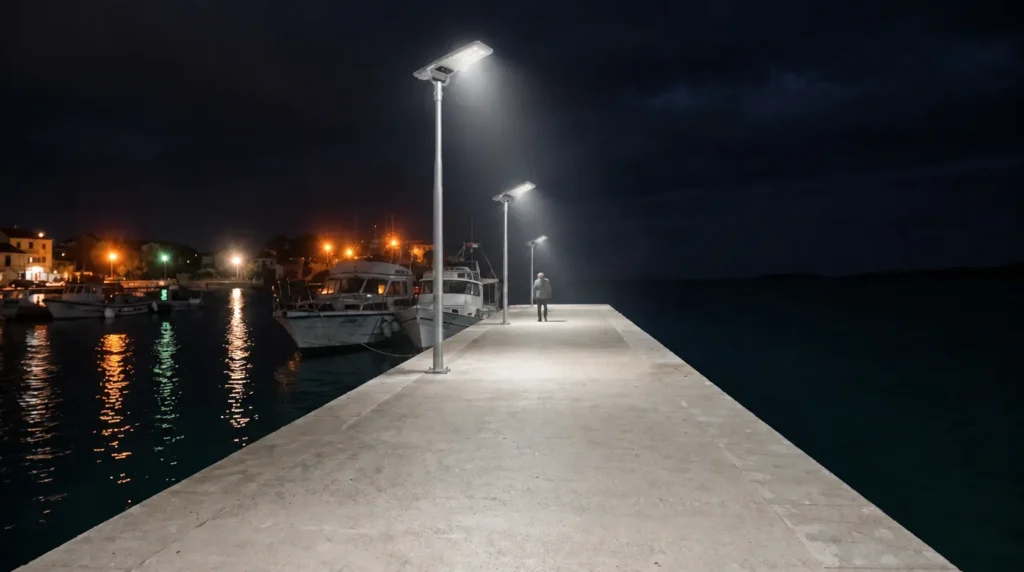
Engineering Challenges and Solutions
Challenge 1: How Can Solar Streetlights Operate Reliably Despite Sea Winds, Salt Spray, and Overcast, Rainy Winter Conditions?
The waterfront promenade is continuously exposed to high humidity, salt spray, and strong winds. The “jugo,” or southerly wind, along the Adriatic coast can also bring sea spray and waves that wash over the shoreline.
At the same time, solar irradiance decreases during winter, while nighttime lighting demand increases. Prolonged periods of overcast and rainy weather can further strain the system’s energy storage capacity.
Therefore, the solar streetlight design must address several factors simultaneously:
- Salt spray corrosion.
- The durability of luminaires and electrical connectors.
- Local wind loads.
- Winter photovoltaic (PV) power generation.
- Battery energy storage capacity.
Selecting luminaires based solely on standard urban road conditions could result in higher maintenance requirements over the long term.
Solution: Integrate Corrosion Protection, Wind Resistance, and Energy Storage Design
For coastal environments, the Sresky Atlas Series solar streetlights are designed with a focus on weather resistance and energy reliability.
Key design considerations include:
- An aluminum alloy luminaire housing with surface protection tailored to the coastal environment.
- Stainless steel mounting brackets to help reduce maintenance requirements in salt spray environments.
- A waterproof sealing design suitable for humid outdoor conditions.
- Structural verification based on the wind load requirements of the project site.
- Energy performance assessments based on Croatia’s winter solar irradiance, PV capacity, battery capacity, and dimming profiles.
Energy storage performance can be simulated using tools such as PVGIS. Rather than applying a fixed number of operating days across all projects, the system should be evaluated according to the specific environmental conditions and energy requirements of the site.
Key Design Consideration: In addition to battery capacity, coastal solar streetlights must account for corrosion protection, wind resistance, and winter energy storage requirements.
Challenge 2: How Can Solar Streetlights Along Waterfront Promenades Minimize Water-Surface Glare Without Interfering with Vessel Navigation Lights?
Waterfront promenades are located very close to the water’s surface. If streetlights produce excessively intense illumination or use overly wide beam angles, some of the light may spill directly onto the water, creating reflections that increase nighttime glare.
At the same time, red navigation lights on nearby vessels must remain clearly visible.
Therefore, the objective of a waterfront solar streetlighting project is not simply to maximize brightness, but to control light distribution and direct illumination where it is needed.
Key considerations include:
- Illuminating the walkway while minimizing light spill onto the water.
- Maintaining visual comfort for pedestrians.
- Reducing unwanted horizontal light spill.
- Preserving the visibility of vessel navigation lights.
Solution: Optimize Light Distribution to Direct Illumination Where It Is Needed
The Sresky Atlas Series solar streetlighting solution focuses on reducing wasted light through appropriate optical design rather than simply increasing luminaire power.
Key measures include:
- Type II light distribution suitable for walkways, directing the main beam toward the walking surface.
- Careful consideration of luminaire positions, mounting angles, and orientations to minimize direct light spill onto the water.
- Provision of IES photometric files for illuminance simulations using DIALux.
- Customized solutions to accommodate project-specific color temperature requirements.
- Built-in dimming modes and motion sensors to reduce unnecessary lighting during late-night hours.
Design Highlight: For waterfront solar streetlighting, higher wattage does not necessarily mean better performance. Appropriate light distribution is often more effective.
By meeting the walkway’s illumination requirements while limiting unnecessary light spill onto the water, this approach helps reduce glare and avoid wasting energy.
Project Outcomes
Reduced Underground Cabling Requirements: Minimized construction work in the waterfront area and reduced disruption to the existing environment.
Lower Risk of Cable-Related Moisture Damage: Reduced reliance on underground wiring, helping ease maintenance demands in areas exposed to prolonged dampness or water ingress.
Energy Savings Through Smart Dimming: Prioritized the use of limited stored solar energy during critical lighting periods.
Improved Adaptability to Coastal Conditions: Addressed salt spray, strong winds, and low winter solar irradiance through project-specific design considerations.
Client Feedback
“The biggest improvement was addressing wind loads, protective measures, and energy storage requirements thoroughly during the initial planning stage, making long-term maintenance easier to manage.”
— Project Manager, Municipal Infrastructure Department
Frequently Asked Questions (FAQ)
1. Is Croatia’s Coastal Region Suitable for Solar Streetlight Installations?
Yes. However, each project requires a design tailored to its specific environmental conditions.
Key considerations include:
- Salt spray and high humidity.
- Local wind loads.
- Winter solar irradiance.
- Battery storage capacity.
- Nighttime dimming strategies.
- Lighting conditions near the water’s surface.
Solar streetlights for coastal areas should not be selected solely according to criteria developed for standard urban road projects.
2. How Can Solar Streetlights Along Waterfront Promenades Cope with Prolonged Rain and Overcast Conditions in Winter?
It is not advisable to rely solely on a product’s rated operating time. The system’s energy performance should be evaluated against local winter conditions.
Recommended measures include:
- Analyzing local winter solar irradiance.
- Calculating the required PV and battery capacities.
- Implementing time-based dimming strategies.
- Using tools such as PVGIS to assess the system’s energy balance.
The key is to design the energy storage system around the project’s actual environment and energy requirements, rather than simply comparing the stated number of operating days.
3. How Can Solar Streetlights Along Waterfront Promenades Reduce Glare on the Water’s Surface?
The key is to optimize light distribution rather than simply increase power output.
Effective measures include:
- Using Type II light distribution.
- Positioning and angling luminaires appropriately to minimize light spill.
- Conducting illuminance simulations using DIALux.
- Selecting an appropriate color temperature, with customization where required.
- Implementing smart dimming strategies.
Minimizing unnecessary illumination of water surfaces to reduce nighttime glare.
Summary: Designing Waterfront Solar Streetlights for Their Specific Environment
As demonstrated by this Croatian waterfront promenade project, solar streetlighting in municipal infrastructure is no longer judged solely by power output and rated operating time. Instead, performance depends increasingly on how well the system addresses the specific engineering requirements of its environment.
Along the Adriatic coast, on islands, in harbors, and in other coastal locations, the main challenges include:
Corrosion Protection + Wind Resistance + Winter Energy Storage + Optimized Light Distribution + Smart Control
When selecting solar streetlights for waterfront promenades, municipal authorities, lighting contractors, and infrastructure planners should look beyond luminaire wattage and consider the complete engineering requirements, including:
- Environmental assessments.
- Wind load calculations.
- Winter energy simulations.
- Light distribution verification.
- Smart dimming strategies.
- Long-term maintenance requirements.
The most suitable solar streetlighting solution is not necessarily the one with the highest specifications, but the one best suited to the project’s environmental conditions and operational requirements.
This represents a significant shift in the approach to waterfront solar streetlighting: from simple product procurement to comprehensive engineering system design.