
Can solar streetlights stay lit all night during prolonged periods of overcast winter weather?
When it comes to residential lighting, brighter isn’t always better. If the light is too bright, it may shine into residents’ windows; if it’s too dim, it can hinder nighttime visibility on sidewalks and in parking areas.
In Hungarian residential areas, solar streetlight projects of this kind must address several key challenges: low winter solar irradiance, low temperatures, warm-colored lighting, and light intrusion.
These are precisely the practical challenges this project was designed to address.
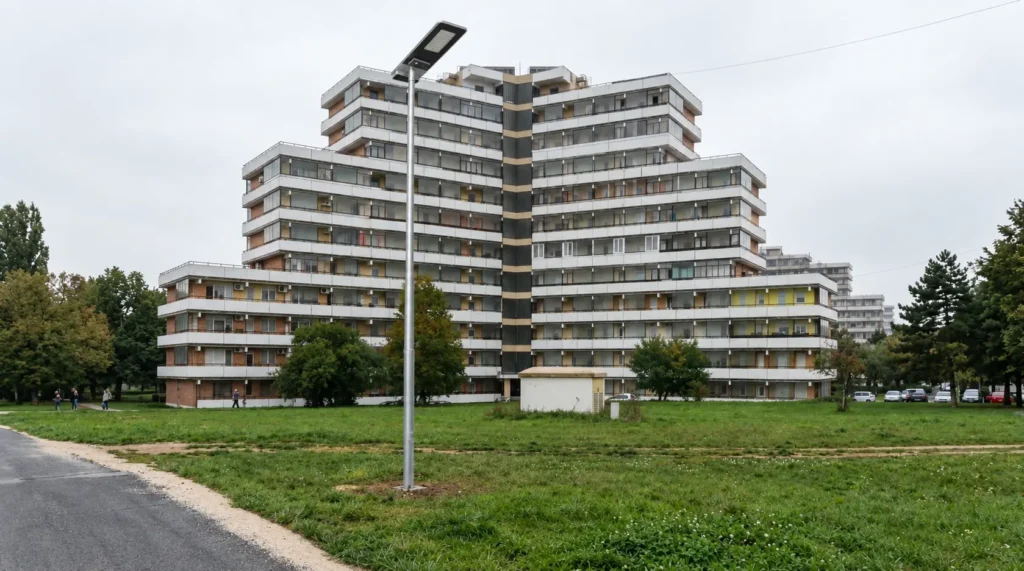
Located on the outskirts of a small-to-medium-sized city in Hungary, this project primarily provides lighting for walkways surrounding apartment buildings, the outer edges of parking areas, and public entrances. The project utilizes Sresky BASALT Series solar streetlights, which are designed to address local winter energy conditions and the residential area’s nighttime lighting requirements.
Project Profile
| Project Entry | Project Details |
|---|---|
| Project Location | Outskirts of a small-to-medium-sized city in Hungary (a satellite town near Budapest) |
| Client Type | Residential area renewal project funded by the European Union |
| Deployment Scale | Initial phase: 20–40 units; to be expanded in four phases to more than 120 units |
| Application Scenarios | Residential area walkways, apartment entrance pathways, and the outer edges of parking areas |
| Product Model | Sresky BASALT Series |
Project Challenges
When designing solar streetlights for residential areas, it is not sufficient to consider only whether the lights “work or not.”
Residential areas differ from industrial parks and major thoroughfares.
For residents, what they see at night is the lighting environment, not the technical specifications of the fixtures. Therefore, the project design must address two questions simultaneously:
Is the lighting sufficient? And does the light fall where it shouldn’t?
Challenge 1: How to Balance Warm-Colored Light, Illuminance, and Solar Power Consumption?
The project requires warm-colored light at approximately 2700K–3000K to meet the lighting needs of both walkways and parking areas.
The issue is that warm-colored LEDs typically have lower luminous efficacy than some higher-color-temperature LEDs. In residential areas, however, it is not advisable to simply compensate by increasing power. If luminaires are designed solely to achieve higher brightness, this may actually increase energy consumption and light intrusion.
If handled improperly, the following issues may arise:
- Increased strain on battery and photovoltaic module capacity;
- Greater pressure on energy storage during winter;
- Excess light entering residents’ windows;
- Wasteful illumination directed toward the sky;
- The need to readjust luminaires later, increasing maintenance costs.
Therefore, the project should focus not on “how to make the lights brighter,” but on how to direct limited light to where it is truly needed.
Solution: Control the Light First, Then Determine Power Requirements
Given the characteristics of residential areas, the project did not simply address illuminance issues by increasing luminaire power. Instead, it began by analyzing light distribution and nighttime usage patterns.
First, warm-colored light (2700K–3000K) was adopted to create a softer nighttime environment along walkways, apartment entrances, and surrounding green spaces.
Next, the light distribution was adjusted based on actual road widths, pole heights, and installation spacing to direct the primary light toward walkways, driveways, and parking areas—rather than toward residents’ windows or the sky.
Before finalizing the luminaire installation plan, we conducted illuminance simulations using IES/Eulumdat light distribution data to first determine “where and how much light is needed,” and then work backward to establish the luminaire installation parameters.
Late at night, when foot traffic in the residential area drops significantly, the system reduces lighting output. When someone passes by, motion sensors automatically increase the lighting level.
The rationale behind this approach is to minimize unnecessary light output while meeting usage requirements—in other words:
Light up where it’s needed, and avoid lighting where it isn’t.
For solar streetlights in residential areas, this precise use of light is also an effective way to conserve energy.
Challenge 2: How Can Solar Streetlights Maintain Stable Operation During Hungary’s Low-Light Winter Months?
For this project, the primary concern is not a single day without sunlight, but whether the system can continue to function normally after several consecutive days of low solar irradiance.
Hungary’s fall and winter seasons may feature prolonged periods of overcast skies, fog, and low temperatures. While solar power generation decreases during the day, the need for nighttime lighting remains unchanged.
If continuous rain and overcast conditions cause the battery’s stored energy to deplete steadily, conventional solar streetlights may experience a drop in brightness during the latter half of the night or even remain off all night.
The project therefore focuses on:
- Insufficient photovoltaic power generation in winter;
- Energy storage recovery following prolonged periods of rain and overcast weather;
- The impact of low temperatures on battery charging and discharging;
- Whether it is necessary to blindly increase battery capacity as a “safety measure.”
Consequently, an energy balance capable of addressing low solar irradiance in winter must be established.
Solution: Reallocate Energy Based on the Most Challenging Winter Operating Conditions
During the project design phase, calculations were not based simply on annual average solar radiation. Instead, low winter irradiance was treated as the primary operating condition for evaluation.
During the day, the system maximizes the utilization efficiency of limited solar energy. At night, lighting power is adjusted according to activity patterns in the residential area at different times.
During the first half of the night, when foot traffic is relatively high, priority is given to lighting walkways, entrances, and parking areas. As the night progresses and foot traffic decreases, the system reduces output, reserving the saved energy for later periods.
At the same time, the system manages battery charging and discharging to account for low-temperature conditions, minimizing the impact of improper charging under cold conditions on battery performance and lifespan.
Therefore, the approach used in this project is not simply to “increase battery size,” but rather to store the solar energy collected each day as efficiently as possible, use it rationally, and alleviate the energy strain caused by consecutive cloudy days through smart lighting.
For solar streetlight projects in Hungary and other cold regions of Europe, this is why it is not advisable to focus solely on “how large the battery capacity is,” but rather to consider the following factors comprehensively:
Winter energy modeling + energy storage management + nighttime load control.
Project Outcomes: Validating System Stability Over One Winter
The first phase, consisting of 30 solar streetlight units, was installed and put into operation in November 2025. As of March 2026, the project has achieved the following results:
- Smooth winter operation: Between December 2025 and January 2026, there were no instances of the lights remaining off all night due to insufficient energy;
- Illuminance met project requirements: On-site testing conducted 30 days after installation confirmed that illuminance levels on both sidewalks and driveways met the project’s design specifications;
- Stable warm-colored lighting environment: The measured color temperature was close to 2700K, and no complaints regarding light intrusion were received from residents during the project period;
- Relatively convenient installation: Installation time per unit was approximately 45 minutes, reducing the need for excavation for underground insulation chambers and cable trenches.
From winter battery life to the nighttime lighting environment, this project demonstrates that solar streetlights in residential areas can effectively balance “bright illumination” and “resident comfort” through proper energy management and precise light distribution.
Client Feedback
“Our biggest concerns were winter battery life and groundwater levels; the light distribution calculations and winter energy consumption simulations resolved these two core challenges.”
—Project contractor, a Hungarian municipal engineering company
FAQ on Solar Street Lights in Hungarian Residential Areas
Q1: Can Solar Street Lights Operate Reliably During the Hungarian Winter?
Provided the system is designed according to Hungarian winter operating conditions, solar streetlights can generally operate reliably.
Key considerations include:
- Minimum solar radiation levels in December and January;
- Battery performance during prolonged periods of overcast and rainy weather;
- Battery management in low-temperature environments;
- Actual power consumption at different times of the night.
When procuring solar streetlights, it is recommended to request that suppliers provide winter energy consumption simulations rather than relying solely on average annual solar radiation data.
Q2: What Color Temperature Is Suitable for Solar Street Lights in European Residential Areas?
For residential areas, areas near residents’ windows, and green spaces, warm-colored light in the 2700K–3000K range should be prioritized.
For actual projects, the following should also be confirmed:
- Local municipal lighting requirements;
- Project design standards;
- Lighting environment requirements for residential areas;
- The latest local regulations or guidelines regarding color temperature.
Therefore, the project designer or local regulatory authority should confirm the applicable requirements before making a specific purchase.
Q3: How Can Light Pollution from Solar Street Lights in Residential Areas Be Reduced?
In addition to appropriately reducing the brightness of the luminaires, it is even more important to control the direction, range, and operating hours of the light.
The following approaches can be adopted:
- Adopt an appropriate asymmetric light distribution;
- Determine pole height and spacing based on road width;
- Use warm-colored light in the 2700K–3000K range;
- Avoid directing light directly toward residents’ windows;
- Conduct illuminance simulations using IES/Eulumdat;
- Reduce unnecessary light output late at night through dimming and motion sensors.
Q4: How Should the Winter Runtime of Solar Street Lights in Hungarian Residential Areas Be Designed?
It is not advisable to focus solely on battery capacity.
A more reasonable approach is to calculate power generation, energy storage, and load requirements together.
It is recommended to complete the following analyses before procurement:
- Winter solar radiation analysis;
- Energy consumption simulation during continuous rainy and cloudy weather;
- Analysis of battery operation at low temperatures;
- Nighttime time-of-use power calculations;
- Matching of photovoltaic module and battery capacity.
Conclusion: Solar Street Lights in European Residential Areas Are Evolving from “Grid Alternatives” to Precision Lighting
In the past, when discussing solar street lights, many projects focused primarily on:
“Can they operate without being connected to the power grid?”
But for today’s European residential projects, the questions have become more specific:
Can they operate reliably during consecutive overcast days in winter?
Can warm-colored light meet residents’ expectations for the nighttime environment?
Can the light be precisely directed onto sidewalks and roads, rather than shining into residents’ windows?
This means that the design of solar streetlights is shifting from simply “off-grid power supply” toward more sophisticated energy management and lighting design.
Future solar streetlight projects, such as those in Hungarian residential areas, warrant close attention in the following areas:
Energy acquisition capability in low-light environments
Winter energy storage and low-temperature management
Warm light environments (2700K–3000K)
Precise light distribution and light intrusion control
Smart dimming and motion sensing
Energy consumption simulation under actual winter operating conditions
The key focus areas also vary among different project stakeholders.
Municipal Authorities
Focus on winter operational endurance, illuminance, residents’ lighting environment, and local lighting regulations.
Construction Contractors
Focus on light distribution data, installation methods, construction efficiency, and whether suppliers can provide accurate winter energy simulations.
Lighting Planners/Design Firms
Focus on IES/Eulumdat data, road lighting standards, pole spacing, and actual illuminance calculations.
For procurement teams, before determining the power rating of solar street lights and the specifications of batteries and photovoltaic modules, it is recommended to first complete:
Winter energy simulation + illuminance calculations + light distribution design.
This is because the most suitable solar street light for European residential areas is not necessarily the model with the highest-looking specifications, but rather a system that can allocate limited solar energy and light to the appropriate locations based on local climate, road conditions, and residents’ needs.
Table of Contents