
Table of Contents
Compared with typical urban roads, coastal island environments experience greater operational and maintenance demands due to salt fog corrosion, high humidity, and contamination of photovoltaic modules.
Therefore, this project required more than just lighting equipment; it required a coastal solar streetlight solution capable of long-term, stable operation while minimizing maintenance requirements.
The Mauritius Road Development Authority (RDA), in collaboration with local engineering departments, ultimately deployed 120 sets of Sresky Thermos Series integrated solar streetlights, covering approximately 4.2 kilometers of coastal arterial roads.
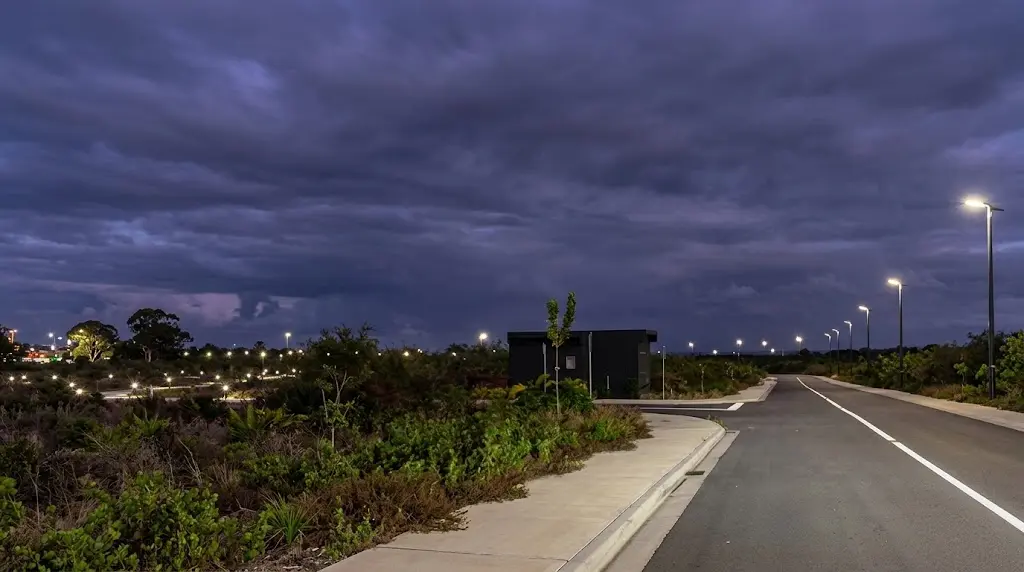
Project Information Details
- Project Location: Coastal arterial roads in the Black River District, Mauritius
- Client and Supervising Authority: Mauritius Road Development Authority (RDA), in collaboration with local municipal engineering departments
- Project Scale: 120 integrated solar streetlights installed in opposing rows on both sides of the road, covering approximately 4.2 kilometers of the main highway
- Product Model: Sresky Thermos Series (SSL-715/716)
Engineering Challenges and Solutions
Challenge 1: The Impact of Coastal Salt Fog and Bird Droppings on the Long-Term Efficiency of Solar Streetlights
Mauritius’ coastal roads are continuously exposed to salt fog and high humidity while also experiencing frequent seabird activity. Salt increases the risk of corrosion to lamp bodies, mounting brackets, and connection points, while contaminants such as bird droppings and dust covering photovoltaic modules can reduce solar energy input.
For coastal road projects, these two factors ultimately create a common operational challenge: increased cleaning frequency, maintenance requirements, and component replacement costs.
Therefore, this project needed to address not only corrosion prevention but also the long-term autonomous operating capability of solar streetlights.
Solution: Proactive Maintenance Design to Enhance the Reliability of Coastal Solar Streetlights
In response to the high levels of salt fog and bird droppings along Mauritius’ coastal highways, the project did not rely solely on traditional anti-corrosion coatings. Instead, it focused on reducing post-installation maintenance requirements.
The key challenges affecting the long-term operation of coastal solar streetlights include:
- Continuous salt fog erosion of metal connecting components;
- Bird droppings covering solar panels and reducing charging efficiency;
- High labor costs associated with manual cleaning in island environments.
Consequently, the Thermos Series adopts a “proactive cleaning + corrosion-resistant structure” design:
- The Auto-Clean system periodically removes contaminants from solar panels, reducing power generation losses caused by bird droppings and dust. Official data indicates that it can improve solar panel charging efficiency by more than 20%;
- The structure uses aluminum alloy and stainless steel (SUS) materials, together with stainless steel brackets, providing excellent corrosion resistance and making it suitable for coastal environments with high salt fog exposure.
By reducing dependence on manual maintenance, this solution is better suited for solar streetlight projects in areas with high maintenance costs, such as islands and coastal regions.
Challenge 2: Long Maintenance Cycles in Island Regions and High Costs of Traditional O&M Models
In island regions such as Mauritius, when a solar streetlight malfunctions, repair costs can become a greater concern than the equipment cost itself.
If the cause of a failure cannot be quickly identified, maintenance personnel may need to make multiple trips to the site:
Identify the malfunction → Inspect the equipment → Diagnose the problem → Wait for spare parts → Return for repairs.
Key issues include:
- Long lead times for cross-border spare parts delivery;
- Low efficiency of on-site fault diagnosis;
- Multiple site visits increasing labor and transportation costs;
- Greater maintenance challenges on remote roads.
Therefore, this project required a smart solar streetlight system capable of reducing maintenance complexity.
Solution: Smart Diagnostics + Modular Maintenance to Reduce Island O&M Costs
For island road projects such as those in Mauritius, repair efficiency after equipment failure directly affects lifecycle costs.
With traditional solar streetlights, multiple site visits are often required to identify problems, followed by additional waiting time for spare parts.
Therefore, the Thermos Series focuses on optimizing post-installation operation and maintenance:
- Built-in BMS (Battery Management System) with 10 levels of hardware safety protection, integrated SOC (State of Charge) and SOH (State of Health) monitoring, helping O&M personnel identify battery conditions earlier and providing reference information for on-site assessments;
- Supports rapid replacement of critical components, reducing on-site repair time compared with traditional step-by-step troubleshooting methods;
- Uses A+ grade LiFePO4 batteries with a cycle life exceeding 4,000 cycles, reducing the need for frequent battery replacements.
Through intelligent O&M design, this project has effectively reduced maintenance complexity and long-term operating costs for solar streetlights on island roads.
Project Outcomes
A total of 120 sets of Thermos Series solar streetlights have been deployed, providing stable off-grid lighting for coastal roads in Mauritius.
Key Outcomes:
- Improved PV Efficiency: The Auto-Clean system reduces the impact of contamination and improves charging efficiency by more than 20%.
- Reduced Maintenance Costs: BMS battery management and modular maintenance design reduce the number of on-site visits, lowering labor and logistics expenses.
- Extended System Lifespan: LiFePO4 batteries reduce replacement frequency and alleviate long-term O&M pressure.
- Enabled Long-Term Off-Grid Operation: No grid connection is required, making the solution ideal for island road infrastructure projects.
Currently, the Mauritius Road Development Authority (RDA) is advancing solar streetlight replacement initiatives in multiple areas, including the M1 Expressway.
Customer Feedback
“For island projects, the primary concern is often not the installation itself, but the difficulty of maintenance years later. This solar streetlight solution has helped us proactively address long-term O&M challenges.”
— Project Director, Mauritian Municipal Engineering Contractor
FAQ: Common Questions About Coastal Solar Streetlight Projects
1. Are Coastal Roads Suitable for Solar Streetlight Installation?
Yes, but the design must be tailored to coastal environmental conditions.
Key considerations include:
- Salt fog corrosion resistance;
- Photovoltaic panel contamination management;
- Battery lifespan;
- Post-installation maintenance methods.
2. How Do Coastal Solar Streetlights Prevent Salt Fog Corrosion?
Coastal corrosion protection cannot rely solely on lamp body materials. Attention must also be given to lamp posts, brackets, fasteners, flanges, electrical compartment seals, and contact points between dissimilar metals.
3. Do Bird Droppings Affect the Power Generation of Solar Streetlights?
Yes.
The main impacts include:
- Blocking solar panels and reducing power generation efficiency;
- Long-term accumulation forming difficult-to-remove contamination;
- Combining with salt fog to accelerate corrosion.
Therefore, in areas with frequent bird activity, solar streetlight solutions with automatic cleaning capabilities are recommended.
Conclusion: Islands and Coastal Areas Require More Reliable Solar Streetlight Solutions
The Mauritius Coastal Highway project demonstrates that the competitiveness of solar streetlights in challenging environments depends not only on lighting performance but also on long-term operational capability.
For islands, coastal areas, and remote regions, an excellent solar streetlight solution must address the following challenges simultaneously:
- Salt fog corrosion;
- Photovoltaic contamination;
- O&M efficiency;
- System lifespan.
Applications include:
- Municipal authorities: Providing a reference for green lighting planning along coastal roads;
- EPC contractors: Supporting project design for islands, tourist areas, and remote roads;
- Planners: Helping select suitable solar streetlights for environments with high salt fog exposure.
In the future, solar streetlights equipped with smart maintenance features, corrosion resistance, and low operating costs will become an increasingly important choice for off-grid infrastructure projects.