
Meta Description: Case Study of a Solar Streetlight Project for a Municipal Park in India: This case study explores how to mitigate project risks through systematic design and standardized acceptance procedures, focusing on battery theft prevention, factory quality traceability, tender compliance, and warranty management for 150 solar park lights.
Project Background: How Can the Long-Term, Reliable Operation of Solar Park Lights Be Ensured After Installation?
When the park first opened, all 150 solar lights illuminated the area, providing lighting for walkways, lawns, and entrances. But what happens if, a few months later, batteries are stolen, lights stop working, or batteries arrive with insufficient charge? Who is responsible?
For municipal procurement departments, the real challenge is not simply purchasing solar streetlights, but ensuring that the equipment meets acceptance criteria, potential faults can be traced, and after-sales responsibilities are clearly defined.
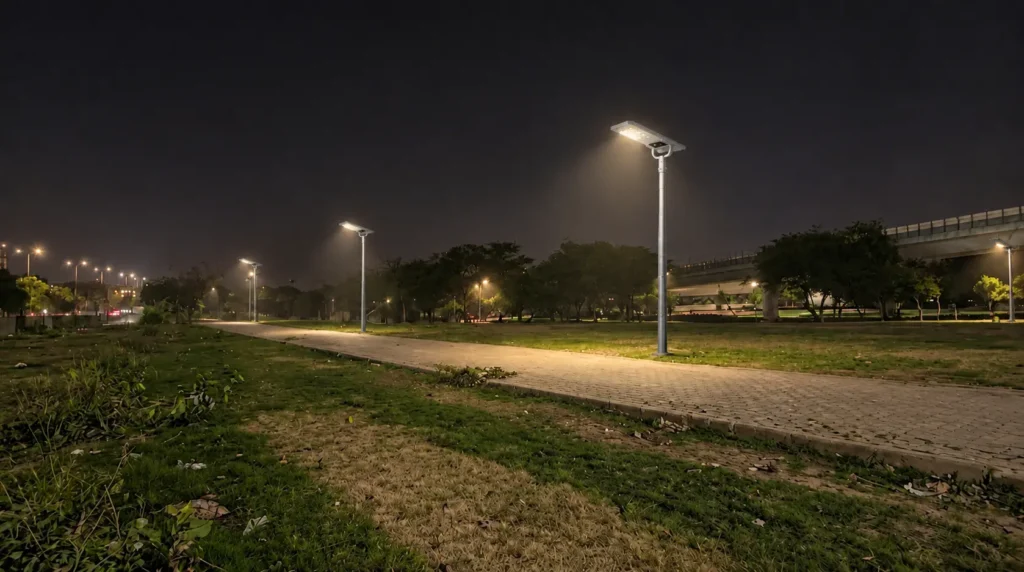
This project focuses on the first batch of 150 solar streetlight units installed in a newly developed municipal park in the plains region of India. It addresses four key areas: battery safety, factory quality control, technical compliance, and long-term maintenance.
Project Snapshot
| Project Elements | Specific Details |
|---|---|
| Project Location | Northern/Central Plains of India, newly developed urban park |
| Client Type | Municipal Corporation / Urban Development Authority’s Landscaping Department |
| Initial Scope | 150 ATLAS SSL-314 solar streetlight units |
| Core Lighting Applications | Park walkways, lawn edges, and connecting access points |
Challenge 1: How Can Operational Risks Associated with Battery Theft and Insufficient Battery Charge Upon Delivery Be Mitigated?
Public solar lighting projects in India have previously encountered issues such as battery theft and premature luminaire failure.
For this newly developed municipal park, the client’s primary concern was not simply whether the luminaires would turn on, but whether they would continue to operate reliably after installation and whether the causes of potential malfunctions could be identified.
The key challenges included:
- Battery Theft: The theft of a battery can render an entire solar streetlight inoperable.
- Insufficient Battery Charge Upon Delivery: Batteries may arrive with insufficient charge, while contractors and manufacturers may have difficulty determining responsibility.
- Lack of Fault Records: Without detailed operating and fault records, maintenance personnel may be unable to monitor equipment status or identify problems promptly.
Solution: Tamper-Resistant Design, Battery Protection, and Factory Quality Traceability
To address these risks, the project adopted the ATLAS SSL-314 solar streetlight solution, integrating battery security and factory delivery quality traceability into a unified management process.
- The battery compartment features a tamper-resistant fastening design to make unauthorized removal more difficult. The specific structure is subject to the product configuration confirmed for the project.
- The luminaires are equipped with A+ grade lithium iron phosphate (LiFePO₄) batteries and a Battery Management System (BMS) featuring multiple hardware protection mechanisms to help maintain safe battery operating conditions.
- Each unit undergoes charging and functional testing during the manufacturing process.
- Each luminaire’s serial number is linked to its corresponding pole number, and the relevant test records are retained as part of the delivery documentation.
- Upon delivery, the client can conduct random inspections of battery condition and verify the results against the corresponding factory records.
As a result, battery protection no longer relies solely on enclosure design, and delivery acceptance goes beyond simply checking whether the luminaires turn on. From battery safety to factory testing records, each stage is supported by more comprehensive documentation.
Challenge 2: How Can Complex Tender Requirements Balance Performance Standards and Warranty Responsibilities?
The park includes walkways, lawn edges, and connecting access routes near entrances and exits. Different functional areas have different lighting requirements.
At the same time, municipal procurement projects involve technical specifications, acceptance documentation, and clearly defined after-sales responsibilities.
The main challenges included:
- Relying solely on luminaire wattage is insufficient to determine whether an entire solar lighting system can meet actual operational requirements.
- Compliance with tender specifications does not automatically guarantee that on-site illuminance levels will meet the required standards.
- Prolonged periods of cloudy or rainy weather may affect solar power generation and system performance.
- Unclear warranty responsibilities and local service arrangements may result in repair delays when equipment failures occur.
Solution: Customize Configurations to Project Requirements and Ensure Delivery Through System Performance and Warranty Compliance
To address the lighting requirements of different areas within the park, the project selection process focused on actual installation conditions rather than simply comparing rated power outputs.
The ATLAS SSL-314 has a rated luminous flux of 4,000 lm and is equipped with a solar panel and a lithium iron phosphate battery.
For energy management, ATLAS incorporates ALS 2.4 intelligent lighting technology and supports multiple lighting modes. The system adjusts nighttime lighting output according to the selected operating mode, helping balance illumination requirements with available battery energy.
ATLAS also incorporates TCS temperature control technology to support battery temperature management and help maintain long-term system performance.
In addition, the project includes technical documentation, lighting acceptance requirements, and a five-year warranty as part of the delivery review. The service scope, spare parts supply arrangements, and responsibilities for fault diagnosis and resolution must all be clearly defined and aligned with the project delivery documentation.
The core objective is not merely to supply solar streetlights, but to establish a complete delivery and management process covering lighting configuration, system operation, and after-sales responsibilities.
Project Outcomes
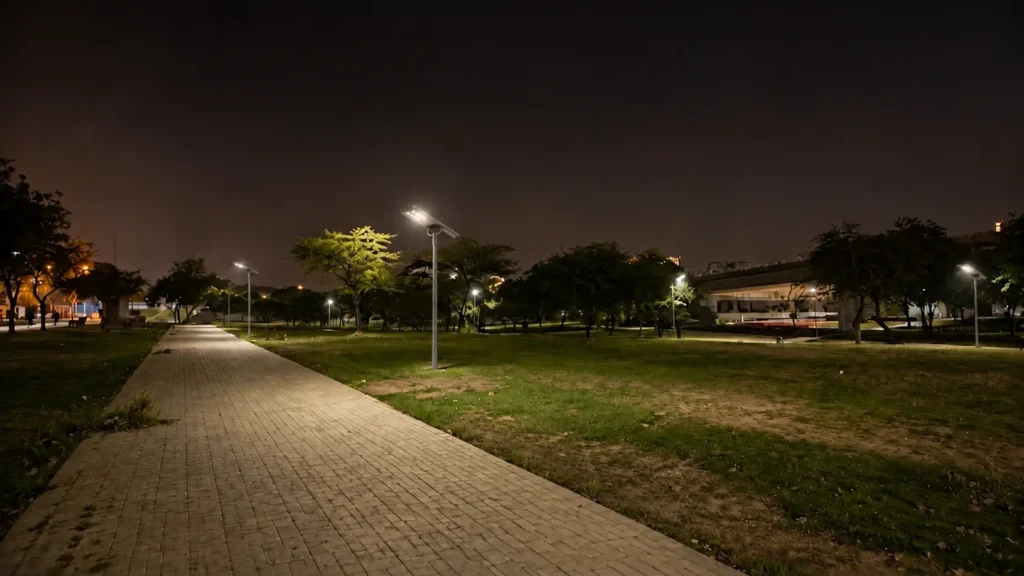
Project Installation: A total of 150 ATLAS SSL-314 units were installed on-site to meet the lighting requirements of the park’s various functional areas.
Battery Safety: The luminaires incorporate lithium iron phosphate batteries and a BMS protection design, providing a product-level foundation for battery safety management. Additional anti-theft measures in public areas should still be implemented according to the actual installation structure and on-site security management requirements.
Lighting and Energy Management: The luminaires feature ALS 2.4 intelligent control and multiple lighting modes, providing technical support for nighttime illumination and energy management across different park areas.
Quality and Maintenance Management: Equipment quality traceability, follow-up inspections, and clearly defined fault-resolution responsibilities are identified as key elements of long-term maintenance. Actual implementation should be verified through delivery documentation and operation and maintenance records.
Customer Feedback
“We need more than just solar streetlights that turn on. We also need documented battery performance, verifiable acceptance criteria, and clearly defined responsibilities for handling equipment failures.”
— On-Site Engineer, Project Owner
FAQ: Common Questions About Purchasing Solar Park Lights in India
1. How Should Municipal Parks in India Select Solar Streetlights?
- Conduct lighting design based on walkway width, pole height, installation spacing, and target illuminance.
- Verify local solar resources, the required number of consecutive cloudy or rainy days the system must withstand, and nighttime operating hours.
- Compare actual photometric data, usable battery energy, solar panel rated power, and warranty conditions.
2. How Can the Risk of Solar Streetlight Battery Theft Be Reduced?
- Select a lockable or tamper-resistant battery compartment design based on the security risks at the installation site.
- Establish a traceable relationship between luminaire serial numbers, battery records, and pole numbers.
- Integrate regular on-site patrols and maintenance procedures. If remote alarms are required, confirm that the product supports the necessary hardware and communication capabilities.
3. How Should Solar Streetlight Battery Quality Be Inspected Upon Delivery?
- Request battery specifications, serial numbers, and factory testing records.
- Check the initial battery voltage, state of charge, and luminaire operating condition according to the agreed acceptance procedures.
- Conduct additional capacity or charge/discharge tests on units that show abnormal results, and retain the corresponding inspection and acceptance records.
Conclusion: Moving Beyond Solar Streetlight Procurement Toward Comprehensive Lighting System Management
The evaluation of municipal solar lighting projects in India should not be limited to equipment prices and rated lumen comparisons. Battery safety, quality traceability, system energy balance, and after-sales support are equally important factors affecting long-term project performance.
For municipal departments, engineering contractors, and landscape planners, the following three tasks should be completed during the project planning and initiation stages:
- Municipal Procurement Teams: Establish a technical specification matrix and a standardized incoming inspection checklist.
- Engineering Contractors: Complete the lighting design, energy balance calculations, and on-site testing plan.
- Landscape Planners: Define illuminance targets, light pole layouts, and maintenance requirements for different functional areas.
For projects planning to procure approximately 150 solar park lights, the ATLAS SSL-314 can be considered as one of the options for technical evaluation. However, the final selection should still be based on actual lighting requirements, tender qualification criteria, on-site verification results, and warranty conditions.
A reliable solar streetlight project involves more than completing the installation. It also requires verifiable technical specifications, traceable product quality, and clearly defined maintenance responsibilities.