
One private road, two sets of needs: on one side are homes where residents seek peace and quiet at night; on the other are rice paddies that are sensitive to artificial light. If the streetlights are too bright, they may shine into bedroom windows and disturb residents’ sleep while affecting the surrounding environment. If they are not bright enough, however, ensuring safe nighttime passage becomes difficult.
Project Snapshot
Project Details
- Location: Urban fringe in Japan’s Kanto/Tokai region, where farmland and newly developed residential areas are interspersed.
- Client: Residential property developer.
- Quantity: 40 Atlas SSL-314 units.
- Application: Private road in a residential area, featuring concrete pavement approximately 2.5 m wide.
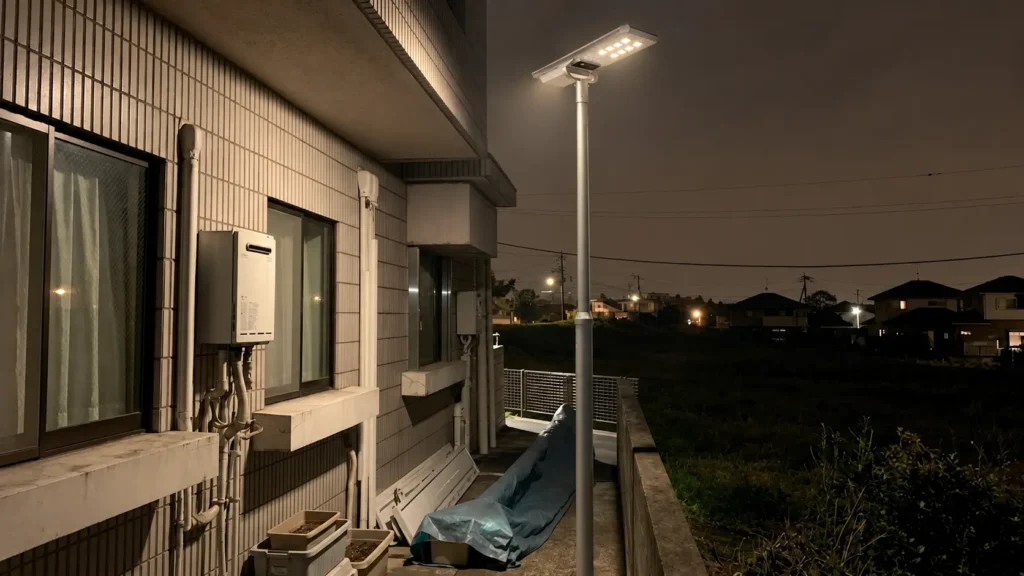
Challenge 1: How Can Solar Streetlights Control Light Pollution Where Residential Areas and Farmland Are in Close Proximity?
This private road in suburban Japan is bordered by newly built homes on one side and rice paddies on the other. The streetlights must provide safe nighttime visibility without allowing light to spread beyond the intended areas. Conventional wide-angle light distribution may cause excessive light spill, while simply reducing brightness is not enough to effectively control the direction of illumination.
Key Challenges Facing the Project:
- Light Disturbance to Residences: Light may shine directly into bedroom windows, disrupting residents’ sleep.
- Risk of Light Pollution to Farmland: Artificial light at night may interfere with the natural photoperiod of rice plants, raising concerns among nearby farmers.
- Increased Retrofit Costs: Installing additional glare-control accessories may increase construction complexity and future maintenance requirements.
Solution: The Sresky Atlas SSL-314 Uses Directional Light Distribution for More Effective Light Control
For a location where residential areas border farmland, the project adopts a Type II-M light distribution pattern. Combined with on-site adjustments to installation height and luminaire orientation, this approach helps minimize light spill onto both sides of the road. If excessive light spill remains after installation, additional shielding measures will be evaluated.
The key is not simply to dim the streetlights, but to optimize the light distribution design so that more illumination remains within the road area where it is needed.
- Directional Light Distribution: Lighting coverage is designed specifically for the approximately 2.5 m-wide private road, helping reduce unnecessary light spill.
- On-Site Acceptance: Illuminance control targets are established in advance for residential windows and farmland boundaries, with final performance verified through on-site measurements.
Core Approach: The focus is on controlling the direction of light rather than merely reducing brightness. The Sresky Atlas SSL-314 solution prioritizes directing light where it is needed, helping achieve a more appropriate balance between road illumination and the surrounding environment.
Challenge 2: How Can Solar Streetlights Balance Battery Life and Operational Reliability During Winters With Limited Sunlight?
In Japan, reduced sunlight during winter can affect the daily energy generation and battery charging capacity of solar streetlights. If high brightness is maintained throughout the night, or if sensors are repeatedly triggered by swaying vegetation, plastic sheeting, or other environmental factors, the additional energy consumption may reduce the power available during the latter part of the night.
Key Challenges Facing the Project:
- Battery Life Pressure: Prolonged cloudy weather may result in insufficient energy replenishment, increasing the risk of nighttime lighting interruptions.
- Inefficient Energy Consumption: Unnecessary sensor activations place an additional burden on the battery.
- Low-Temperature Risks: Charging lithium iron phosphate (LiFePO₄) batteries outside their permitted temperature range may affect battery performance and service life.
Solution: Sresky ALS 2.4 Adaptive Lighting Control for Optimized Nighttime Energy Management
To address the challenge of balancing winter energy generation with nighttime lighting requirements, the project incorporates Sresky ALS 2.4 Adaptive Lighting Control. By combining time-based dimming with sensor-activated brightness increases, the system helps reduce unnecessary energy consumption during periods of lower activity.
The planned operating strategy is as follows:
- Shortly After Sunset: Maintain a relatively high brightness level to meet lighting requirements during peak activity hours.
- Late Night to Dawn: Reduce brightness to a lower baseline level to limit energy consumption during periods of reduced activity.
- When People or Vehicles Are Detected: Temporarily increase brightness and return to the baseline level shortly after movement is no longer detected.
In addition, the project configuration incorporates PIR (passive infrared) motion sensors for on-site commissioning, allowing the team to evaluate false triggers caused by environmental factors such as swaying vegetation.
The system also incorporates a Temperature Control System (TCS) and corresponding battery management mechanisms to help prevent charging outside the battery manufacturer’s specified temperature range.
Core Approach: Intelligent dimming manages energy consumption, while low-temperature protection helps safeguard battery performance. The ALS 2.4 system coordinates lighting output with energy usage, while the TCS protection mechanisms address the risks associated with low-temperature charging. Together, these technologies provide a more comprehensive approach to designing off-grid lighting systems for winter conditions.
Project Deliverables and Key Acceptance Criteria
The installation of all 40 Atlas SSL-314 units was completed as scheduled. Nighttime field tests and acceptance inspections were subsequently conducted in accordance with the project’s deployment and acceptance requirements.
- Light Pollution Control: Illuminance control targets were established for residential windows and farmland boundaries, providing a clear basis for assessing and verifying light spill during on-site acceptance.
- Lighting and Energy Management: The luminaires are equipped with ALS 2.4 intelligent control and PIR sensor functions, supporting time-based dimming, baseline illumination during the latter part of the night, and improved energy management.
- Winter Battery Protection: The luminaires incorporate a TCS temperature control system to support battery management under low-temperature conditions.
Customer Feedback
“From concerns about light pollution affecting the farmland to worries about the batteries running out in the middle of the night, neither issue became a problem. This solar streetlight system enabled us to complete the project successfully.”
— Project Development Team, Project Acceptance Feedback Summary
FAQ: Common Questions About Selecting Solar Streetlights for Residential Areas
1. How Can Solar Streetlights in Residential Areas Reduce Light Pollution?
Controlling the direction of light is essential. It is not simply a matter of reducing brightness.
- Select a directional light distribution pattern suited to the road width.
- Adjust luminaire installation height and orientation to minimize direct light toward residential windows.
- Verify actual light control performance through on-site illuminance measurements.
2. What Color Temperature Is Suitable for Solar Streetlights in Japanese Residential Areas?
A color temperature of 3000K warm white can serve as a reference for locations where residential areas border farmland.
- Color temperature is not the only consideration. Beam direction, spectral distribution, illuminance, and operating hours must also be evaluated.
- For agricultural areas that are particularly sensitive to artificial light, such as rice paddies, light control strategies should be developed according to local requirements and actual environmental conditions.
3. How Should Solar Streetlights Address Limited Sunlight and Low Temperatures During Winter?
- Calculate solar panel and battery capacity, as well as the required number of autonomous operating days, based on local winter solar resources.
- Verify the low-temperature charging protection features and permissible operating temperature range of LiFePO₄ batteries.
- Implement appropriate time-based dimming and sensor-activated brightness adjustments to manage nighttime energy consumption.
Conclusion: Solar Streetlight Design Is Evolving Beyond Basic Road Illumination Toward More Refined Lighting Management
As residential developments gradually expand into areas where farmland and natural environments meet, solar streetlight design must consider more than illuminance alone. Light spill across property boundaries, nighttime dimming strategies, and the system’s ability to operate reliably throughout winter all influence actual project performance.
For municipal authorities, residential developers, lighting contractors, and urban planners, this project provides a practical evaluation framework: first, clarify the lighting requirements of the road and its surrounding environment; then, verify the light distribution design, sensor-based control functions, battery protection mechanisms, and winter energy budget.
A successful solar streetlight solution is not necessarily one that produces brighter light. Instead, it is one that delivers reliable illumination in the right place, at the right time, while minimizing unnecessary impact on the surrounding environment.