
In the coastal regions of southern and southeastern Mauritius, road lighting must meet nighttime traffic requirements while withstanding challenging environmental conditions, including intense sunlight, high humidity, salt-laden fog, and seasonal sugarcane ash deposits.
For government infrastructure projects, road construction contractors, and lighting system integrators, selecting solar street lights requires more than simply comparing initial purchase prices. Photovoltaic efficiency, energy storage capacity during prolonged periods of cloudy or rainy weather, road lighting distribution, and ease of maintenance over the system’s service life all affect the project’s total life-cycle cost.
To address these requirements, this project involved the installation of 200 Sresky Basalt SSL-918 all-in-one solar street lights as part of a coastal road infrastructure project in Mauritius. The system configuration focused on road lighting performance, smart energy management, and adaptability to the coastal environment.
Project Overview
| Project Element | Project Information |
|---|---|
| Project Area | Coastal regions of southern and southeastern Mauritius |
| Project Type | New coastal road lighting project |
| Project Scale | 200 all-in-one solar street lights |
| Product Model | Sresky Basalt SSL-918 |
| Core Requirements | Road lighting distribution, energy management, corrosion resistance, and ease of maintenance |
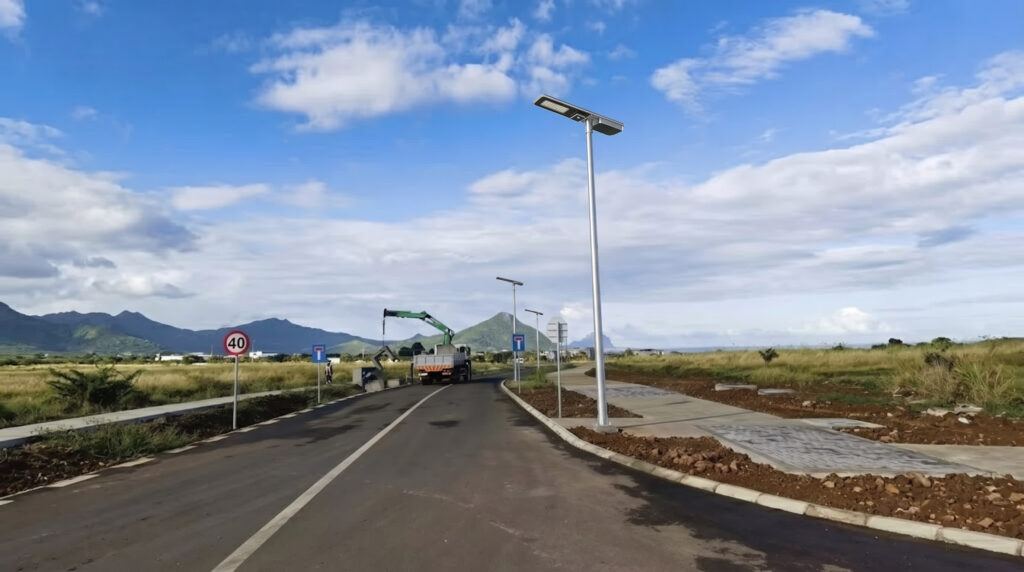
Challenge 1: Intense Sunlight, Ash, and Salt Affect Solar Street Light Performance
Mauritius receives abundant sunlight, but intense ultraviolet (UV) radiation, sugarcane ash, and coastal salt deposits can collectively challenge the optical components and photovoltaic systems of solar street lights.
Ash accumulation and salt deposits can reduce the amount of solar radiation absorbed by photovoltaic panels, thereby affecting charging efficiency. Prolonged UV exposure can also accelerate lens aging and affect optical performance.
Key risks include:
- Dust and ash accumulation on photovoltaic panels, resulting in reduced power generation.
- Long-term UV exposure that may accelerate lens aging and degrade optical performance.
- Insufficient energy storage during prolonged rainy periods, potentially shortening nighttime illumination duration.
- Inappropriate light distribution, potentially causing localized areas of insufficient illuminance or uneven brightness.
Sresky Solution: The SSL-918 Balances Road Lighting Distribution and Smart Energy Management
The project selected the Sresky Basalt SSL-918, prioritizing road lighting performance and off-grid operating capabilities.
- Road Lighting: The system uses weather-resistant, optical-grade lenses and a customized light distribution pattern to distribute light across a two-lane, two-way road. This helps reduce excessive illumination directly beneath the luminaire while maintaining adequate lighting toward the edges of the road.
- Solar Power Generation: An optimized photovoltaic configuration and appropriate energy management strategies help mitigate the effects of ash accumulation and weather fluctuations on system performance. Regular panel cleaning and verification of charging capacity should also be included in the operation and maintenance (O&M) plan.
- Smart Dimming: The Adaptive Lighting System (ALS) adjusts light output according to the system’s energy status. This helps manage power consumption when charging is insufficient and reduces the risk of prematurely depleting the stored energy.
- Environmental Adaptability: The system should be configured according to local solar resources, the expected number of consecutive rainy days, and nighttime lighting requirements. This helps ensure an appropriate balance among power generation, energy storage, and lighting loads.
Core Value: Solar street lights must do more than deliver sufficient initial brightness. They must also provide effective energy management that adapts to changing weather conditions.
Challenge 2: Coastal Salt-Fog Corrosion and Difficulties with Subsequent Maintenance
Coastal roads are continually exposed to humid air and saline conditions, placing luminaire housings, mounting brackets, fasteners, and electrical connection points at risk of corrosion. If components are difficult to access or disassemble, maintenance can become more complicated when batteries or controllers require replacement.
Key risks include:
- Corrosion of metal components, potentially compromising structural reliability.
- Rusted or seized fasteners, making disassembly and reassembly more difficult.
- Complicated battery and controller replacement procedures, increasing maintenance time.
- Additional costs associated with working at height, traffic management, and equipment replacement, all of which contribute to higher life-cycle costs.
Sresky Solution: The SSL-918 Is Designed with Coastal Environments in Mind
The Sresky Basalt SSL-918 incorporates structural and material features intended to support reliable operation and convenient maintenance in challenging outdoor environments.
- Corrosion Protection: Stainless steel mounting brackets with an outdoor powder-coated finish help improve resistance to corrosion and weather exposure.
- Protection Ratings: The luminaire carries IP66 and IK08 protection ratings, while its circuit boards feature a triple-proof coating to provide additional protection against environmental exposure.
- Maintenance-Friendly Battery Design: The battery pack features a modular, maintenance-friendly design intended to reduce on-site servicing time. Individual battery modules can be removed and replaced without replacing the entire luminaire, subject to the manufacturer’s specified maintenance procedures and sealing requirements.
- Warranty and Thermal Management: The Sresky Basalt series comes with a five-year warranty and incorporates a Thermal Control System (TCS) designed to help slow battery degradation under high-temperature conditions. According to the manufacturer’s comparative data, batteries without TCS may experience a significant reduction in cycle life after approximately three years under high-temperature conditions. By comparison, batteries equipped with TCS can maintain a cycle life of more than 2,000 cycles after over five years of operation, according to the manufacturer. These figures should be verified against the applicable product specifications and test conditions.
Key Selling Points: Stainless steel mounting brackets, a maintenance-friendly battery pack, a five-year warranty, and the TCS thermal control system can help simplify maintenance and component replacement for coastal solar street lighting installations.
Project Results
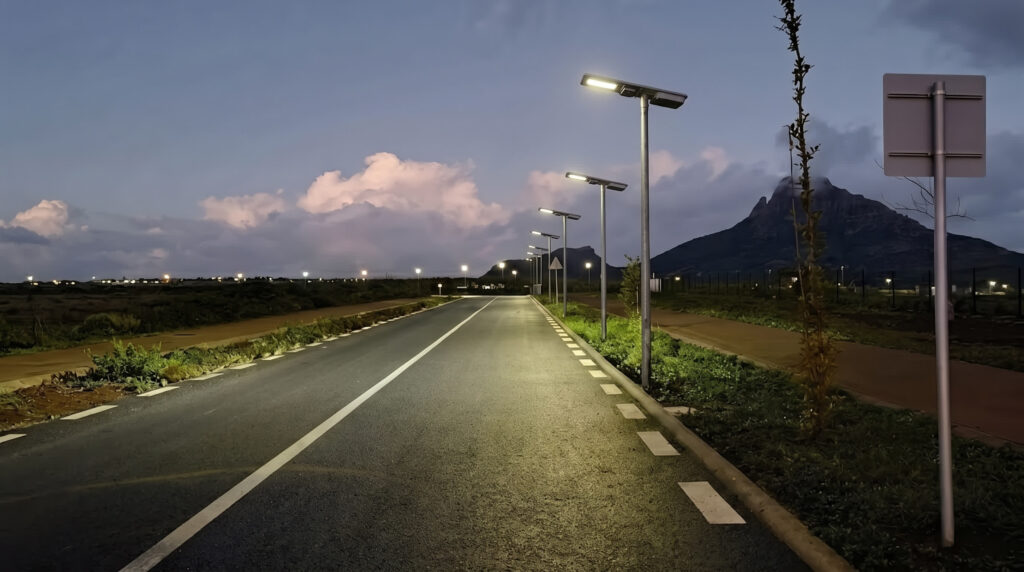
- The 200 Sresky Basalt SSL-918 units operated during overlapping periods of the ash and salt-fog seasons and passed the project’s illuminance acceptance inspection.
- Measured illuminance uniformity met the acceptance requirements, and dark spots along curves were significantly reduced.
- After ash deposits settled, tropical afternoon showers provided some natural cleaning of the photovoltaic panel surfaces. However, regular manual cleaning remained necessary as part of routine maintenance.
- During periods of continuous rain, the ALS system helped maintain road illumination by adjusting light output according to the system’s energy status.
- During spot inspections, no significant rust was observed on the stainless steel mounting brackets. The battery packs could also be installed and removed smoothly, without jamming.
Client Feedback
“When selecting solar street lights for coastal roads, it is important not only to ensure uniform illumination but also to verify resistance to salt fog and ensure that batteries can be easily replaced when necessary.”
— RDA Project Supervision Engineer
Compiled from communications during the project acceptance phase.
Frequently Asked Questions (FAQ)
1. Are solar street lights suitable for installation along coastal roads in Mauritius?
Solar street lights can be suitable for coastal road projects in Mauritius, provided that the site conditions and technical requirements are carefully evaluated. Key considerations include:
- Local solar resources and the expected number of consecutive rainy days.
- Applicable road lighting standards, pole spacing, and surrounding obstructions.
- Battery capacity, photovoltaic power, and required nighttime illumination duration.
- Salt-fog corrosion risks and the availability of suitable post-installation maintenance services.
2. What corrosion protection features are required for coastal solar street lights?
When evaluating solar street lights for coastal environments, it is advisable to examine the following:
- The materials and protective coatings used for the luminaire housing, mounting brackets, and fasteners.
- The sealing performance of the luminaire and the protection of critical electrical connection points.
- Salt-fog corrosion test reports, including the test methods, duration, and environmental conditions.
- Corrosion protection measures for the base of the light pole, flanges, and foundation components.
Note: An IP66 protection rating does not replace salt-fog corrosion testing. IP ratings primarily address protection against the ingress of dust and water, rather than resistance to corrosion caused by prolonged exposure to saline environments.
3. What should be considered when procuring solar street lights for government road projects?
During the bidding and technical evaluation stages, procurement teams should verify the following:
- Luminous flux specifications, photometric distribution documents, and road lighting simulation results.
- Photovoltaic power, battery capacity, and energy management strategies.
- Test reports covering IP and IK protection ratings, as well as salt-fog corrosion resistance.
- Battery replacement procedures, warranty terms, and spare parts availability.
- On-site illuminance acceptance criteria and long-term operation and maintenance plans.
Conclusion
The success of a coastal road lighting project in Mauritius depends not simply on selecting a particular solar street light model, but on integrating optical design, photovoltaic power generation, corrosion protection, and post-installation maintenance into a comprehensive engineering solution.
For government agencies, engineering contractors, and lighting distributors planning to procure 200 solar street lights, the Sresky Basalt SSL-918 can be considered as one potential solution. The final selection should be based on model-specific technical documentation, road lighting calculations, environmental suitability assessments, and clearly defined after-sales service agreements.
In environments characterized by high salinity, high humidity, and intense sunlight, solutions supported by verifiable technical data, clearly defined maintenance procedures, and on-site acceptance testing are more likely to deliver reliable performance and long-term value throughout their service life.