
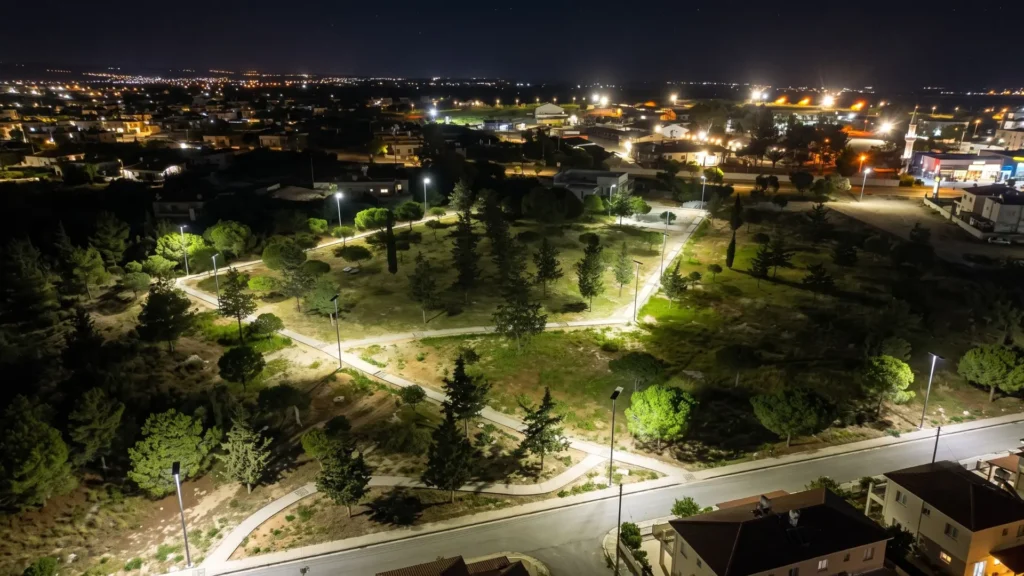
In early 2025, an installation team arrived at the “Strovolos Green Community” construction site on the outskirts of Nicosia, Cyprus. Project manager Andreas Ioannou stood on an open hillside overlooking a 5,000-square-meter undeveloped area—a mix of children’s playgrounds, park trails, residential green spaces, and community activity zones.
The objective was clear: to deploy a lighting system with no grid connection, capable of withstanding the extreme Mediterranean climate, and requiring virtually no maintenance over the next decade.
The site is located just a few kilometers from the coastline. Summer temperatures consistently exceed 35°C, with surface temperatures rising even higher. Winters are overcast and accompanied by strong sea winds. The open terrain also exposes the area to high levels of UV radiation throughout the year.
After evaluating multiple suppliers, the project team ultimately selected 55 units from the SRESKY Atlas Series smart solar street lights.
| Project Element | Details |
|---|---|
| Project Name | “Strovolos Green Community” Public Space Smart Lighting Project, Nicosia, Cyprus |
| Project Scope | Community green space covering approximately 5,000 m² |
| Project Location | Suburbs of Nicosia, Republic of Cyprus (a few kilometers from the coastline; typical Mediterranean climate) |
| Climate Characteristics | Hot, dry summers (28–35°C), mild winters (4–10°C), and over 3,000 hours of annual sunshine |
| Selected Products | 55 sets of SRESKY Atlas Series smart solar street lights |
Engineering Challenges and the SRESKY Atlas Series Solution
Challenge 1: High Temperatures, Intense UV Radiation, and Salt Fog Affect Long-Term Reliability
The difficulty of this project lies not in high temperatures or coastal exposure alone, but in the long-term cumulative impact of multiple environmental stressors:
- Summer temperatures consistently exceed 35°C, with even higher equipment surface temperatures
- High UV exposure year-round accelerates material aging
- Proximity to the coast leads to persistent salt fog in the air
- Metal structures are continuously exposed to a combined environment of heat, salt, and UV radiation
This environment typically results in two major issues:
- High temperatures accelerate battery aging and increase system thermal stress
- Salt fog and UV exposure gradually degrade protective coatings and metal fasteners, causing long-term corrosion
The issue is often not immediate failure, but gradual system degradation after 2–5 years of operation, including reduced brightness, structural corrosion, and rising maintenance costs.
SRESKY Atlas Series Solution
The design of the Atlas series focuses on reducing overall environmental stress at the system level:
- Integrated aluminum alloy housing improves natural heat dissipation and reduces internal heat accumulation
- Intelligent Battery Management System (BMS) dynamically optimizes charging and discharging under high temperatures
- Dual protection coating (anodizing + electrostatic powder coating) passes a 2,000-hour salt spray test
- SUS 316L stainless steel fasteners enhance resistance to chloride corrosion
- Reduced external connection points minimize pathways for salt fog intrusion
Design goal: simultaneously mitigate thermal aging and salt fog corrosion to prevent long-term performance degradation.
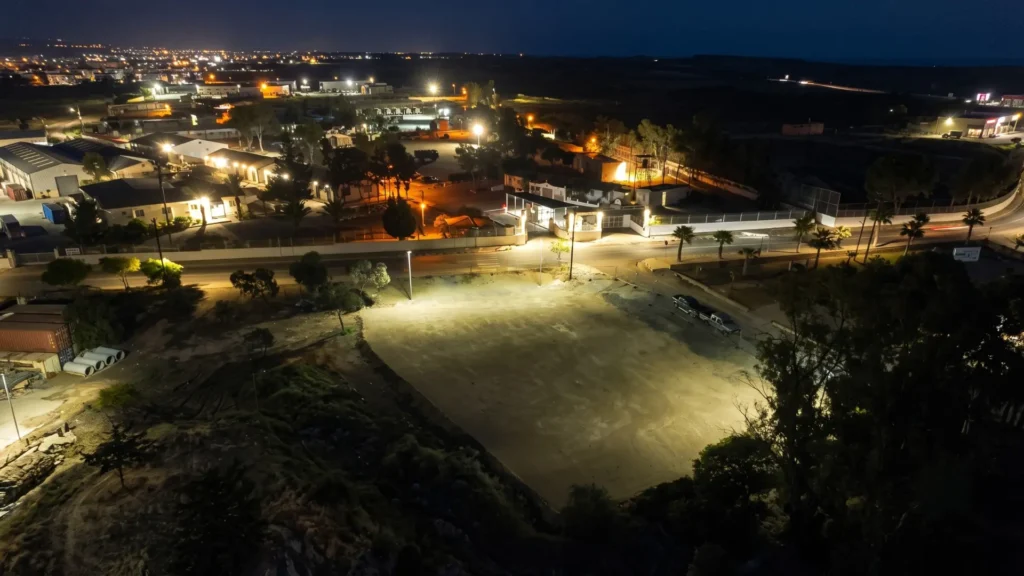
Challenge 2: Continuous Overcast Winter Days and Unstable Solar Energy Supply
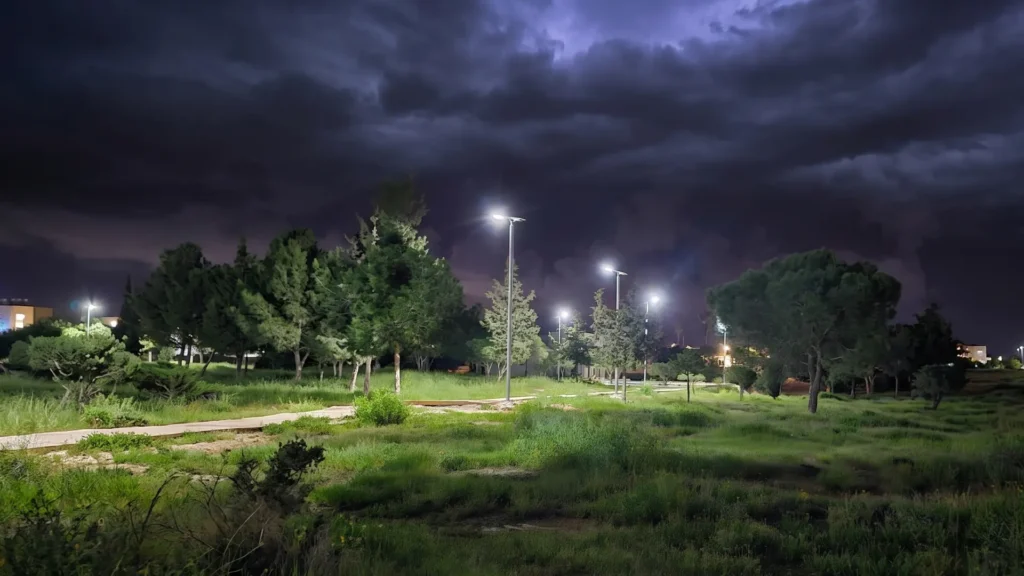
Cyprus winters are characterized not by heavy rainfall but by consecutive overcast days:
- Solar irradiance drops significantly
- Charging efficiency decreases
- Battery discharge continues daily without full recovery
For a park environment, this creates a critical safety risk: lighting must remain operational at all times due to complex trail layouts and lack of auxiliary lighting. Any outage directly impacts public safety.
SRESKY Atlas Series Solution
The system applies uninterrupted power priority logic:
- ALS intelligent energy regulation adjusts output based on remaining battery capacity
- Power output is gradually reduced in stages instead of sudden shutdown
- Maintains minimum lighting continuity to ensure path visibility and safety
In simple terms: brightness can be reduced, but the lights must not go out.
With a full charge, the system can operate for up to 7 days—sufficient to handle prolonged overcast conditions typical of Cypriot winters.
Project Outcomes
Based on post-deployment operational feedback:
- 55 units were successfully deployed without reliance on complex grid infrastructure
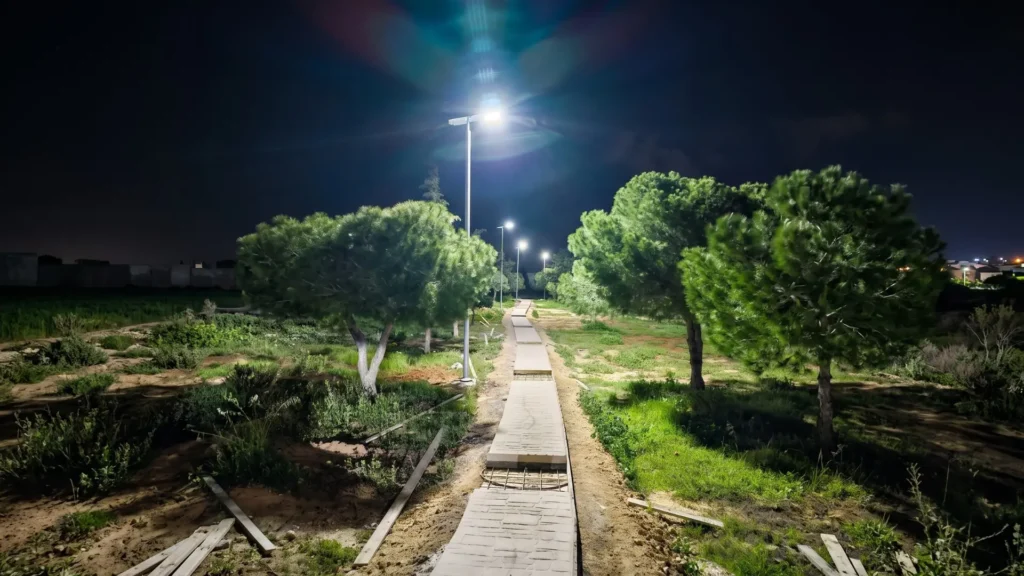
- Nighttime pathway lighting remains stable, with no significant dark zones or interruptions
- Maintenance teams no longer require frequent on-site inspections
- No widespread corrosion issues have been observed in the coastal environment
- Community feedback indicates a significant improvement in nighttime safety
For the EPC contractor, the most important outcome is that once the system entered stable operation, long-term maintenance costs were significantly reduced.
Client Testimonial
“What we value most is not brightness, but long-term stability. After a period of operation, this system has maintained stable performance in both high-temperature and coastal environments, and has significantly reduced the need for ongoing maintenance.”
— Andreas Ioannou, Senior Project Manager, Strovolos Green Community Project Contractor
Frequently Asked Questions
Q: How should coastal areas select solar street lights for long-term use?
A: Focus on overall corrosion resistance rather than only IP ratings. Key factors include die-cast aluminum housings, weather-resistant coatings, SUS 316 stainless steel fasteners, and integrated designs that minimize exposed connections.
Q: Why are integrated solar street lights increasingly used in coastal communities?
A: Integrated designs reduce exposed wiring, battery compartments, and connection points, minimizing damage from salt fog, humidity, and moisture while reducing maintenance requirements.
Q: Does high temperature affect solar street light battery life?
A: Yes. Prolonged high temperatures accelerate lithium battery aging. Systems with intelligent battery management and thermal optimization help reduce heat stress and extend cycle life.
Conclusion
The Strovolos Green Community project demonstrates that in Mediterranean coastal environments, the challenge for solar street lighting is not only illumination, but long-term reliability under combined stress from heat, salt fog, and extended overcast conditions.
Through weather-resistant structural design, intelligent energy management, and integrated low-maintenance architecture, the SRESKY Atlas Series delivers a more stable off-grid lighting solution for communities, parks, and public spaces. It also provides practical reference value for similar projects across Cyprus and other Mediterranean coastal regions.
If your project faces challenges such as coastal corrosion, high temperatures, or low winter solar availability, SRESKY can provide lighting simulations, product selection support, and system design assistance to help build a more reliable and low-maintenance solar lighting solution.